Sign languages are full natural languages, with grammar and vocabulary built from handshape, movement, location, palm orientation, and facial expression rather than sound — and there are hundreds of distinct sign languages worldwide, most not mutually intelligible and not derived from the spoken language of the surrounding hearing community.
Reading time
— 5 min
Updated
— Aug 16, 2026
Fact-reviewed
— Aug 16, 2026
Key Takeaways
Key Takeaways
1Sign languages are complete natural languages with their own grammar, syntax, and vocabulary — not gestured versions of the spoken language used around them.
2There is no single universal sign language. Linguists and catalogues like Ethnologue count hundreds of distinct sign languages worldwide, and most aren't mutually intelligible.
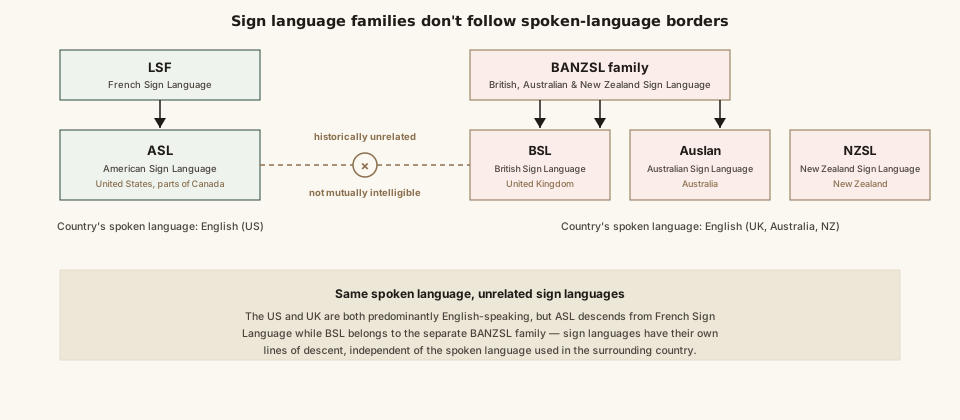
3Sign language relatedness doesn't follow spoken-language geography — American Sign Language descends largely from French Sign Language, not British Sign Language, even though the US and UK share English as their majority spoken language.
The concept
Sign languages are complete languages, produced with the hands, face, and body instead of sound, used by Deaf communities around the world. Each one has its own grammar as rule-governed and complex as any spoken language — American Sign Language (ASL), British Sign Language (BSL), and the hundreds of other sign languages worldwide developed independently within their own Deaf communities, and knowing one doesn't mean you can understand another.
With grammar built from handshape, movement, location, orientation, and facial expression instead of sound, it becomes clear why a sign language can't be reduced to "gestured" speech — it's operating on an entirely independent grammatical system.
Quick check
Is American Sign Language (ASL) essentially English, just performed with the hands instead of spoken aloud?
Worked examples
Example 1: ASL grammar basics — how it differs from English (baseline case)
ASL commonly uses a topic-comment sentence structure, where the topic of a sentence is signed first and set off with a raised-eyebrow non-manual marker, followed by a comment about it — a pattern with no direct one-to-one match in spoken English word order. ASL also uses the physical space in front of the signer grammatically: a signer can assign an imaginary location to a person or object being discussed, then point back to that same spot later in the conversation as a kind of pronoun, a technique with no equivalent in spoken English. Non-manual markers do real grammatical work too — raised eyebrows can mark a yes/no question, furrowed brows can mark a wh-question (who, what, where), and specific mouth shapes can modify a verb's meaning, none of which is simply English rendered by hand.
Example 2: Signed Exact English — a real system that IS built to mirror English (variation / exception)
Signed Exact English (SEE) and other Manually Coded English systems were deliberately constructed, mainly for educational use, to represent spoken/written English word-for-word, including English grammatical endings that ASL doesn't mark the same way. This is a genuinely useful distinction: SEE is exactly the "gestured English" that the common misconception assumes all sign language is — but SEE is an artificial teaching tool, not a naturally evolved language, and it is grammatically and historically distinct from ASL, which developed independently within the Deaf community over generations of natural use.
Example 3: Interpreting and legal recognition today (real-world / applied case)
Professional sign language interpreting is a distinct, trained skill — a fluent ASL interpreter generally cannot interpret for a BSL signer without separate training, the same way a Spanish interpreter can't automatically interpret Japanese. A growing number of countries have given their national sign language official legal recognition — New Zealand recognizes New Zealand Sign Language as one of its official languages, for example — treating it as a language in its own right rather than a communication aid layered onto the spoken national language. This legal and professional infrastructure only makes sense because sign languages function as independent languages, not as a coded version of the surrounding spoken one.
Quick check
Would a fluent American Sign Language (ASL) signer and a fluent British Sign Language (BSL) signer, meeting for the first time, be able to understand each other automatically?
How it works (visual)
Sign language families don't follow spoken-language geography
Seeing the two family trees side by side makes the point concrete: sign language ancestry runs through the history of Deaf education and community contact, not through whatever spoken language happens to surround it.
Common mistakes
Common Mistakes
✕
Assuming a sign language is a gestured or coded version of the spoken language spoken around it.
→ Treat it as an independent language with its own grammar — word order, spatial referencing, and non-manual markers that don't map onto the surrounding spoken language.
✕
Assuming one universal sign language exists worldwide.
→ Recognize that hundreds of distinct sign languages exist, most historically unrelated and not mutually intelligible, just like spoken languages.
✕
Assuming fingerspelling is the primary way sign languages communicate.
→ Fingerspelling is a supplementary tool, mainly for proper nouns and loanwords — the vast majority of signed communication uses the language's own signs and grammar, not letter-by-letter spelling.
Common misconception
“Sign languages are just gestured versions of the local spoken language, rather than independent languages with their own grammar.”
Natural sign languages like ASL and BSL have fully independent grammatical systems — their own word order patterns, spatial grammar, and non-manual markers carried by the face and body — that developed within Deaf communities, not by translating the surrounding spoken language sign-for-sign. The clearest proof this distinction is real: ASL and BSL are historically unrelated and mutually unintelligible, despite both existing in predominantly English-speaking countries. Manually Coded English systems like Signed Exact English do represent English word-for-word by design, but those are artificial educational tools distinct from naturally evolved sign languages, not evidence that ASL or BSL work the same way.
Quick check
If sign languages were simply gestured versions of the local spoken language, what would you expect to be true about ASL and BSL — and is it actually true?
What to do next
What to do next
Next time you see two people signing, don't assume they're using the same sign language you've seen elsewhere — check which one it is.
Learn a handful of signs in your region's national sign language and notice how the grammar and word order differ from spoken word order.
Look up whether your country legally recognizes a national sign language.
Read the entry on endangered and extinct languages — some sign languages, especially small village and community sign languages, face endangerment too.
FAQ
FAQ
Related terms
Related terms
Non-manual marker
A grammatical signal in a sign language carried by the face, head, or body rather than the hands — such as raised eyebrows marking a yes/no question, distinct from an emotional facial expression.
Fingerspelling
Spelling a word letter-by-letter using a manual alphabet, used in sign languages mainly for proper nouns, technical terms, or loanwords — a supplementary tool, not the primary way sign languages communicate.
BANZSL
A sign language family covering British Sign Language, Auslan (Australian Sign Language), and New Zealand Sign Language, which share a common historical origin distinct from American Sign Language.
Manually Coded English
An artificially constructed signing system, such as Signed Exact English, designed to represent English word-for-word using signs — built for educational use, and distinct from naturally evolved sign languages like ASL, which have independent grammars.
Deaf community
A cultural and linguistic community of Deaf sign-language users, often referred to with a capital 'D' to distinguish cultural identity and shared language from the audiological condition of hearing loss.
This entry was researched from public sources and drafted with AI-assisted tools, then edited — errors are still possible. Spot one, or want a topic covered? Read our disclaimer.
 KnowThis