 KnowThis
Key Takeaways
Key Takeaways
- 1Pride Month is observed each June, in the United States and, per the Library of Congress, in many other countries, to mark the anniversary of the Stonewall uprising — a series of protests that began at the Stonewall Inn in Greenwich Village, New York City, in the early hours of June 28, 1969.
- 2The first organized Pride marches took place in June 1970, on the uprising's first anniversary, including New York City's Christopher Street Liberation Day March, per the Smithsonian Institution — the observance grew out of a specific, documented event and a specific follow-up date, not an undated tradition.
- 3June was first formally recognized at the US federal level in 1999, when President Bill Clinton issued the first presidential proclamation designating June as 'Gay and Lesbian Pride Month,' a designation reissued in 2000 and continued in subsequent years, per the Library of Congress.
The concept
That sequence — a specific dated event in 1969, documented anniversary marches the following year, and formal federal recognition beginning three decades later, in 1999 — is the well-documented backbone worth having straight before looking at how the observance plays out today.
What event do institutions such as the National Park Service and the Library of Congress cite as the catalyst for the modern Pride Month observance?
Documented milestones
Milestone 1: The Stonewall uprising, June 1969 (baseline / originating event)
Milestone 2: The first Pride marches, June 1970 (a documented follow-through, not an isolated event)
Milestone 3: Federal recognition and today's observance (present-day)
What happened in June 1970, according to the Smithsonian Institution?
How it works (visual)
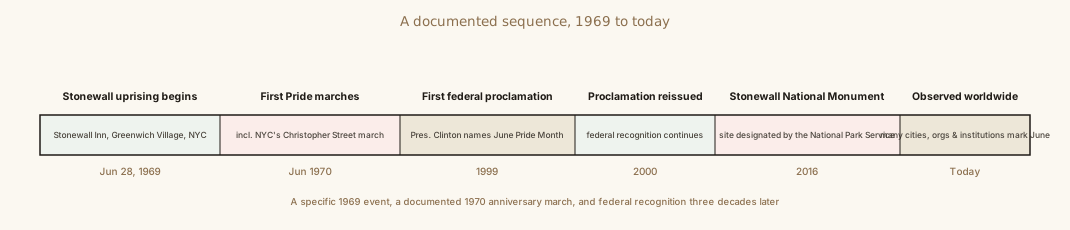
Set out this way, Pride Month's history reads as a documented sequence anchored to a specific 1969 event, not an undated or informal custom — the same standard applied to other historical observances covered on this site.
Common mistakes
Common Mistakes
Assuming Pride Month commemorates a vague or undated tradition.
→ It's anchored to a specific, dated event — the Stonewall uprising, which began June 28, 1969 — and a specific documented follow-on date, the first Pride marches in June 1970, per Britannica, NPS, and the Smithsonian.
Assuming the Stonewall uprising was the very first instance of LGBTQ rights organizing in US history.
→ Earlier organizations, including the Mattachine Society (founded in the 1950s), predate it. The Library of Congress describes Stonewall as a documented 'tipping point' that accelerated organizing, not the movement's absolute starting point.
Assuming federal recognition of Pride Month is a very recent development.
→ The first US presidential proclamation designating June as Gay and Lesbian Pride Month dates to 1999, reissued in 2000, per the Library of Congress's commemorative-observances research guide.
Common misconception
“Pride Month commemorates a vague, undocumented origin rather than a specific, well-documented historical event.”
Pride Month is anchored to a specific, dated, well-documented event: the Stonewall uprising, which began at the Stonewall Inn in Greenwich Village, New York City, in the early hours of June 28, 1969, per Encyclopaedia Britannica and the National Park Service. It is followed by a documented sequence of dated milestones — the first Pride marches on the uprising's first anniversary in June 1970 (per the Smithsonian Institution), the first US presidential proclamation recognizing Pride Month in 1999 (per the Library of Congress), and the 2016 designation of Stonewall National Monument by the National Park Service. This is the same kind of documented, source-attributed historical record applied to other dated historical observances.
Which best describes the historical basis for Pride Month, according to institutions such as NPS and the Library of Congress?
What to do next
What to do next
- Next time June is described simply as 'Pride Month' with no further context, note that it traces to a specific dated event, the Stonewall uprising of June 28, 1969.
- If you read about Stonewall National Monument, note that it's administered by the National Park Service and was designated in 2016 as its first unit dedicated to LGBTQ history.
- Notice that the first Pride marches took place in 1970, on the uprising's first anniversary, not immediately in 1969 — the annual march tradition has its own documented starting point.
- If you see a claim about when the US government first officially recognized Pride Month, check it against the Library of Congress's documented record of the 1999 and 2000 presidential proclamations.