 KnowThis
Key Takeaways
Key Takeaways
- 1The Mughal Empire was founded in 1526 by Babur, a Central Asian ruler descended from both Timur and Genghis Khan, after his victory at the First Battle of Panipat.
- 2Emperor Akbar (r. 1556–1605) built the empire's administrative foundations and pursued religious tolerance policies, including abolishing a tax on non-Muslim subjects — a stance later reversed under Aurangzeb.
- 3The empire produced deeply syncretic Indo-Persian-Central Asian culture, most visibly in architecture like the Taj Mahal (built 1632–1653), before formally ending in 1857 after the Indian Rebellion.
The concept
That shift from Akbar's accommodation to Aurangzeb's stricter orthodoxy is a useful entry point into how much the empire changed over its 331-year span — it wasn't one unbroken policy from founding to end.
Who founded the Mughal Empire, and how?
Worked examples
Example 1: The First Battle of Panipat, 1526 (baseline case)
Example 2: Akbar's religious tolerance versus Aurangzeb's orthodoxy (variation / internal exception)
Example 3: The Taj Mahal and Mughal architecture today (real-world / applied case)
What documented policy change did Aurangzeb make regarding the jizya tax, compared to Akbar's earlier policy?
How it works (visual)
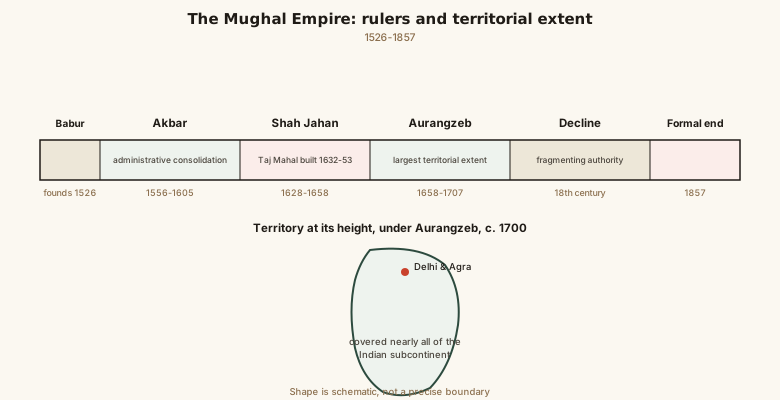
The empire's territorial extent peaked under Aurangzeb in the early 1700s, covering nearly the entire Indian subcontinent — but that same reign also marks the beginning of the empire's political decline, a reminder that an empire's largest territorial size and its period of greatest internal stability weren't necessarily the same moment.
Common mistakes
Common Mistakes
Assuming the Mughal Empire was religiously and culturally uniform across its whole 331-year history.
→ Policy varied significantly by ruler — Akbar's tolerance-focused reign looked very different from Aurangzeb's more orthodox one, roughly a century later.
Treating the Mughal Empire as a foreign occupying force disconnected from Indian culture.
→ Historians describe Mughal rule as deeply syncretic — its art, architecture, language, and even court philosophy under Akbar actively blended Persian, Central Asian, and Indian (including Hindu) traditions rather than existing separately from them.
Confusing the empire's founder (Babur) with its most famous builder (Shah Jahan, who commissioned the Taj Mahal).
→ Babur founded the empire in 1526; Shah Jahan, his great-great-grandson, ruled over a century later (1628-1658) and commissioned the Taj Mahal starting in 1632.
Common misconception
“The Mughal Empire was a foreign, disconnected ruling power layered on top of Indian society, rather than genuinely part of it.”
Historians describe Mughal rule as deeply syncretic rather than separate from Indian culture. Mughal emperors, particularly Akbar, actively incorporated Hindu nobility into the imperial administration and military through the Mansabdari system, formed marriage alliances with Rajput ruling families, and patronized art and architecture that fused Persian, Central Asian, and Indian styles — visible today in monuments like the Taj Mahal and the Red Fort. The Urdu language itself developed during this period from the blending of Persian, Arabic, and local Indian languages. While later rulers, especially Aurangzeb, pursued more religiously orthodox policies, characterizing the empire as a whole as culturally disconnected from India overlooks nearly three and a half centuries of genuine cultural, administrative, and artistic fusion documented by historians.
What does the development of the Urdu language during the Mughal period illustrate about the empire?
What to do next
What to do next
- Next time you see the Taj Mahal in a photo, remember it's a mausoleum commissioned by Shah Jahan for his wife Mumtaz Mahal, not a palace.
- When 'Mughal' comes up, place the ruler being discussed on the Babur-to-Aurangzeb timeline to know roughly which policy era you're in.
- Notice Persian-derived vocabulary in modern Hindi and Urdu next time you encounter either language — much of it dates to this period.
- Read the related entry on the British Empire to see how the East India Company's rise directly overlapped with, and eventually replaced, Mughal political authority in India.