History's most consequential leaders span every continent and era — from ancient emperors like Ashoka and medieval rulers like Mansa Musa to modern figures like Simón Bolívar, Mahatma Gandhi, and Nelson Mandela, each of whom used political or moral authority to permanently redirect the societies, and often the regions, they led.
Reading time
— 5 min
Updated
— Oct 10, 2026
Fact-reviewed
— Aug 16, 2026
Key Takeaways
Key Takeaways
1"World leader who changed history" isn't limited to modern presidents and prime ministers — ancient and medieval rulers like Ashoka of India (3rd century BCE) and Mansa Musa of the Mali Empire (14th century CE) reshaped their regions just as decisively, centuries before the nation-states we know today existed.
2Many of history's most consequential leaders led liberation or independence movements rather than simply inheriting or seizing power — Simón Bolívar helped free six South American nations from Spanish colonial rule, and Mahatma Gandhi led India's independence movement primarily through organized nonviolent resistance.
3Leadership that "changes history" isn't always about winning wars — Ashoka's legacy rests on renouncing further conquest after witnessing war's cost, and Nelson Mandela's rests substantially on choosing national reconciliation over retribution after 27 years of imprisonment.
The concept
Throughout history, certain leaders have redirected the course of entire nations or regions — sometimes through conquest and empire-building, sometimes through liberation movements, and sometimes by fundamentally changing how their society was governed. This isn't limited to any one era, region, or type of leadership: Ashoka the Great expanded and then transformed the Mauryan Empire in ancient India, Mansa Musa's 14th-century pilgrimage put the wealthy Mali Empire permanently on European and Middle Eastern maps, Simón Bolívar led multiple South American nations to independence from Spain in the early 1800s, Mahatma Gandhi organized a nonviolent movement that ended British colonial rule in India, and Nelson Mandela led South Africa's transition away from apartheid and became its first Black president in 1994.
That range — from an ancient emperor who gave up conquest, to a medieval ruler whose wealth alone reshaped a regional economy, to modern liberators and reconcilers — is the point: there's no single template for a leader who changes history.
Quick check
What made Ashoka the Great's transformation as a ruler unusual?
Worked examples
Ashoka the Great and the Edicts of Ashoka, c. 268-232 BCE (baseline case)
After his brutal conquest of Kalinga, in which ancient sources report hundreds of thousands of casualties and deportations, Ashoka is recorded as having renounced further military expansion and turned to governing through Buddhist-influenced principles of tolerance, nonviolence toward animals, and public welfare. He had his policies inscribed on rocks and stone pillars across the Indian subcontinent — the Edicts of Ashoka — some of which survive and are still readable today, making them among the earliest large-scale public communications from any government in world history.
Simón Bolívar and the liberation of South America, 1810s-1820s (variation / multi-nation case)
Unlike a single-nation independence leader, Simón Bolívar led military and political campaigns across a vast, difficult terrain to help liberate what are now six separate South American nations — Venezuela, Colombia, Ecuador, Peru, Bolivia, and Panama — from Spanish colonial rule between roughly 1810 and 1825. His campaigns included the famously grueling 1819 crossing of the Andes to surprise Spanish forces in Colombia, a maneuver still studied as a major military achievement. Bolívar's continent-spanning vision, though his hoped-for unified South American federation ultimately fractured into separate republics, earned him the enduring title "El Libertador" across the region.
Nelson Mandela and post-apartheid reconciliation (real-world / applied case)
Nelson Mandela spent 27 years imprisoned for his opposition to South Africa's apartheid system before his 1990 release and subsequent election as the country's first Black president in 1994. Rather than pursuing retribution against the system that had imprisoned him, Mandela oversaw the creation of the Truth and Reconciliation Commission, a mechanism for publicly documenting apartheid-era abuses while pursuing national healing over prosecution in many cases. This model — transitional justice through public truth-telling rather than purely punitive measures — has since directly influenced post-conflict processes in other countries, making Mandela's approach a continuing, actively applied template in international human rights and conflict-resolution work today.
Quick check
What set apart Nelson Mandela's approach to South Africa's post-apartheid transition?
How it works (visual)
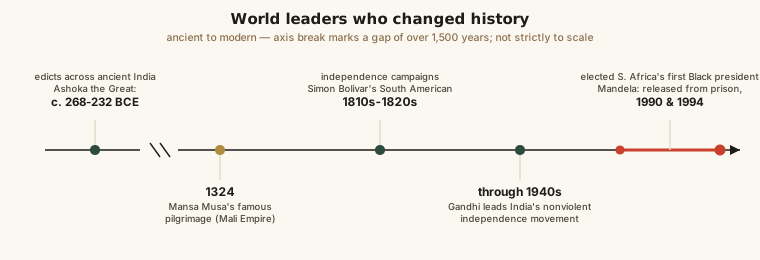
Timeline: world leaders who changed history, ancient to modern
Spread across more than two thousand years and four continents, these leaders show that "changing history" has taken remarkably different forms — imperial policy reversal, continent-spanning military liberation, organized nonviolent resistance, and negotiated post-conflict reconciliation are all represented on this single timeline.
Common mistakes
Common Mistakes
✕
Assuming "world leaders who changed history" refers only to modern presidents, prime ministers, and monarchs.
→ Ancient and medieval rulers like Ashoka and Mansa Musa reshaped their regions just as decisively — the category spans every era, not just the last few centuries.
✕
Treating historically significant leadership as always involving military conquest.
→ Some of the most studied leaders, like Ashoka after Kalinga and Gandhi throughout his movement, are historically significant specifically because they achieved change without continued warfare.
✕
Assuming Simón Bolívar's independence campaigns liberated only a single country.
→ Bolívar's campaigns contributed directly to the independence of six modern nations — Venezuela, Colombia, Ecuador, Peru, Bolivia, and Panama — not just one, which is why he's still called 'El Libertador' across the wider region.
Common misconception
“Historically significant leadership always means winning wars or expanding territory.”
Several of history's most studied leaders are significant precisely for the opposite: choosing restraint, reconciliation, or nonviolent resistance over continued conflict. Ashoka the Great renounced further military conquest after the Kalinga war and is remembered for edicts promoting tolerance, not further expansion. Mahatma Gandhi led India's independence movement primarily through organized nonviolent noncooperation rather than armed struggle. Nelson Mandela chose national reconciliation over retribution after his release from 27 years of imprisonment. In each case, the leader's lasting historical impact rests substantially on a deliberate move away from further conflict, not a military victory.
Quick check
Which statement most accurately reflects how historians commonly assess "leaders who changed history"?
What to do next
What to do next
Next time "a great world leader" comes up in conversation, notice whether the example given is being judged by conquest, by restraint, or by what came after their time in power.
When you encounter Ashoka's edicts or similar ancient political texts, remember they're primary historical sources you can still read today, not just secondhand descriptions.
Look up which present-day countries trace their independence directly to Simón Bolívar's campaigns next time South American history comes up.
Read the related entry on Social Reformers and Activists to see how leadership that changes history isn't limited to formal heads of state.
FAQ
FAQ
Related terms
Related terms
Edict
An official public order or announcement issued by a ruler with the force of law; Ashoka's edicts, carved on pillars and rocks across his empire, are among the earliest surviving public policy declarations in history.
Sovereignty
The authority of a state or nation to govern itself, free from external control — the core goal of most independence and liberation movements led by figures in this entry.
Reconciliation
A deliberate political and social process of repairing relationships and addressing past harm between formerly opposed groups, rather than pursuing retribution.
Liberator
A historical title used for leaders credited with freeing a nation or region from colonial or oppressive rule — most closely associated with Simón Bolívar, still called 'El Libertador' across much of South America.
This entry was researched from public sources and drafted with AI-assisted tools, then edited — errors are still possible. Spot one, or want a topic covered? Read our disclaimer.
 KnowThis