The 2020s opened with the COVID-19 pandemic, a global public health emergency declared by the World Health Organization in March 2020, followed by Russia's large-scale invasion of Ukraine in February 2022 and the rapid mainstream adoption of generative AI tools beginning in late 2022.
Reading time
— 5 min
Updated
— Aug 16, 2026
Fact-reviewed
— Aug 16, 2026
Key Takeaways
Key Takeaways
1The decade opened with the COVID-19 pandemic, which the World Health Organization characterized as a pandemic on March 11, 2020, disrupting travel, schooling, and economies worldwide for years afterward.
2In February 2022, Russia launched a large-scale military invasion of Ukraine, a conflict that Encyclopaedia Britannica documents as the largest conventional war in Europe since World War II, prompting broad international sanctions and continued fighting for years afterward.
3Beginning with the November 2022 launch of ChatGPT, generative AI tools moved from a research curiosity to mainstream daily use within a remarkably short period, becoming one of the decade's defining technology shifts alongside the pandemic and the war.
The concept
The 2020s opened with a global health crisis and continued with a major armed conflict in Europe and a fast-moving technology shift. The COVID-19 pandemic, first identified in late 2019, spread worldwide through early 2020, and the World Health Organization declared it a pandemic on March 11, 2020, prompting lockdowns, travel restrictions, and vaccination campaigns across the globe. In February 2022, Russia launched a large-scale invasion of Ukraine, beginning a war that has continued for years and reshaped European security policy. And starting in late 2022, generative AI tools became part of everyday life for hundreds of millions of people within a strikingly short span of time.
As with the two decades before it, the 2020s so far resist being reduced to one single story — a public health emergency, a major war, and a fast-moving technology shift have all unfolded on overlapping but largely separate timelines.
Quick check
When did the World Health Organization declare COVID-19 a pandemic?
Three defining events of the 2020s so far
The COVID-19 pandemic (2020- )
First identified in late 2019, the disease later named COVID-19 spread to countries across the globe within months. The World Health Organization declared a Public Health Emergency of International Concern in January 2020 and characterized the outbreak as a pandemic on March 11, 2020. Governments worldwide responded with lockdowns, travel restrictions, and eventually large-scale vaccination campaigns. The WHO ended the PHEIC emergency classification in May 2023, though the organization has continued to track ongoing COVID-19 cases and deaths since.
Russia's invasion of Ukraine (2022- )
In February 2022, Russia launched a large-scale military invasion of Ukraine, escalating a conflict that had roots going back to 2014. Encyclopaedia Britannica documents the war as the largest conventional military conflict in Europe since World War II, involving sustained fighting, significant civilian and military casualties, and mass displacement of people within and beyond Ukraine's borders. The invasion prompted extensive international economic sanctions against Russia and continued military and humanitarian support for Ukraine from a broad coalition of countries, with the conflict continuing for years afterward.
The mainstream rise of generative AI (2022- )
Generative AI tools existed in research settings for years before the 2020s, but the November 2022 public launch of ChatGPT marked the point where the technology reached mainstream, everyday use for hundreds of millions of people within months. Encyclopaedia Britannica documents ChatGPT's rapid user growth as among the fastest of any consumer technology in history. The years that followed saw generative AI tools integrated into search engines, office software, and countless consumer apps, continuing to develop rapidly as one of the decade's defining technology stories.
Quick check
What did the World Health Organization's May 2023 announcement about COVID-19 actually mean?
How it works (visual)
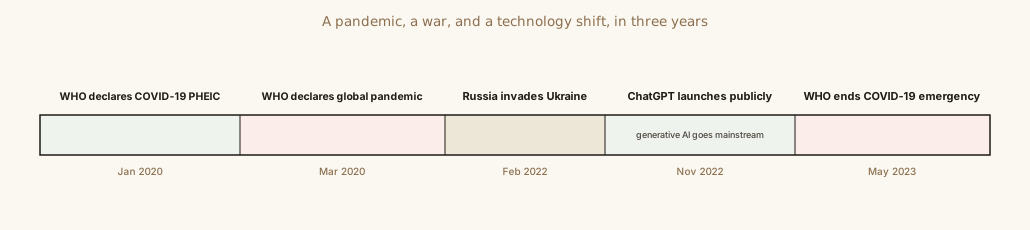
The 2020s so far: three defining global events, in sequence
Laid out chronologically, the timeline shows three overlapping but largely independent threads: a public-health thread running from early 2020 through the 2023 end of the formal emergency status, a geopolitical and military thread beginning in February 2022 and continuing for years afterward, and a technology thread that accelerated sharply starting in late 2022.
Common mistakes
Common Mistakes
✕
Assuming the COVID-19 pandemic ended abruptly on a single announced date.
→ The World Health Organization ended its formal emergency classification (the PHEIC) in May 2023, a change in emergency-response status, not a statement that the virus had stopped circulating or causing illness and death.
✕
Treating Russia's 2022 invasion of Ukraine as the start of the underlying conflict.
→ The large-scale invasion began in February 2022, but Britannica and other historical sources trace the roots of the conflict back to 2014, an important distinction when discussing the war's timeline.
✕
Assuming generative AI tools like ChatGPT emerged with no prior research history.
→ The underlying AI research dates back years earlier; what changed in November 2022 was public, mainstream access, which is what drove the technology's rapid adoption curve.
Common misconception
“The COVID-19 pandemic was declared over on a single date, ending abruptly.”
The World Health Organization ended its Public Health Emergency of International Concern (PHEIC) classification for COVID-19 on May 5, 2023. That was a formal change in emergency-response status, made because the disease's global impact had substantially decreased from its peak — it was not a declaration that the virus had disappeared or stopped causing illness and death. The WHO has continued to monitor and report on COVID-19 cases and deaths since that date, and the disease remains part of ongoing global public health surveillance.
Quick check
Which of the following accurately describes the timeline of Russia's invasion of Ukraine?
Try it yourself
Years since the WHO declared COVID-19 a pandemic
Years since the March 2020 pandemic declaration0.0 years
What to do next
What to do next
Next time someone says the COVID-19 pandemic 'ended' in May 2023, clarify that this was a change in the WHO's formal emergency classification, not a claim the virus disappeared.
When discussing the war in Ukraine, note the distinction between the conflict's roots in 2014 and the large-scale invasion that began in February 2022.
Notice how quickly generative AI tools became part of everyday apps and services after ChatGPT's November 2022 launch, and compare that adoption speed to the smartphone's rise after 2007.
Read the related entry on major global events of the 2010s to see how the decade's opening events connect back to the one before it.
FAQ
FAQ
Related terms
Related terms
Pandemic
A disease outbreak that spreads across multiple countries or continents, affecting a large number of people; the World Health Organization characterized COVID-19 as a pandemic on March 11, 2020.
PHEIC
Public Health Emergency of International Concern — the World Health Organization's highest formal alert level for an outbreak, declared for COVID-19 in January 2020 and ended in May 2023.
Generative AI
Artificial intelligence systems capable of producing new text, images, audio, or other content in response to a prompt, which entered mainstream public use following the November 2022 launch of ChatGPT.
Sanctions
Economic or political penalties imposed by one country or group of countries on another, often in response to a conflict, without direct military engagement.
This entry was researched from public sources and drafted with AI-assisted tools, then edited — errors are still possible. Spot one, or want a topic covered? Read our disclaimer.
 KnowThis