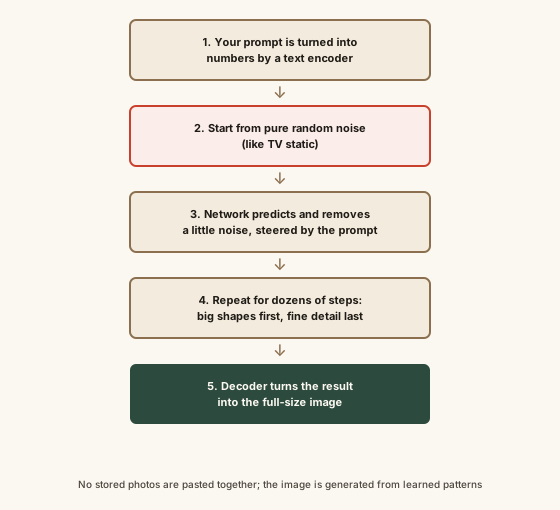
Most modern AI image generators are diffusion models. During training, a neural network sees millions of captioned images with increasing amounts of random noise added and learns to predict the noise, a method described in the 2020 paper 'Denoising Diffusion Probabilistic Models' (Ho, Jain and Abbeel). To make a new picture, the model starts from pure noise and removes a little of it at each of many steps, steered at every step by a numerical encoding of the text prompt from a text-image model like CLIP (Radford et al., 2021). Latent diffusion (Rombach et al., 2022) does this in a compressed representation rather than on full-size pixels, which makes it fast enough for ordinary hardware. The model doesn't store and collage training photos, though researchers have shown it can reproduce a small number of heavily duplicated training images almost exactly (Carlini et al., 2023). Its errors with hands and lettering come from learning statistical patterns rather than rules about anatomy or spelling.
Reading time
— 5 min
Updated
— Sep 26, 2026
Fact-reviewed
— Sep 26, 2026
Key Takeaways
Key Takeaways
1Most AI image generators are diffusion models: they start from random static and remove noise step by step until a picture appears.
2Your prompt is turned into numbers that steer every step. The model isn't searching a photo library and pasting pieces together.
3It learned patterns, not rules, which is why hands, text, and exact counts can go wrong, and why a few heavily repeated training images can be reproduced.
The concept
Picture a sculptor who has studied millions of statues but keeps none of them in the studio. You hand them a block of rough stone and say "a fox in the snow." They chip away a little at a time, each cut guided by what foxes and snow usually look like, until a fox appears. An AI image generator works the same way, except the stone is random static, like an old TV with no signal. During training, the model watched millions of pictures get buried under more and more static and practiced digging them back out. Now it can start with pure static and "dig out" a picture that never existed, with your words telling it what to dig toward at every step.
If you've read how large language models predict the next word, this is the image version of a similar idea: learn patterns from huge amounts of data, then generate something new one small step at a time.
Quick check
You type the same prompt twice and get two different images. What's the main reason?
Worked examples
Example 1: "A red bicycle leaning on a brick wall" (baseline case)
The prompt becomes an embedding. The model creates a small grid of random numbers in latent space and runs a few dozen denoising steps. Early steps settle the big shapes: a bright region near the middle, a textured band behind it. Middle steps turn those into a frame, wheels and rows of bricks. Late steps add fine detail like spokes and mortar lines. The decoder then expands the latent into a full-size image. No bicycle photo was copied. The model learned what red bicycles and brick walls tend to look like and steered the noise toward that.
Example 2: "A sign that says OPEN 24 HOURS" (edge case)
The result may show a convincing shop sign with lettering like "OPNE 42 HOUSR." The model learned that signs contain letter-shaped marks in neat rows, but nothing in the training objective checks spelling. The same thing explains six-fingered hands: the model learned that hands have several finger-like shapes close together, not the rule that there are five. Newer models improve on this with more and better-captioned data and larger text encoders, but it's still a pattern-matching improvement, not the model learning rules.
Example 3: Checking a viral "photo" (real-world use)
A dramatic image of a flooded landmark is spreading online. Knowing how diffusion works tells you what to look for: text on signs that almost makes sense, repeated or melting patterns in crowds and windows, shadows that don't agree with each other, and hands or jewelry that blend into skin. None of these clues is proof. The better check is the one NIST's synthetic-content report emphasizes: provenance. Where did the image first appear, is there content-credential metadata, and do trusted news sources show the same scene from other angles? The same provenance-first approach works for text too, where detectors are even less reliable; see how to tell if content was AI-generated.
Quick check
Why might a generated shop sign read 'OPNE' instead of 'OPEN'?
How it works (visual)
From prompt to picture in a diffusion model
Common mistakes
Common Mistakes
✕
Assuming the model looked up and remixed specific photos when it answered your prompt.
→ Generation starts from noise and uses learned patterns. No image database is searched at that moment.
✕
Concluding that a model can never reproduce training images.
→ It's rare, but research has extracted near-copies of heavily duplicated images. That's part of why copyright questions around these tools are still being argued.
✕
Treating visual glitches as the only way to spot a generated image.
→ Glitches keep disappearing as models improve. Check provenance: the original source, credentials metadata, and independent confirmation.
Common misconception
“AI image generators work by cutting and pasting pieces of real photos from a stored library.”
A diffusion model stores learned numerical weights, not a library of pictures. The model files are far smaller than the hundreds of millions of training images, so a stored collage isn't even possible. It generates by removing noise step by step, guided by the prompt. The more accurate worry is narrower: Carlini et al. (2023) showed that a small number of images repeated many times in training can come back out almost exactly. So "it never copies" is also wrong.
What to do next
What to do next
Write prompts that name the subject, setting, lighting and style. The text embedding can only steer toward what you describe.
If you need readable text or exact counts in an image, expect to fix them by hand or check them carefully.
Before sharing a striking image, trace it to its first source and look for content credentials rather than relying on glitches.
Read the tool's terms on commercial use and training data before using generated images for business.
FAQ
FAQ
Related terms
Related terms
Diffusion model
A type of generative AI that learns to reverse a gradual noising process, so it can turn random noise into a new image step by step.
Noise (in images)
Random pixel values, like TV static. Diffusion training adds it on purpose so the model can learn to remove it.
Text encoder
The part of the system that turns a written prompt into a list of numbers (an embedding) the image model can use as guidance.
Latent space
A compressed numerical representation of an image. Latent diffusion does its denoising here instead of on full-size pixels, which saves a lot of computing.
Memorization
When a model reproduces a specific training example almost exactly instead of generating something new, most likely for images duplicated many times in the training data.
This entry was researched from public sources and drafted with AI-assisted tools, then edited — errors are still possible. Spot one, or want a topic covered? Read our disclaimer.
 KnowThis