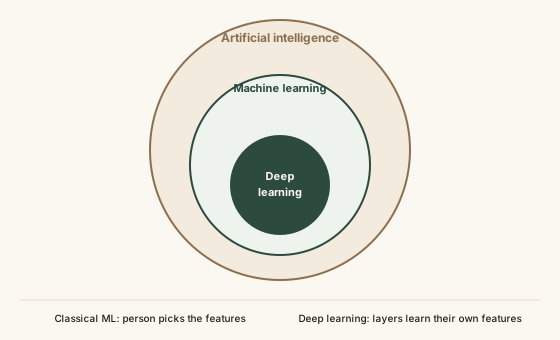
Machine learning is the broader field of getting a system to improve at a task from data rather than from explicit programmer-written rules; deep learning is a subset of machine learning that uses neural networks with many stacked layers to learn its own internal representations directly from raw data, rather than relying on features a person hand-selects in advance.
Reading time
— 5 min
Updated
— Sep 23, 2026
Fact-reviewed
— Sep 23, 2026
Key Takeaways
Key Takeaways
1Deep learning is not a separate technology from machine learning — it's a specific subset of it, built from neural networks with many stacked layers.
2Classical machine learning typically relies on a person hand-selecting which input features matter; deep learning models learn their own internal representations directly from raw data.
3Deep learning generally needs far more training data and computing power than classical machine learning, and its learned representations are much harder for a person to inspect and explain.
The concept
Think of artificial intelligence as the biggest circle, machine learning as a smaller circle inside it, and deep learning as a smaller circle still, inside machine learning. Every deep learning system is a machine learning system — just one built a specific way, out of neural networks with many layers. The practical difference shows up in how each one gets its input features. A classical machine learning model usually needs a person to decide in advance which details of the data actually matter and hand-code them in. A deep learning model is instead handed the raw data itself — pixels, audio waveforms, raw text — and its layers learn on their own which patterns in that raw data are useful.
This containment relationship also explains a common phrasing mix-up: someone can accurately say a system "uses machine learning" without it using deep learning at all — a spam filter built on a decision tree is real machine learning with zero neural network layers involved.
Quick check
A company builds a system that predicts customer churn using a decision tree trained on structured account data (tenure, plan type, support tickets). Is this system an example of deep learning?
Worked examples
Example 1: Predicting house prices with hand-picked features (baseline case)
A classical machine learning model — linear regression — predicts a home's sale price from features a person chose in advance: square footage, number of bedrooms, and neighborhood. The model learns a weight for each feature from historical sales data, and each weight is directly readable: a person can see exactly how much the model credits an extra bedroom. This is machine learning, and it is not deep learning — there's no neural network layer stack involved.
Example 2: Spam filtering, built two different ways (edge case / variation)
One spam filter uses a classical method (Naive Bayes) trained on hand-selected features like word frequency counts and sender reputation — machine learning, not deep learning. Another spam filter instead feeds the raw text of each email into a multi-layer neural network that learns its own representation of what "spam-like" text looks like. Both are legitimately "machine learning spam filters." Only the second is a deep learning system, because only it uses a many-layered neural network learning its own features from raw input.
Example 3: Recognizing objects in photos (real-world / applied case)
Identifying objects in a photo from raw pixel values is a case where classical feature engineering breaks down — there's no practical way for a person to hand-write rules covering every possible arrangement of pixels that could represent a "dog." Deep learning's ability to learn its own layered representations directly from raw pixels — edges, then textures, then shapes, then objects — is a major reason deep learning methods became the standard approach for image recognition tasks, per NIST's overview of the field's development.
Quick check
Why has deep learning become the standard approach for tasks like image recognition, where classical feature engineering struggles?
How it works (visual)
Machine learning vs deep learning: a containment relationship, not a rivalry
Common mistakes
Common Mistakes
✕
Treating 'machine learning' and 'deep learning' as two competing, mutually exclusive technologies.
→ Recognize deep learning is a subset of machine learning — every deep learning system is a machine learning system, just one built from multi-layer neural networks specifically.
✕
Assuming deep learning is simply a more advanced, strictly-better replacement for classical machine learning.
→ Weigh the real tradeoffs: deep learning typically needs far more data and compute, and is much harder to interpret than classical methods that often work fine for structured, smaller datasets.
✕
Calling any system that uses an algorithm or automation 'deep learning' by default.
→ Reserve 'deep learning' specifically for systems built on multi-layer neural networks — many real machine learning systems, like decision trees or linear regression, use no neural network at all.
Common misconception
“Machine learning and deep learning are two separate, competing technologies — you pick one or the other for a project.”
Deep learning is not a rival to machine learning; it's a specific type of it. Per NIST's framing of the field, machine learning is the broad category of systems that improve at a task from data, and deep learning is the subset of that category built from neural networks with many stacked layers. Asking whether to use "machine learning or deep learning" is a bit like asking whether to use "fruit or apples" — every deep learning model is a machine learning model. The real decision practitioners face isn't machine learning versus deep learning; it's whether a given problem's data volume, compute budget, and interpretability needs favor a classical method or a deep, many-layered neural network.
What to do next
What to do next
When you hear 'deep learning,' mentally file it as 'a type of machine learning that uses many-layered neural networks' — not a separate technology.
When evaluating whether a project needs deep learning, weigh the real tradeoffs: data volume available, compute budget, and how important it is that the model's decisions be explainable.
Don't assume a system is deep learning just because it's described as 'AI' or 'algorithmic' — many real, useful machine learning systems use no neural network at all.
For an accessible primer on the broader field this sits inside, see NIST's and Stanford HAI's public resources on artificial intelligence, linked in the sources above.
FAQ
FAQ
Related terms
Related terms
Machine learning
A branch of artificial intelligence where a system improves its performance on a task by learning patterns from data, rather than following only rules a person wrote in advance.
Deep learning
A type of machine learning that uses neural networks with many stacked layers, which learn to represent data — such as images, audio, or text — at increasing levels of abstraction directly from raw input.
Neural network
A machine learning model loosely structured like interconnected layers of simple processing units, each layer transforming its input before passing it to the next.
Feature engineering
The process of a person manually selecting and constructing the specific input variables a machine learning model will use, based on domain knowledge of what's likely to matter.
Training data
The set of examples a machine learning system learns from before it's used to make predictions on new, unseen data.
This entry was researched from public sources and drafted with AI-assisted tools, then edited — errors are still possible. Spot one, or want a topic covered? Read our disclaimer.
 KnowThis