 KnowThis
Key Takeaways
Key Takeaways
- 1Machine learning is trial-and-error at massive scale: a model guesses, checks its guess against a known answer, and adjusts itself slightly — repeated until the errors get small.
- 2Once training stops, the model is frozen. Using it afterward (inference) applies what it already learned; it doesn't keep changing itself with every new question you ask it.
- 3A trained model has learned a statistical pattern from its examples, not an understanding of the underlying subject — which is exactly why it can be confidently wrong on cases unlike anything it trained on.
The concept
The one detail that reframes almost everything else about how these systems behave: training and using a model are two separate phases, and only one of them involves learning.
After a machine learning model has finished training and is deployed for people to use, does it keep learning from every new question or task it's given?
Worked examples
Example 1: Sorting emails as spam or not spam (baseline case)
A spam filter correctly flags 98% of spam during testing on emails it already saw labeled examples of. What does this tell you, and what doesn't it guarantee?
Example 2: A model trained only on one region's data used elsewhere (edge case / variation)
A home-value model trained only on data from City A performs noticeably worse when used on City B's housing market. What's the most likely explanation?
Example 3: Why a photo app can sort pictures by "beach" or "dog" without being told the rules (real-world / applied case)
A photo app that can group pictures by content wasn't given a rulebook defining what a beach or a dog looks like in pixels — that would be nearly impossible to write by hand given how much lighting, angle, and background vary. Instead, a model was trained on a very large set of images that were already labeled with their contents. Through the guess-compare-adjust loop, the model gradually learned which patterns of pixels tend to correlate with each label. When you later scroll through your own photos, the app is running that frozen, trained model against your images — it has no idea what a beach actually is in the sense a person does, only that certain pixel patterns statistically resemble the ones labeled "beach" during training.
Why can't a photo-sorting model simply be given an explicit set of programmed rules for what a 'dog' looks like, the way a spam filter might use a fixed rule like 'block emails containing this exact phrase'?
How it works (visual)
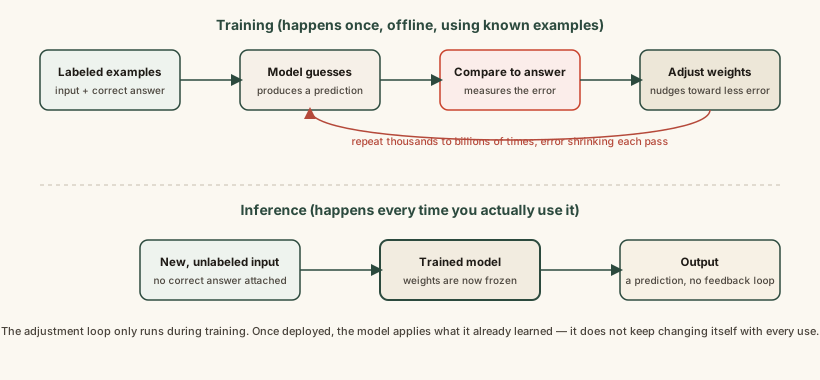
The loop at the top only runs during training, often offline and in advance. Everything below the dashed line — what happens whenever the model is actually used — has no feedback arrow at all in ordinary use, which is the mechanical reason a deployed model behaves the same way for the same input rather than improving in real time from your specific interactions with it.
Common mistakes
Common Mistakes
Assuming a deployed model keeps learning and updating itself from everyday use.
→ Remember training and inference are separate stages — a model's weights are typically frozen after training, unless a provider deliberately retrains a new version later on new data.
Treating strong performance on familiar examples as proof the model will work well on completely new situations.
→ Check performance specifically on data the model didn't train on — that gap between 'seen' and 'unseen' performance is exactly what overfitting looks like.
Assuming a model 'understands' the concept it's classifying, the way a person would.
→ A model has fit a statistical pattern to its training examples — it can be highly accurate without any grasp of the underlying subject, which is why unusual or unlike-anything-it-trained-on cases can produce confidently wrong results.
Common misconception
“Machine learning means a computer thinks like a human brain.”
Machine learning is a statistical fitting process — a model adjusts internal numbers to minimize the gap between its guesses and known correct answers on a specific set of training examples. It has no reasoning process, no beliefs, and no awareness of what the labels mean. The resemblance to human learning is only at the surface level (both improve from feedback); the underlying mechanism is closer to curve-fitting at enormous scale than to human cognition.
What to do next
What to do next
- Next time you see a tool marketed as "AI-powered," ask what it was trained on — the training data shapes and limits everything the tool can reliably do.
- Remember that a model's confidence isn't the same as correctness — it can produce a wrong answer just as fluently as a right one.
- If you're evaluating a tool's accuracy claims, check whether they're measured on new, unseen data rather than just the data it was trained on.
- Read What a Chatbot Is Actually Doing next to see this same training/inference split applied to a specific, very common kind of model.