 KnowThis
Key Takeaways
Key Takeaways
- 1Each additional character in a password multiplies the total number of possible combinations, rather than just adding to it — this multiplicative growth is why length matters as much as, or more than, character variety.
- 2Real-world cracking isn't pure random guessing — attackers try common patterns, dictionary words, and known-breached passwords first, so a long password built from predictable words can still be weaker than the raw math suggests.
- 3Current password guidance, including NIST's, emphasizes length over forced complexity rules and mandatory periodic changes, favoring long, unique passphrases over short passwords stuffed with symbols.
The concept
Once password strength is understood as a keyspace math problem, not a subjective "does this look complicated" judgment, the practical guidance follows directly: favor length and true randomness over forced symbol-stuffing.
Why does adding one more character to a password have such a large effect on how hard it is to brute-force guess?
Worked examples
Example 1: A short, lowercase-only password (baseline case)
Why is this 6-character, lowercase-only password crackable so quickly?
Example 2: A longer passphrase built from predictable, common words (edge case / variation)
Why might this long, common-word passphrase be weaker in practice than its character count implies?
Example 3: A password manager–generated random passphrase (real-world / applied case)
Someone uses a password manager to generate a 16-character passphrase combining several unrelated, randomly selected words with no predictable grammatical structure. Because the words are chosen randomly rather than in a common, expected pattern, standard dictionary-based and pattern-based cracking shortcuts don't apply the way they would to Example 2's predictable phrase, and the password's effective keyspace approaches what the raw length-and-charset math promises. This combination, real length plus genuine unpredictability, is what current guidance is actually recommending, not simply "use more characters."
Why does this randomly generated 16-character passphrase resist the same dictionary-based shortcut that weakened Example 2's passphrase?
How it works (visual)
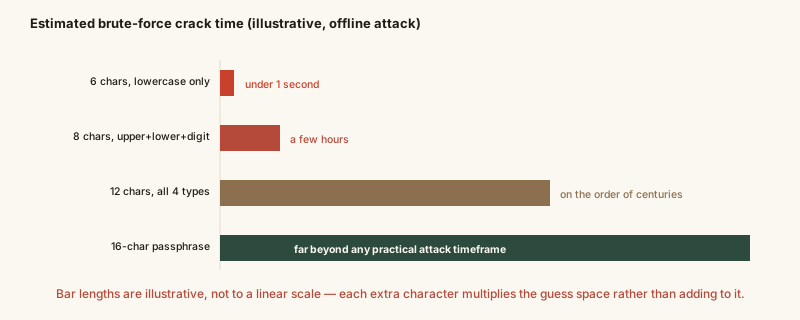
These are estimates for illustrating the shape of the math, not guarantees for any specific real password or system — actual crack time depends heavily on the hashing method a service uses and the guessing hardware and technique an attacker has available.
Enter a password length, the size of the character set used, and an assumed guessing speed to see the rough estimated time to crack it by exhaustive search.
A simplified estimate: keyspace (charset size raised to the power of length), assuming an attacker on average needs to search half the keyspace before finding a match at the given guessing speed. Real-world cracking often tries common patterns first, which can be much faster than this math suggests for predictable passwords, and much of the true protection also comes from how slowly a service intentionally hashes passwords, which this simple calculator doesn't model.
Common mistakes
Common Mistakes
Using a slightly modified but structurally similar password across multiple sites, believing it counts as genuinely different.
→ Use a unique, unrelated password for every account, since a predictable variation pattern is exactly what attackers test for after a breach exposes one version of it.
Relying on common character substitutions, like swapping 's' for '$', to feel like a meaningful security upgrade.
→ Recognize cracking tools already routinely test these well-known substitution patterns first, so they add far less real protection than genuine length and randomness.
Focusing entirely on adding symbols and numbers to a short password while ignoring length.
→ Prioritize length first — each added character multiplies the keyspace, generally contributing more real strength than adding another character type to an already-short password.
Common misconception
“Adding one extra character or a couple of symbols to a password only helps a little.”
Because a password's keyspace is calculated as character-set size raised to the power of length, each added character multiplies the total number of possible combinations rather than simply adding to it. A jump from 8 to 12 characters, for example, can turn a password crackable in hours into one that would take centuries at the same guessing speed. The effect compounds specifically because it's multiplicative, not incremental.
What to do next
What to do next
- Prioritize length over forced complexity — a long, random passphrase generally outperforms a short password stuffed with symbols.
- Use a password manager to generate and store genuinely random, unique passwords for every account, since memorizing many long random strings isn't realistic on your own.
- Avoid predictable patterns like common substitutions or dictionary words in expected order, since these are exactly what real-world cracking tools test first.
- Enable two-factor authentication wherever it's available, so a guessed or exposed password alone still isn't enough to access the account.