 KnowThis
Key Takeaways
Key Takeaways
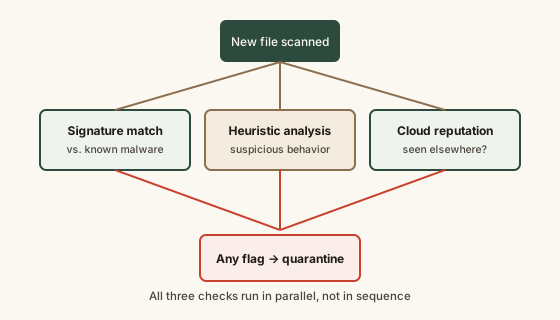
- 1Antivirus software runs three detection methods in parallel: signature matching, behavior-based heuristics, and cloud reputation checks — not just one.
- 2Signature matching only catches malware that's already been identified and cataloged; it's fast but useless against something brand new.
- 3Heuristic analysis and cloud reputation checks exist specifically to catch new or modified threats that don't match any known signature yet.
The concept
Understanding this layered approach matters because it explains a real limitation: a brand-new, never-before-seen piece of malware can briefly slip past signature matching, which is exactly why heuristic and behavior-based layers exist as a backstop, not a redundant afterthought.
A file has no matching entry in any antivirus signature database yet. Does that mean it's automatically safe?
Worked examples
Example 1: A known virus attachment (baseline case)
Example 2: A slightly modified variant (edge case / variation)
Example 3: Ransomware encrypting files in real time (real-world / applied case)
Why can antivirus software stop a brand-new ransomware strain it has literally never seen before?
How it works (visual)
Common mistakes
Common Mistakes
Assuming antivirus with an up-to-date signature database is fully protected against everything.
→ Understand that signature databases are always reactive — they can only catch what's already been cataloged, which is why behavior-based detection and safe habits still matter.
Disabling real-time/behavior-based scanning because it feels like it slows the computer down.
→ Keep behavior-based scanning on — it's the layer that catches genuinely new threats, and it's usually the more important layer, not the disposable one.
Treating every antivirus flag as confirmed malware.
→ Heuristic flags can be false positives — check the vendor's specific alert details before assuming the worst, but don't ignore the warning either.
Common misconception
“Antivirus software works by having a giant list of every virus and just checking files against it.”
That describes only one of several layers, and it's the layer with the biggest blind spot — it can only catch malware that's already been identified and added to the database. Modern antivirus adds behavior-based and cloud-reputation detection specifically because relying on a static list alone would leave every brand-new threat undetected until someone else got hit first.
What to do next
What to do next
- Keep both your antivirus's signature database AND its real-time/behavior-based scanning turned on — they cover different gaps.
- Don't disable heuristic/behavior-based detection just to reduce occasional false-positive alerts.
- If a file gets flagged, check the antivirus vendor's specific detection reasoning before assuming it's either definitely dangerous or definitely a false alarm.
- Keep your antivirus software itself updated — the detection engine and cloud reputation lookups improve over time, not just the signature list.