 KnowThis
Key Takeaways
Key Takeaways
- 1A data breach's risk to you doesn't only depend on whether a password was exposed — exposed personal details alone can make future phishing attempts significantly more convincing.
- 2If a password exposed in a breach was reused on other sites, attackers can try that same combination elsewhere in bulk, an automated attack called credential stuffing.
- 3Breach notifications specify exactly what information was exposed — reading that detail matters more than the fact that a breach happened at all, since the appropriate response depends on what was actually taken.
The concept
Once a data breach is understood as exposing an organized, lookup-ready copy of personal data, it becomes clear why the two downstream risks, credential stuffing and more convincing phishing, are both real regardless of exactly which fields were included.
Why does a data breach matter even when a person's password was NOT included in the exposed data?
Worked examples
Example 1: A breach notification listing an exposed email and hashed password (baseline case)
Why are the person's two other, unrelated accounts now at risk in this scenario?
Example 2: A breach exposing only names and addresses, no passwords at all (edge case / variation)
Why is it a mistake to treat this breach as low-risk simply because no password was exposed?
Example 3: Using unique passwords per site after repeated breach notifications (real-world / applied case)
After receiving several unrelated breach notifications over the years, someone switches to a password manager and sets a unique, randomly generated password for every account. The next time a breach notification arrives for one of those services, the exposed password there is useless anywhere else, since it was never reused. The breach still requires attention, checking whether other exposed details warrant caution, but it no longer cascades into a credential-stuffing risk across other accounts the way it once would have.
Why does using unique passwords per site specifically neutralize the credential-stuffing risk from a future breach?
How it works (visual)
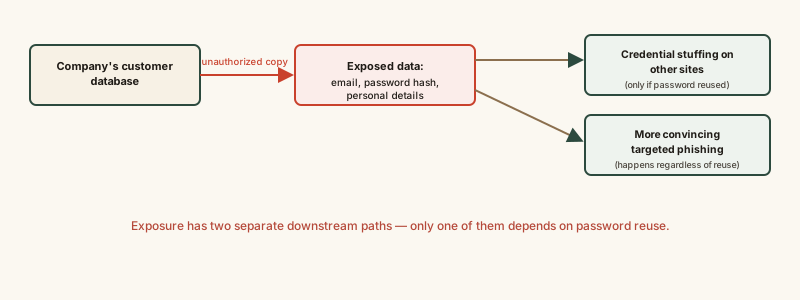
The two downstream paths in the diagram run independently of each other — the indirect phishing-risk path applies even in a breach that exposed no passwords at all, which is why reading exactly what was exposed matters more than just noting that a breach happened.
Common mistakes
Common Mistakes
Ignoring breach notification emails because nothing seems wrong with the affected account yet.
→ Read exactly what data was exposed and act accordingly, since the appropriate response, changing a password versus watching for targeted phishing, depends on the specific details involved.
Reusing the same password across multiple accounts.
→ Use a unique password per account, ideally through a password manager, so a breach at one service can't cascade into other accounts through credential stuffing.
Assuming a company disclosing a breach was uniquely careless compared to others.
→ Recognize breaches happen even at well-defended organizations, and timely, transparent disclosure is itself a reasonable practice worth expecting, not a sign of unusual negligence on its own.
Common misconception
“A data breach only matters to me if my password was included.”
A breach's risk splits into two separate paths, and only one of them involves a password at all. If an exposed password was reused elsewhere, credential stuffing puts other accounts at risk. But exposed personal details alone, like a name, address, or account specifics, with no password involved, can still make future targeted phishing attempts significantly more convincing. Both paths deserve attention, not just the one involving a password.
What to do next
What to do next
- Read breach notifications carefully to see exactly what data was exposed, rather than reacting only to the fact that a breach occurred.
- Change any reused password immediately across every account where it was reused, not just the breached account itself.
- Use a password manager to keep every account's password unique, so a future breach can't cascade through credential stuffing.
- Be more cautious of unexpected messages referencing personal details after a breach involving your information, since that data can make targeted phishing more convincing.