 KnowThis
Key Takeaways
Key Takeaways
- 1Predictive text and autocomplete rank candidate next words or completions by statistical likelihood given the specific text typed so far — they're not pulling from one fixed, global list of popular words.
- 2The same underlying prediction mechanism shows up in very different products — phone keyboards, search bars, document editors, code editors — not just as a single phone-specific feature.
- 3Suggestions get noticeably worse on uncommon words, jargon, or unfamiliar names precisely because the ranking is based on frequency in training data and personal typing history, not on understanding what you actually mean.
The concept
Once you picture the mechanism as "rank candidates by likelihood given the specific text so far" rather than "look up a word in a fixed dictionary of common terms," it becomes clear why the same three letters typed in two different sentences can produce two completely different top suggestions.
Does predictive text choose its suggestions from one fixed, universal list of the most popular words in the language?
Worked examples
Example 1: Finishing a common phrase while messaging (baseline case)
When a keyboard suggests 'back,' 'tonight,' and 'later' after the phrase 'Can you call me,' what determines that specific ranking?
Example 2: Predicting an uncommon name or technical term (edge case / variation)
Why does predictive text often struggle to suggest an uncommon surname or specialized technical term, especially the first few times it's typed?
Example 3: Search bar autocomplete predicting a full query (real-world / applied case)
Typing the first few letters into a search bar and seeing a dropdown of complete, plausible full queries appear is the same underlying prediction mechanism as phone keyboard predictive text, applied to a different kind of input and a much larger aggregate body of prior queries rather than one person's typing history. The system ranks likely full-query completions by how often similar queries have historically started the same way, offering the most statistically likely completions first. This shows the mechanism described throughout this entry isn't a single phone-specific feature — it's a general-purpose prediction approach that shows up anywhere a system needs to guess a likely continuation of partial text, from messaging apps to search engines to document and code editors.
Why does search bar autocomplete count as the same underlying mechanism as phone keyboard predictive text, even though it operates on queries instead of everyday sentences?
How it works (visual)
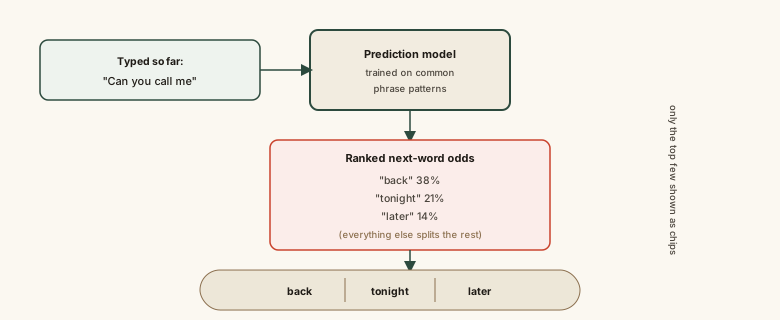
The note along the side of the diagram — that only the top few ranked candidates ever get shown — is a practical detail as much as a technical one: the model estimates a probability for many more candidates than actually appear on screen, and the interface simply truncates the ranked list to whatever fits as suggestion chips.
Common mistakes
Common Mistakes
Assuming predictive text pulls suggestions from one fixed, universal list of common words.
→ Picture it instead as a ranking of candidates by likelihood given the specific text typed immediately before — which is why the same starting letters produce different suggestions in different sentences.
Getting frustrated that a name or technical term never gets suggested, without realizing why.
→ Recognize that suggestion quality is tied to how frequently a word appears in the training data and your own typing history — an uncommon word will naturally rank lower until it's been typed repeatedly.
Treating predictive text and autocorrect as identical features.
→ Keep them conceptually separate: predictive text suggests likely next words as you type forward, while autocorrect changes a word you've already typed to a likely intended spelling — both rank candidates by likelihood, but they act on different parts of what you've written.
Common misconception
“Predictive text and autocomplete work from a fixed list of the most popular words, shown in the same order no matter what you're typing.”
Predictive text and autocomplete rank candidate next words or completions by their statistical likelihood given the exact text typed immediately before, using a language model trained on large amounts of text and often personalized to an individual's own typing history. That's why the same starting letters can produce entirely different top suggestions depending on the words that came before them — the ranking is context-dependent, not a single static popularity list applied the same way every time.
What to do next
What to do next
- Notice that predictive suggestions change based on the words you've already typed — that context-dependence is a useful way to spot the ranking mechanism in action.
- If a name or technical term never gets suggested, remember that's a frequency issue, not the system rejecting the word — typing it consistently over time will often improve its personalized ranking.
- Keep predictive text (suggesting the next word) and autocorrect (fixing a word already typed) conceptually separate — they act on different parts of your text even though both rank candidates by likelihood.
- Read What a Chatbot Is Actually Doing next to see this same next-word ranking idea scaled up into full, multi-sentence text generation.