 KnowThis
Key Takeaways
Key Takeaways
- 1The Internet of Things is defined by three things together — a sensor, a network connection, and automatic reporting to another system — not by how advanced or 'smart' a device's internal logic is.
- 2A device can be highly automated internally and still not be part of the IoT, if it has no network connection and reports its data to nowhere.
- 3IoT devices typically connect indirectly, through a local hub or router, rather than talking to the wider internet directly — the data still ends up traveling over the internet, just not in one single hop.
The concept
Once the definition is framed as "sensor plus network connection plus automatic reporting," the marketing habit of calling almost any electronic gadget "smart" becomes easy to check against a real technical bar, rather than taking the label at face value.
A battery-powered kitchen timer automatically shuts off an oven's heating element after a preset countdown, entirely on its own, with no wireless components. Is this device part of the Internet of Things?
Worked examples
Example 1: A WiFi-connected smart thermostat (baseline case)
What three elements together make the smart thermostat in this example a genuine Internet of Things device?
Example 2: A sensor that talks to a hub, not directly to the internet (edge case / variation)
Does a battery-powered sensor that only connects to a local hub, and never directly to WiFi or the internet, still count as an Internet of Things device?
Example 3: A building with many connected sensors coordinating automatically (real-world / applied case)
An office building equips its lighting, HVAC vents, and occupancy sensors as separate IoT endpoints, each reporting its own data (light level, temperature, whether a room is occupied) to a shared cloud-based management platform. That platform can then apply a rule using data from multiple devices at once — for instance, turning off the lights and reducing HVAC output in a room the occupancy sensor reports as empty for a set period — coordinating action across devices that each only sense one specific thing on their own. This illustrates the Internet of Things' real value at scale: individually simple sensing devices become far more useful once their reported data can be combined and acted on together by a system none of them could run alone.
What capability does connecting many separate IoT sensors to a shared platform add, beyond what any single sensor could do alone?
How it works (visual)
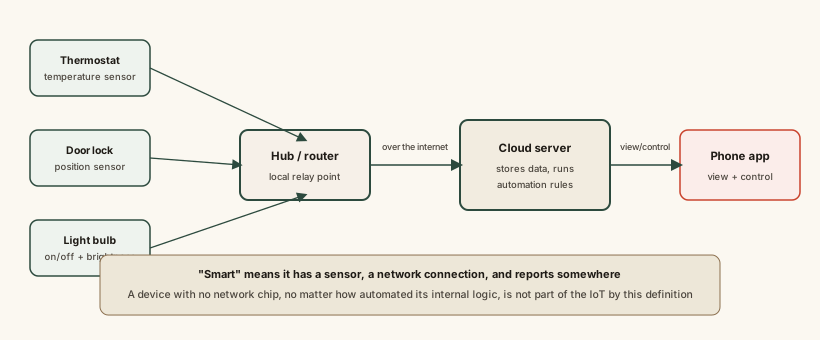
The callout at the bottom names the actual test: does the device have a sensor, a network path (direct or through a hub), and does it report somewhere automatically? A device that fails any one of those three checks — however automated its internal behavior — falls outside the definition used in this diagram.
Common mistakes
Common Mistakes
Assuming 'Internet of Things' just means a device has WiFi.
→ Check for all three elements together — a sensor measuring something, a network connection (direct or via a hub), and automatic reporting to another system. WiFi alone, without sensing and reporting, doesn't make something an IoT device.
Assuming any automated device is automatically part of the IoT.
→ Ask whether the device's data or status ever leaves the device over a network to reach another system. A fully self-contained automated device with no network connection doesn't qualify, no matter how sophisticated its internal automation is.
Assuming a device must connect directly to the internet to count as an IoT endpoint.
→ Remember that many IoT devices connect through a local hub using a short-range protocol — as long as the data is ultimately relayed onward over the internet, the device still counts.
Common misconception
“A device is part of the Internet of Things simply because it has WiFi or is described as 'smart.'”
The Internet of Things is defined by three elements present together: a sensor measuring some physical condition, a network connection (which can be indirect, through a local hub), and the ability to automatically report data to, or receive commands from, another system. Having WiFi alone, without sensing and automatic reporting, doesn't meet that definition — and conversely, a device without a direct internet connection can still qualify if a hub relays its data onward. "Smart" is a marketing term with no fixed technical meaning; whether a device is genuinely part of the IoT depends on this specific combination of capabilities, not the label on the box.
What to do next
What to do next
- When evaluating whether a device is 'genuinely' an IoT device, check for all three elements together: a sensor, a network path, and automatic reporting — not just one of them.
- Remember a device connecting through a hub instead of directly to WiFi still counts as an IoT endpoint, as long as its data ultimately reaches another system over the internet.
- Don't assume 'automated' and 'connected' are the same thing — a device can be highly automated internally while having no network connection at all.
- Read Automation vs. Artificial Intelligence next to see how the automated-behavior side of many IoT devices actually works once their data reaches a decision-making system.