 KnowThis
Key Takeaways
Key Takeaways
- 1Facial recognition doesn't store or compare a photo at the matching step — it converts the geometry of a face into a numeric template (a faceprint) and compares that number set against others.
- 2There are two structurally different tasks that both get called 'facial recognition': verification (does this face match one specific claimed identity?) and identification (does this face match anyone in a larger database?).
- 3A match is a similarity score crossing a set threshold, not an exact equality check — which means both false matches and false rejections are possible outcomes by design, not just failure states.
The concept
Once you picture the mechanism as "measure geometry, convert to numbers, compare number sets against a threshold" rather than "look at two pictures and decide if they're the same person," several counterintuitive behaviors — twins scoring as near-matches, a good match still occasionally failing, one system reporting differently from another on the same face — stop being mysterious.
When a facial recognition system checks a new face against a stored record, what is it actually comparing?
Worked examples
Example 1: Unlocking a phone with your face (baseline case)
Why is a phone's face unlock feature classified as verification rather than identification?
Example 2: Identical twins and the match threshold (edge case / variation)
Why can identical twins sometimes challenge a facial recognition system's accuracy?
Example 3: Searching a large database for a possible match (real-world / applied case)
A system tasked with finding whether a newly captured face matches anyone in a database of many thousands of stored faceprints is running identification (1:N matching), a fundamentally harder problem than verification. Instead of one comparison, it runs the new faceprint against every stored entry (or a narrowed subset), ranking candidates by similarity score. Because there are far more opportunities for an accidental near-match as the database grows larger, identification systems typically require a higher confidence threshold and often route borderline results to a human reviewer rather than acting automatically — a distinction NIST's testing program specifically evaluates, since accuracy at 1:1 verification doesn't guarantee equivalent accuracy at large-scale 1:N identification.
Why does searching a large database for a facial match (identification) carry more risk of error than checking a face against one specific claimed identity (verification)?
How it works (visual)
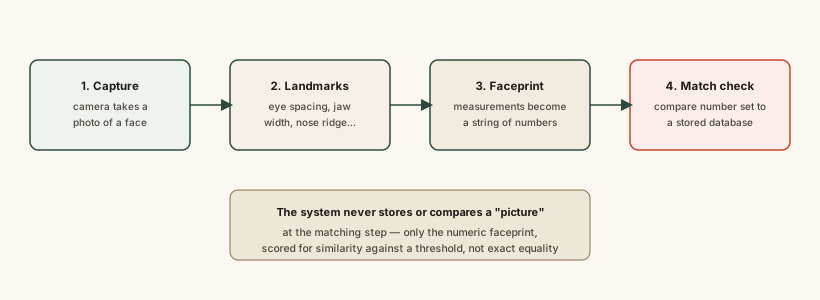
The callout under step four is the detail most people miss: nothing in this pipeline stores or compares a picture at the matching stage. Only the numeric faceprint from step three ever gets compared, which is also why systems built this way can, in principle, discard the original photo after the faceprint is calculated.
Common mistakes
Common Mistakes
Assuming facial recognition 'sees' a face the way a person does, recognizing it holistically.
→ Picture it as geometry measurement instead — a set of distances and proportions between specific landmark points, converted to numbers and compared as numbers, not as a holistic visual impression.
Treating a reported match as a certainty rather than a similarity score.
→ Remember any match is a score against a threshold, not an exact equality check — both false matches and false rejections are statistically possible outcomes of any threshold-based system, not proof of malfunction when they occur.
Assuming verification and identification are the same task with the same accuracy expectations.
→ Distinguish 1:1 verification (checking against one claimed identity) from 1:N identification (searching a whole database) — testing programs like NIST's evaluate them separately because their error rates behave differently.
Common misconception
“Facial recognition technology sees and recognizes a face the same way a person does.”
Facial recognition measures the geometric distances and proportions between specific landmark points on a face — eye spacing, jaw width, nose bridge position — and converts those measurements into a numeric faceprint. Matching is a similarity-score comparison between faceprints against a set threshold, not a holistic visual recognition process the way a person glances at a face and knows it. That mechanical difference is exactly why the technology can be confused by conditions a person would easily see past, or unexpectedly confident about a similarity a person might not even notice.
What to do next
What to do next
- When you hear a facial recognition system 'confirmed a match,' remember that's a similarity score clearing a threshold, not an infallible certainty.
- Distinguish verification claims (checking one specific identity) from identification claims (searching a whole database) when evaluating any accuracy statistic you come across — the two tasks have different error characteristics.
- If you're curious about a system's real-world accuracy, look for evaluation from an independent testing program like NIST's Face Recognition Vendor Test rather than a vendor's own claims.
- Read How Machine Learning Actually Works next to see the training process that produces the landmark-detection models these systems rely on.