 KnowThis
Key Takeaways
Key Takeaways
- 1The real dividing line between AR and VR is how much of the real world stays visible: augmented reality adds a digital layer on top of a view you can still see; virtual reality replaces the whole view with something computer-generated.
- 2Both rely on the same underlying feedback loop — sensors track where your head or device is pointed, and the display updates to match — but AR applies that tracking to placing objects into a real scene, while VR applies it to a fully synthetic one.
- 3AR and VR aren't competing versions of the same idea; they solve different problems, which is why the same company can build both without one making the other obsolete.
The concept
Once the distinction is framed as "how much of the real world stays visible," questions like whether a given headset or app counts as AR or VR stop being a matter of marketing and become a simple visual check.
A person is wearing a headset that completely blocks their view of the room around them and shows only a computer-generated scene. Is this AR or VR?
Worked examples
Example 1: Previewing furniture through a phone camera (baseline case)
Why does the furniture-preview app example count as augmented reality rather than virtual reality?
Example 2: Losing tracking accuracy indoors (edge case / variation)
Why can both an AR app and a VR headset suffer from similar 'drifting' problems when tracking accuracy degrades?
Example 3: A pilot's heads-up display vs. a flight simulator (real-world / applied case)
A cockpit heads-up display overlays flight data — altitude, speed, heading — onto a pilot's real view of the sky and runway, keeping the actual world fully visible underneath the numbers; that's augmented reality, chosen specifically because the pilot needs to see the real environment while getting extra information layered on top. A flight training simulator, by contrast, puts a trainee in a fully enclosed, computer-generated cockpit and sky, replacing their real surroundings entirely; that's virtual reality, chosen because it lets trainees safely practice scenarios — like an engine failure or severe weather — that would be far too dangerous or expensive to stage in a real aircraft. Same broader goal of using digital simulation to help pilots, but the choice between AR and VR follows directly from whether the task requires staying grounded in the real environment or benefits from being fully replaced by a controlled one.
Why would an airline choose AR for a cockpit heads-up display but VR for pilot training on emergency scenarios?
How it works (visual)
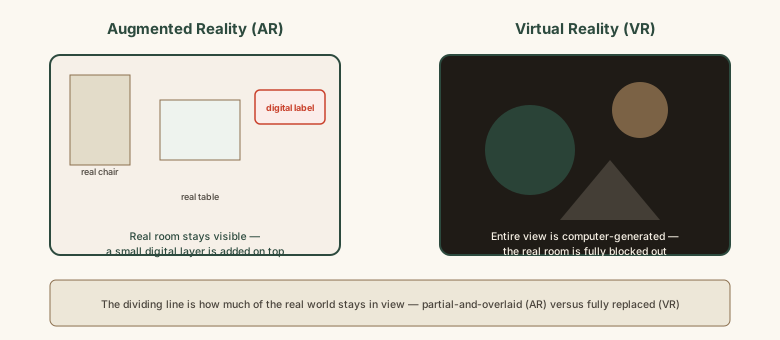
The dividing line running conceptually between the two panels is exactly what makes the category call simple: check how much of the real environment remains visible in the person's field of view, not what device is on their face or what the marketing calls it.
Common mistakes
Common Mistakes
Treating AR and VR as the same technology with two different names.
→ Check how much of the real world stays visible — AR keeps it visible and adds to it, VR replaces it entirely. That's the actual distinction, not the headset brand or shape.
Assuming any headset is automatically a VR device.
→ Some headsets are built for AR, using transparent lenses or pass-through cameras that keep the real world visible while overlaying digital content — headset form factor alone doesn't tell you which category it is.
Assuming VR is simply a 'more advanced' or 'better' version of AR.
→ They solve different problems: AR is suited to tasks needing real-world context with added information; VR is suited to fully simulating environments, including ones too dangerous, expensive, or impossible to create in reality. Neither replaces the other.
Common misconception
“Augmented reality and virtual reality are basically the same thing.”
They differ in a specific, checkable way: augmented reality keeps the real world visible and adds digital content on top of it, while virtual reality replaces the entire field of view with a computer-generated environment. Both rely on the same underlying head/device-tracking feedback loop to keep digital content correctly positioned as a person moves, but what gets displayed — a small overlay versus an entire synthetic scene — is fundamentally different, which is why the two are suited to different tasks rather than being interchangeable versions of one technology.
What to do next
What to do next
- When evaluating a headset or app, check one thing first: does the real world stay visible, or is it fully replaced? That single check settles the AR-vs-VR question every time.
- Don't assume a product is VR just because it's a headset — many headsets are built specifically to keep the real world visible through cameras or transparent lenses.
- If you're choosing between AR and VR for a specific task, ask whether the task needs real-world context (favors AR) or benefits from a fully controlled, safe simulation (favors VR).
- Read How Machine Learning Actually Works next to see how the object-recognition step behind many AR overlays gets trained in the first place.