 KnowThis
Key Takeaways
Key Takeaways
- 1Automation runs a fixed rule a person explicitly wrote — same input, same output, every time. Artificial intelligence applies a pattern learned from data, which can behave probabilistically rather than identically every time.
- 2Automation existed and was widely useful for decades before modern AI — a thermostat, a factory conveyor system, and an email auto-reply are all automation with zero machine learning involved.
- 3Many real systems combine both: AI makes a judgment call (is this transaction suspicious?), and automation carries out the resulting action (freeze the account) — the two aren't competitors, they're often layered together.
The concept
Once the distinction is framed as "fixed rule vs. learned pattern," a huge amount of marketing language that blurs the two — calling any automated feature "AI-powered" — becomes easy to evaluate on its own terms rather than taking the label at face value.
A smart thermostat turns the heat on whenever the temperature drops below a number the owner set, every single time, with no exceptions. Is this automation or artificial intelligence?
Worked examples
Example 1: An email auto-reply vs. a spam filter (baseline case)
Why is an 'out of office' auto-reply classified as automation rather than artificial intelligence?
Example 2: A factory robot arm with a fixed program vs. one with computer vision (edge case / variation)
What's the key functional difference between the fixed-program robot arm and the computer-vision-equipped robot arm in this example?
Example 3: Fraud detection combining AI judgment with automated action (real-world / applied case)
A bank's fraud detection pipeline typically works in two connected stages. First, a machine-learned model scores each transaction for how suspicious its pattern looks, based on learned associations between transaction features and past confirmed fraud cases — this scoring step is artificial intelligence. Second, a separate, rule-based system checks that score against a fixed threshold: if the suspicion score is above a set number, automatically flag or freeze the transaction, no exceptions — this action step is automation. The bank gets the adaptability of a learned pattern where it's genuinely useful (spotting subtle, evolving fraud patterns) combined with the predictability and auditability of a fixed rule where it matters most (consistently acting the same way once a threshold is crossed).
In a fraud detection pipeline that scores transactions with a machine-learned model and then freezes any transaction scoring above a fixed threshold, which part is AI and which part is automation?
How it works (visual)
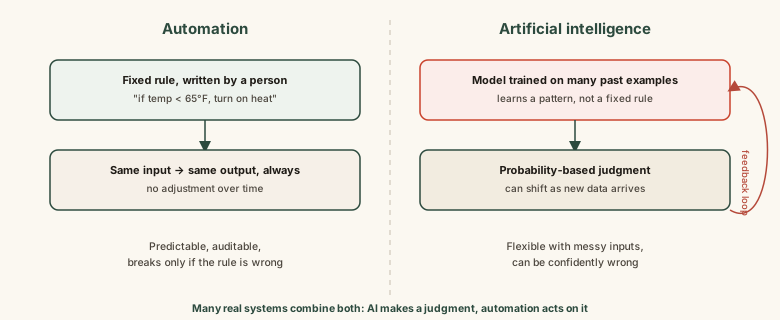
The dashed center line marks the real dividing question to ask about any system: was this specific behavior explicitly written as a rule by a person, or was it learned as a pattern from data? Many products blend both, applying the label "AI-powered" to the whole system even when only one component actually involves a learned pattern.
Common mistakes
Common Mistakes
Treating 'automation' and 'artificial intelligence' as the same thing or as interchangeable marketing words.
→ Ask whether the behavior follows an explicit rule someone wrote (automation) or a pattern learned from data (AI) — they're different mechanisms, even though both can run without a person clicking anything.
Assuming any product labeled 'smart' or 'AI-powered' must involve machine learning.
→ Check what the specific feature actually does — a fixed threshold rule marketed as 'smart' is still automation, no matter the label on the box.
Assuming AI has replaced automation as the superior, newer technology.
→ Automation remains the better tool for consistent, auditable, rule-following tasks — many well-designed systems intentionally use AI only for the judgment step and automation for reliably acting on that judgment.
Common misconception
“Automation and artificial intelligence are basically the same thing, just different names for 'a computer doing something without a person.'”
Automation executes a fixed, explicitly programmed rule and produces the same output for the same input every time. Artificial intelligence, typically built through machine learning, applies a pattern learned from data and can produce probability-based judgments that shift with new information or model updates. A calculator performing arithmetic is automation; a spam filter guessing whether an email is junk based on learned patterns is AI — both run without a human in the loop, but the underlying mechanism is fundamentally different.
What to do next
What to do next
- When a product claims to be 'AI-powered,' ask specifically which feature involves a learned pattern versus a fixed rule — the two require very different trust and testing approaches.
- For tasks where consistency and predictability matter most, prefer a rule-based automated approach over a learned one, or at least understand why a system chose AI for that specific step.
- Notice when a system layers AI judgment with automated action (like fraud scoring plus an automatic freeze) — that combination is extremely common and worth recognizing as two distinct components.
- Read How Machine Learning Actually Works next to see exactly how the 'learned pattern' side of this comparison gets built in the first place.