 KnowThis
Key Takeaways
Key Takeaways
- 1A blockchain is a general-purpose record-keeping method — linked, tamper-evident blocks of entries copied across many computers — that cryptocurrency is only one application of, not a synonym for it.
- 2Tamper resistance comes from a chain of cryptographic fingerprints (hashes): altering any past entry changes its hash, which breaks the link stored in every block after it, making the change detectable.
- 3No copy in the network is the single 'master' record — many independent computers hold matching copies, and a consensus mechanism governs how they agree on new additions without one central authority deciding alone.
The concept
Cryptocurrency is simply one application that needed exactly this property — a shared, tamper-evident transaction record with no single central authority — which is why blockchain and cryptocurrency became so closely associated. The underlying record-keeping method has no inherent connection to currency at all.
If someone tried to secretly alter a transaction recorded in an old block on a blockchain, what would happen?
Worked examples
Example 1: A simple chain of three blocks (baseline case)
Why does each block need to store the previous block's hash, rather than just its own?
Example 2: Why a lone attacker altering their own copy doesn't work (edge case / variation)
An attacker edits an old transaction on their own single copy of a blockchain and recalculates all the later hashes to make that one copy internally consistent. Does this successfully tamper with the blockchain?
Example 3: Using blockchain to track a product through a supply chain (real-world / applied case)
A company wants to let customers verify that a product moved through a genuine, unaltered sequence of custody — from factory, to shipper, to warehouse, to retailer — without any single party being able to secretly rewrite the history to hide a problem. Each handoff is recorded as an entry in a block, cryptographically linked to the previous handoff's block, and the record is shared across the participating companies' own computers rather than stored solely on one company's server. No cryptocurrency is involved anywhere in this system — the value here is purely the tamper-evident, shared record-keeping property, which is the actual core feature blockchain offers, independent of any currency use case.
A supply-chain tracking system uses blockchain with no cryptocurrency involved at all. Does this make sense given what blockchain actually is?
How it works (visual)
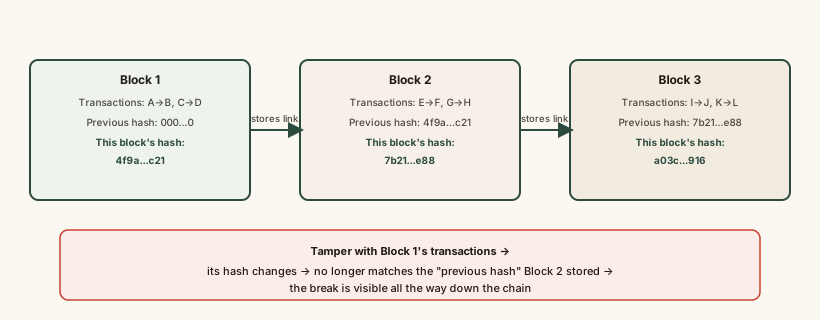
The stored "previous hash" fields are the entire mechanism — remove them and you just have a pile of independent, unlinked records with no built-in way to detect if an earlier one was quietly changed. It's the linking, not the hashing alone, that turns a list of blocks into a chain.
Common mistakes
Common Mistakes
Treating 'blockchain' and 'cryptocurrency' as interchangeable terms.
→ Blockchain is the general record-keeping structure; cryptocurrency is one application built on top of it. Blockchains are also used for supply-chain tracking, record verification, and other non-currency purposes.
Assuming a blockchain is literally impossible to alter under any circumstances.
→ It's tamper-evident and highly resistant to alteration because of decentralization, but not mathematically impossible to change if an attacker gains control of enough of the network's validating power — the security comes from having many independent honest participants, not from the hashing technique in isolation.
Assuming every blockchain is public and viewable by anyone.
→ Some blockchains are public and open to anyone; others are private or permissioned, restricted to a specific set of participating organizations — the hash-chain and distributed-copy structure works either way.
Common misconception
“Blockchain is only useful for, or only exists to support, cryptocurrency.”
Blockchain is a general-purpose method for keeping a tamper-evident, shared record across many independent computers. Cryptocurrency was an early and prominent application because it needed exactly that property — a transaction record no single party could secretly rewrite — but the same structure is used for tracking goods through supply chains, verifying document authenticity, and other record-keeping tasks that have nothing to do with any currency.
What to do next
What to do next
- Next time you hear 'blockchain,' separate the record-keeping structure from any specific currency or coin built on top of it — they're not the same thing.
- If you're evaluating a blockchain-based product, ask what specific tamper-evidence or decentralization property it actually needs — the technology adds real overhead and isn't the right fit for every record-keeping problem.
- Remember 'tamper-evident' is not the same claim as 'unchangeable' — understand what a specific system's consensus mechanism actually protects against.
- Read What Algorithm Actually Means next to see the general concept of a defined procedure that both hashing and consensus mechanisms are built from.