 KnowThis
Key Takeaways
Key Takeaways
- 1An algorithm is simply a precise, ordered set of steps for solving a problem — the concept predates computers by centuries and applies to recipes and long division just as much as to software.
- 2The word doesn't imply artificial intelligence, secrecy, or bias by default — a sorting algorithm, a search algorithm, and a social feed's ranking algorithm are all just different step-by-step procedures for different goals.
- 3Two algorithms can produce the same correct result while taking wildly different amounts of time or resources to get there — which is why 'a faster algorithm' is a meaningful, specific engineering achievement.
The concept
Once "algorithm" is understood as simply meaning "a precise procedure," the modern, more loaded use of the word — as in "the algorithm decided what I'd see" — becomes a lot less mysterious: it just means a specific set of ranking rules was applied, not that something inscrutable or intentional made a judgment about you.
Is a recipe for baking bread technically an algorithm?
Worked examples
Example 1: Finding the largest number in a list (baseline case)
In the 'find the largest number' algorithm, why does it only need to look at each number in the list exactly once?
Example 2: Two different sorting algorithms, same result, very different speed (edge case / variation)
Two sorting algorithms both correctly sort the same million-item list, but one finishes far faster than the other. What does this demonstrate about algorithms?
Example 3: What people mean by "the algorithm" on a social media feed (real-world / applied case)
When people say a social platform's "algorithm" decided what to show them, they're describing a ranking algorithm: a procedure that takes a large pool of candidate posts as input, calculates a score for each one based on defined factors (recency, past engagement with similar content, relationships between accounts, and more), and outputs an ordered list — the feed. It's still just an algorithm in the formal sense: a finite, defined procedure taking input and producing output. What makes it feel different from long division is scale and opacity — the exact scoring factors and their weights usually aren't published, so the procedure's existence is clear even when its precise steps aren't.
What makes a social media feed's ranking system 'an algorithm' in the same technical sense as a sorting or searching algorithm?
How it works (visual)
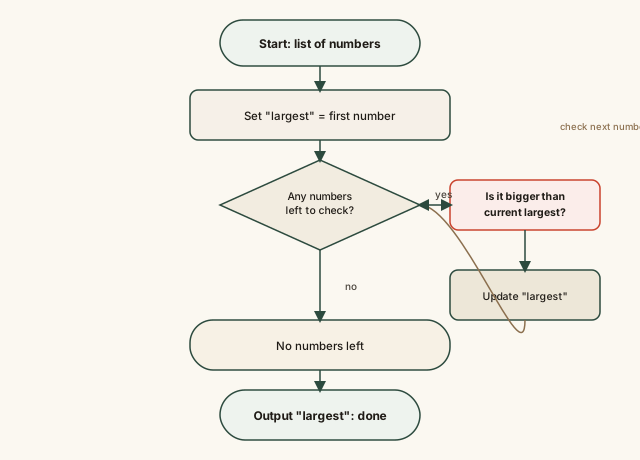
Every algorithm can be drawn this way: a defined starting point, a sequence of unambiguous steps (including decisions and repeats), and a defined stopping point that produces an output. Whether the boxes represent comparing numbers, mixing ingredients, or scoring social media posts, the underlying shape — start, precise steps, stop, output — stays the same.
Common mistakes
Common Mistakes
Assuming 'algorithm' automatically means artificial intelligence or machine learning is involved.
→ Remember an algorithm is just a precise procedure — a fixed sorting method or a simple recipe is an algorithm without any learning or AI involved at all.
Treating an unfamiliar or undisclosed algorithm as inherently mysterious or unknowable in principle.
→ An undisclosed algorithm is still a finite, defined procedure — the mystery is about which specific rules are being used, not about whether a definable procedure exists at all.
Assuming any correct algorithm for a task is as good as any other correct algorithm for the same task.
→ Correctness and efficiency are separate — two algorithms can both produce the right answer while differing enormously in speed, memory use, or other resource costs.
Common misconception
“An algorithm is a modern, computer-specific, and inherently complex concept.”
An algorithm is simply a precise, finite, step-by-step procedure for solving a problem — a concept that predates computers by well over a thousand years and includes things as ordinary as a recipe or long division. Modern computing didn't invent the concept; it gave algorithms a machine that could execute enormous numbers of simple steps extremely quickly, which is what makes today's large-scale applications (search, ranking, route-finding) possible.
What to do next
What to do next
- Next time you hear "the algorithm did this," mentally translate it to "a specific, defined procedure did this" — it reframes the sentence as something concrete rather than mysterious.
- When comparing two tools or apps that do the same task, remember that different underlying algorithms can produce very different speed or resource use, even with identical correct results.
- If you write out steps for any repeatable task clearly enough that someone else could follow them exactly, you've written an algorithm, whether or not a computer is involved.
- Read How Machine Learning Actually Works next to see a specific, modern category of algorithm — one that learns its own rules from data instead of having them written out directly.