 KnowThis
Key Takeaways
Key Takeaways
- 1A chatbot built on a language model generates its reply one small chunk of text (a token) at a time, each time predicting the statistically likeliest next piece given everything written so far.
- 2It builds a reply by repeatedly feeding the growing text back into itself — there is no single moment where it "decides" the whole answer in advance.
- 3Because the mechanism is pattern prediction, not fact-checking, a chatbot can produce fluent, confident, and completely incorrect text — a known failure mode called hallucination.
The concept
Once you picture the mechanism as one-token-at-a-time prediction rather than retrieval of a stored answer, several otherwise puzzling behaviors — fluent wrong answers, sensitivity to how a question is phrased, inconsistent answers to the same question asked twice — stop being mysterious.
When a chatbot generates its reply, is it choosing the entire sentence at once or building it piece by piece?
Worked examples
Example 1: Finishing a common phrase (baseline case)
Why does a chatbot answer 'What is the capital of France?' correctly with such apparent confidence and consistency?
Example 2: A confident, fabricated answer to an obscure question (edge case / variation)
Why can a chatbot state an incorrect, fabricated fact in exactly the same confident tone as a correct one?
Example 3: Why rephrasing a question can change the chatbot's answer (real-world / applied case)
Someone asks a chatbot the same underlying question two different ways — once as a direct question, once embedded in a longer, more detailed prompt — and gets two noticeably different answers. This happens because next-token prediction is sensitive to the exact sequence of tokens it's conditioning on: a different phrasing produces a different token sequence, which can shift which continuations the model rates as most probable at each step, especially for questions near the edge of what the training data covered clearly. Practically, this means how a question is phrased is not a cosmetic detail — it's a real input that changes the prediction path the model follows.
A user gets two different answers from a chatbot after rephrasing the same underlying question. What does this reveal about how the chatbot works?
How it works (visual)
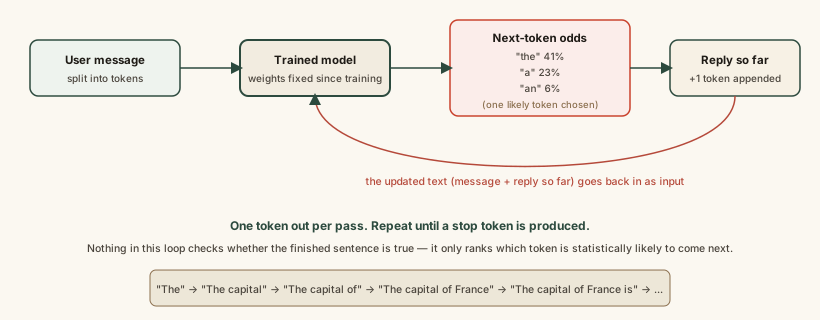
The loop running along the bottom of the diagram is the entire mechanism, repeated once per token. Nothing in that loop checks whether the finished sentence is true — it only ranks which token is statistically likely to come next, which is the structural root of both the technology's fluency and its capacity to be fluently wrong. That same fluency is why telling AI-written text from human writing is much harder than it sounds.
Common mistakes
Common Mistakes
Assuming a chatbot understands your question the way a person would.
→ Treat it as a highly capable pattern-continuation engine — it predicts likely text, it doesn't comprehend meaning or intent the way a human listener does.
Trusting a confident, fluent-sounding answer as automatically accurate.
→ Fluency and accuracy come from the same mechanism and aren't linked — verify important factual claims against an independent, authoritative source, especially on obscure topics.
Assuming the chatbot 'remembers' you or is continuously learning from your specific conversations the way a person builds a relationship.
→ A deployed model's core weights are generally frozen; any memory of a conversation is typically limited to the current session's text being fed back in, not a permanent update to what the model has learned.
Common misconception
“A chatbot understands what it's saying, the same way a person understands their own sentences.”
A chatbot generates text by repeatedly predicting the statistically likeliest next token given everything written so far — a mechanism with no comprehension, beliefs, or awareness of meaning built in. It can produce text that reads as understanding because human writing itself encodes patterns of reasoning, and the model has learned to continue those patterns convincingly. That is different from actually understanding the content, which is why it can generate fluent nonsense with the same ease as fluent, accurate text.
What to do next
What to do next
- Verify any specific, checkable fact a chatbot gives you against an independent source before relying on it, especially for anything consequential.
- If an answer seems off, try rephrasing your question — since the exact wording changes the model's prediction path, a rephrase can sometimes surface a better answer.
- Remember a chatbot's tone of confidence carries no information about accuracy — treat fluency and correctness as two separate things to judge.
- Read How Machine Learning Actually Works next to see the training process that produced the model's underlying patterns in the first place.