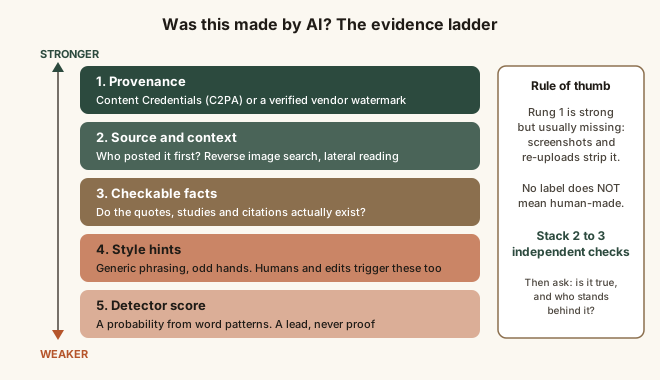
Telling whether content was AI-generated is a question of evidence, not a single test. AI text detectors estimate how predictable the wording is, which makes them probabilistic: OpenAI withdrew its own classifier in 2023 for low accuracy, and a 2023 study in Patterns found popular detectors flagged most essays by non-native English writers as AI-written. Stronger evidence comes from provenance (C2PA Content Credentials and vendor watermarks such as Google's SynthID), from the source and context of a post, and from checking whether facts, quotes and citations actually exist. Style tells such as smooth, generic phrasing are weak hints, because people write that way too and AI output can be edited. The practical approach is to stack several independent signals and treat any detector score as a lead, never as proof.
Reading time
— 5 min
Updated
— Oct 8, 2026
Fact-reviewed
— Oct 8, 2026
Key Takeaways
Key Takeaways
1No tool can reliably prove a piece of text was written by AI. Detectors measure how predictable the wording is, and plenty of real people write predictably.
2The strongest evidence is provenance: Content Credentials or a vendor watermark recorded when the content was made. Most content carries neither, so you usually fall back on source and facts.
3Stack independent checks: who posted it and where it came from, whether its facts and citations exist, and only then style hints. Treat any detector score as a lead, never a verdict.
The concept
Think of it like working out who baked a cake. If the bakery's label is still on the box, you know. If the box is gone, you can ask who brought it and check whether the ingredients list makes sense, but tasting it and saying "this feels like a shop cake" is a guess. AI content works the same way. A small but growing share of AI tools put a label on what they make: a signed record called Content Credentials, or an invisible watermark. When that label survives, it's strong evidence. Most of the time it doesn't, because screenshots, re-uploads and copy-paste strip it. Then you check the source and the facts. "AI detector" websites are the taste test: they look at how predictable the words are and give a percentage. That percentage is a guess, and it's wrong often enough that OpenAI pulled its own detector in 2023. The honest answer to "was this AI?" is often "I can't prove it either way," and the more useful question is usually "is this true, and who stands behind it?"
Images and video follow the same evidence order. Visual glitches such as warped hands or garbled signs were once reliable tells, but newer image generators make far fewer of them, so a clean-looking image proves nothing. Checking where an image first appeared, with a reverse image search, usually tells you more.
Quick check
An AI detector says an essay is '94% likely AI'. What does that number actually tell you?
Worked examples
The numbers below are illustrative, chosen to show the arithmetic of testing. They are not measurements of any specific product.
Example 1: A "small" error rate in one class (baseline case)
A teacher runs 300 essays through a detector advertised with a 1% false-positive rate. Even if every student wrote their own essay, the expected number of human essays flagged is 300 × 0.01 = 3 students. Across a school running 30,000 essays a year, that's about 300 false flags. OpenAI's withdrawn classifier had a reported false-positive rate of 9%, which would mean 27 flagged students in that one class. A false-positive rate that sounds tiny becomes real people once you multiply by volume.
Example 2: Why most flags can be wrong (edge case)
Now take 1,000 essays where 100 really were written with AI. A detector catches 80% of those (80 essays) and wrongly flags 5% of the 900 human essays (45 essays). It raises 125 flags, and 45 ÷ 125 = 36% of flags point at a human. Cut the false-positive rate to 1% and it's 9 out of 89 flags, about 10%. This is the base-rate effect: when the thing you're hunting for is uncommon, even a decent test produces a large share of false alarms. It's the same reason medical screening tests get a second, different test before anyone acts.
Example 3: A viral photo (applied)
A dramatic photo of a flooded landmark is spreading. Step one: inspect it with a Content Credentials viewer such as the one linked from c2pa.org. If it carries a signed record saying an AI tool generated it, you have your answer. Here it has none, which is normal after a re-post. Step two: a reverse image search finds the earliest copy, posted two hours ago by an account that has shared other AI art, and no news outlet or local agency has published anything similar. Step three: the landmark's official webcam and local weather service show no flooding. Three independent checks agree, so you can say with confidence that it isn't a real event, even though no single test "detected AI". That's lateral reading, and it works whether a fake was made with AI or with photo editing.
Quick check
A photo has no Content Credentials attached. What can you conclude?
How it works (visual)
The evidence ladder: which signals actually tell you something
Common mistakes
Common Mistakes
✕
Treating a detector percentage as proof.
→ Use it only as a reason to look closer. Ask for drafts, version history or a quick conversation about the work before drawing any conclusion.
✕
Hunting for 'AI words' like 'delve' or 'tapestry'.
→ Word lists are weak tells: people use them, and anyone using AI can delete them. Check facts and sources instead.
✕
Assuming no watermark means human-made.
→ Only some tools add watermarks, and only their own checker can read them. Absence tells you nothing.
✕
Relying on visual glitches in images.
→ Newer generators rarely make the classic hand and text errors. Trace the image to its first appearance instead.
Common misconception
“AI detectors can tell you for certain whether something was written by AI.”
They can't. They estimate predictability, which overlaps heavily with plain human writing. OpenAI withdrew its own classifier in 2023 after it caught only about a quarter of AI text while flagging 9% of human text, and peer-reviewed research has shown detectors disproportionately flag non-native English writers. NIST's 2024 review treats detection as one imperfect signal among several.
What to do next
What to do next
Before sharing something surprising, find its first appearance with a reverse image search or by searching a distinctive quote.
Check one specific, checkable claim: a named study, a quote, a statistic. Confirm it exists and says what is claimed.
Look for Content Credentials using a C2PA-compatible viewer when you have the original file.
If you review others' work, set a rule that a detector score alone never triggers an accusation.
Ask the better question: regardless of who or what wrote it, is it accurate and who is accountable for it?
FAQ
FAQ
Related terms
Related terms
AI detector
A tool that estimates the probability that a piece of text or media was produced by an AI model, usually from statistical patterns rather than any hidden marker.
Perplexity
A measure of how surprising a text is to a language model. Low perplexity means each word was highly predictable, which many detectors treat as a sign of AI writing.
False positive
When a test flags something that isn't there, such as a detector labelling human writing as AI-generated.
Watermark (AI)
A signal deliberately embedded in AI output when it is generated, such as a statistical bias in word choice or an invisible pattern in pixels, that a matching tool can later detect.
Content Credentials (C2PA)
An open standard for attaching signed, tamper-evident records to a file describing how it was created and edited, including whether AI tools were used.
Provenance
The documented origin and history of a piece of content: who made it, with what, and how it changed along the way.
Base rate
How common something is in the group being tested. A low base rate means even an accurate test produces many false alarms.
This entry was researched from public sources and drafted with AI-assisted tools, then edited — errors are still possible. Spot one, or want a topic covered? Read our disclaimer.
 KnowThis