A primary source is direct, firsthand evidence of an event — original documents, direct testimony, raw data — while a secondary source interprets, summarizes, or reports on that primary evidence; most news coverage is secondary-source reporting built on primary evidence the outlet gathered or was given access to.
Reading time
— 4 min
Updated
— Aug 21, 2026
Fact-reviewed
— Aug 21, 2026
Key Takeaways
Key Takeaways
1A primary source is direct, firsthand evidence — an original document, direct testimony, raw data; a secondary source interprets or reports on that evidence, which is what most news coverage actually is.
2Most news articles are secondary sources built on primary evidence the outlet gathered, was given access to, or is describing — the article itself isn't usually the original evidence.
3Distortion risk generally increases with each additional step in the source chain, which is why checking whether a claim traces back to an identifiable primary source is a genuinely useful media-literacy habit.
The concept
A primary source is the original, firsthand evidence itself — a government report, a court transcript, a recorded speech, raw survey data. A secondary source is something that describes, summarizes, or interprets that evidence — most news articles are secondary sources, since they're reporting on events, documents, or data rather than being that original evidence themselves.
The practical value of this distinction isn't treating secondary sources as untrustworthy — good journalism does careful, responsible secondary reporting constantly — it's knowing when a claim matters enough to be worth tracing back to its original evidence.
Quick check
Is a typical news article reporting on a newly published scientific study considered a primary or secondary source for that study's findings?
Worked examples
Example 1: Tracing a claim back to its primary source (baseline case)
A news article reports that "a new study found X." To verify the specific claim, a reader can look up the study itself (the primary source) — often linked or named in the article — and check whether the article's summary accurately reflects the study's actual findings, methodology, and caveats. This single verification step catches the most common distortions, like an article overstating a correlational finding as a definitive causal one.
Example 2: A claim that has passed through multiple summarization steps (edge case / variation)
A social media post summarizes a news article, which itself summarized a government report, which itself summarized raw survey data. By the time the claim reaches the social media post, several layers of compression have occurred, and a caveat present in the original report ("results applied only to a specific subgroup") may have been dropped entirely by the second or third step — not necessarily due to any single actor's bad intent, but simply from repeated summarization.
Example 3: A primary source directly available to the public (real-world / applied case)
A government agency publishes its full report directly on its own official website at the same time news coverage of the report appears. A reader with a specific question about the report's actual methodology can go directly to the primary source rather than relying entirely on secondary summaries — a check that's become significantly easier as more primary source documents are published openly online rather than only being available through intermediaries.
Quick check
Does using secondary sources (like news articles) for everyday information consumption mean a reader is being careless or uninformed?
How it works (visual)
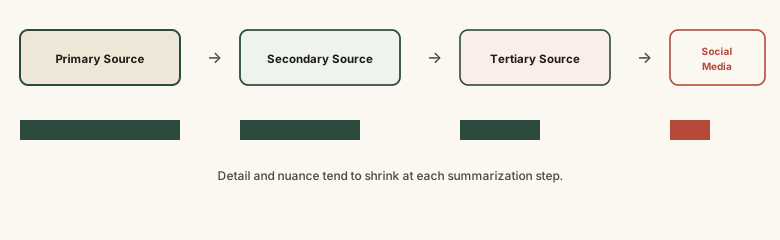
A claim's journey through the source chain
The shrinking bar underneath each stage is the core idea — detail and nuance tend to compress at each summarization step, which is exactly why checking further back up the chain matters most for claims a reader actually cares about getting right.
Common mistakes
Common Mistakes
✕
Treating a news article's summary of a study as equivalent to the study itself.
→ Check the actual primary source (the study) for important claims, since summarization can drop caveats or oversimplify findings.
✕
Assuming multiple outlets reporting the same claim independently confirms it.
→ Check whether those outlets are actually independently sourced or all citing the same original primary source or wire report.
✕
Dismissing all secondary-source reporting as inherently unreliable.
→ Recognize careful secondary reporting is normal and valuable — the useful skill is selectively verifying claims that matter against their primary source.
Common misconception
“If a claim is widely repeated across many different outlets and social media posts, it must be independently verified and therefore reliable.”
Wide repetition doesn't equal independent verification — many outlets and posts repeating a claim may all trace back to the same single original source (or to each other), meaning any distortion introduced early in the chain can spread widely without ever being independently checked against the actual primary evidence.
Quick check
What is a tertiary source, in relation to primary and secondary sources?
What to do next
What to do next
For any claim that matters to you, try tracing it back one step further than where you first encountered it.
When a news article cites a study or report, check whether it links directly to the primary source document.
Notice when multiple sources repeating a claim actually trace back to the same single origin, rather than being independently verified.
Practice distinguishing primary, secondary, and tertiary sources on a few real examples from your own regular reading.
FAQ
FAQ
Related terms
Related terms
Primary source
Direct, firsthand evidence of an event or fact — original documents, direct testimony, raw data, or a recording — created at or close to the time of the event itself.
Secondary source
A source that interprets, summarizes, analyzes, or reports on primary evidence rather than being that firsthand evidence itself, such as a news article describing a study.
Tertiary source
A source that compiles or summarizes secondary sources, such as an encyclopedia entry or a roundup article citing multiple news reports.
Source chain
The sequence of sources a piece of information passes through from its original primary evidence to the version a reader ultimately encounters, with distortion risk generally increasing at each additional step.
This entry was researched from public sources and drafted with AI-assisted tools, then edited — errors are still possible. Spot one, or want a topic covered? Read our disclaimer.
 KnowThis