 KnowThis
Key Takeaways
Key Takeaways
- 1Misinformation is engineered to trigger a fast emotional reaction (outrage, fear, validation) before a reader slows down to check it — the emotional pull itself is a warning sign, not proof either way.
- 2The single highest-value habit is lateral reading: leaving the article to open new tabs and check what independent, established sources say about the same claim, rather than judging the page purely on how it presents itself.
- 3A claim doesn't need to be proven false to be treated cautiously — the absence of a verifiable source, date, or independent confirmation is itself enough reason to withhold sharing until checked.
The concept
None of this requires special training or software — it's a short sequence of habits that becomes fast with repetition, the same way checking a source's credentials becomes automatic for anyone who reads news regularly.
A post claims a shocking statistic and has thousands of shares, but no named source or link to where the number came from. What should that absence tell you?
Worked examples
Example 1: A viral quote attributed to a public figure (baseline case)
Example 2: A dramatic photo shared as breaking news (edge case / variation)
A reverse image search shows a viral 'breaking news' photo was actually taken three years earlier at a different event. What does this tell you about the photo itself?
Example 3: An unfamiliar news site reporting an extraordinary claim (real-world / applied case)
How it works (visual)
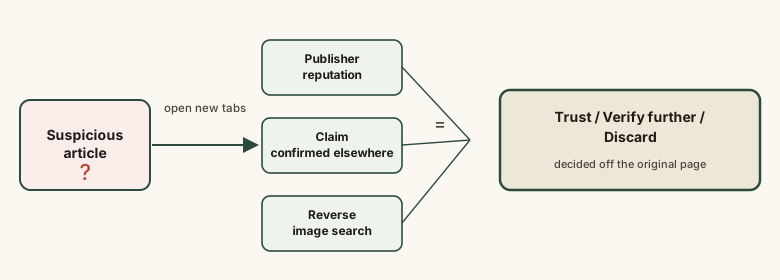
The core move is spatial as much as mental: instead of staying on the suspicious page and evaluating its own citations, design, and tone, the reader leaves it entirely to check independent, already-established sources — the verification happens off the page, not on it.
Common mistakes
Common Mistakes
Judging a source's credibility by its design quality, tone of confidence, or use of citations that aren't actually checked.
→ Professional-looking design and confident tone are cheap to fake. Check where the citations actually lead, and search the publisher's name independently rather than trusting its self-presentation.
Sharing something because it confirms an existing belief, without applying the same scrutiny used for claims that contradict it.
→ Apply the same lateral-reading check regardless of whether the claim is convenient or inconvenient to what you already think — motivated reasoning is exactly what misinformation is designed to exploit.
Treating 'I couldn't find it debunked' as equivalent to 'this is confirmed true.'
→ Absence of a debunking isn't confirmation — many false claims simply haven't been fact-checked yet. Look for positive, independent confirmation, not just the absence of a rebuttal.
Common misconception
“Misinformation is always obviously fake — poorly written, badly designed, or from a clearly sketchy source.”
Some of the most effective misinformation is genuine media (a real photo, a real statistic, a real quote) placed in a false context — a real image with a fabricated caption, a real statistic from the wrong year, a real quote attributed to the wrong situation. Because the underlying material is authentic, it often passes a casual glance far more easily than an obviously fabricated story, which is exactly why lateral reading (checking the claim independently, not just the page's surface credibility) matters more than surface impressions.
Why might a real, unaltered photograph still count as misinformation when it's shared with a new caption?
What to do next
What to do next
- Before sharing a surprising claim, open a new tab and search the claim's key terms plus the word 'fact check' to see what independent sources say.
- For a suspicious photo or video, use a reverse image search to check where and when it was first published.
- Search an unfamiliar publisher's name alongside words like 'reliability' or 'about' before trusting its reporting on an important claim.
- Apply the same verification standard to claims you agree with as to claims you don't — motivated reasoning is precisely what misinformation exploits.