 KnowThis
Key Takeaways
Key Takeaways
- 1Most media bias operates through story selection and framing — which events get covered, which facts lead, and which words are used — not through stating things that are factually false.
- 2Reading how multiple outlets cover the exact same event reveals framing differences far more clearly than trying to judge a single outlet's fairness in isolation.
- 3News content and opinion/editorial content are different products with different purposes — labeled opinion pieces are expected to argue a viewpoint, while news reporting is expected to describe events.
The concept
Recognizing this distinction changes what "checking for bias" actually means — it's less about hunting for a single false statement and more about noticing what's emphasized, what's left out, and how it compares to other outlets' coverage of the same event.
Two news outlets both accurately report the same unemployment statistic, but one leads with 'unemployment rises' and the other leads with 'unemployment remains near historic lows.' What best describes what's happening?
Worked examples
Example 1: Comparing headlines on the same event (baseline case)
Example 2: Selection bias without any false statement (edge case / variation)
An outlet publishes only individually accurate crime stories, but consistently over-selects stories involving one group relative to real crime statistics. Is this outlet's individual reporting biased?
Example 3: Mistaking an opinion column for news reporting (real-world / applied case)
How it works (visual)
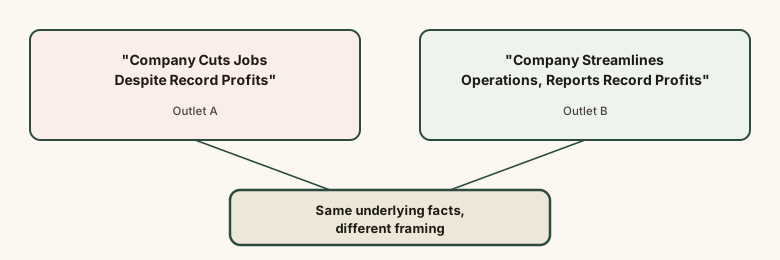
Both headlines can be independently checked and confirmed true — the difference between them lives entirely in which fact leads and which word carries the connotation, which is precisely why comparing multiple outlets on the same story surfaces framing more clearly than reading any single outlet alone.
Common mistakes
Common Mistakes
Judging an outlet's overall bias from a single article rather than a pattern of coverage over time.
→ Bias, especially selection bias, shows up as a pattern across many stories — a single article, even a strongly framed one, doesn't establish a pattern on its own.
Treating a labeled opinion or analysis piece as equivalent to that outlet's straight news reporting.
→ Check the section label. Opinion and analysis content is explicitly meant to argue a viewpoint and is held to a different standard than news reporting from the same publisher.
Assuming that finding a framing difference between two outlets means one of them is lying.
→ Framing differences usually involve two accurate facts being weighted differently, not a factual dispute — check whether the underlying facts themselves are actually in question before concluding either side is wrong.
Common misconception
“Media bias means an outlet is reporting things that are factually false.”
The large majority of what gets called media bias operates through story selection (which events get covered, and how prominently) and framing (which facts lead, and which words carry connotation) — not through stating things that are demonstrably untrue. An outlet can maintain a strong track record of factual accuracy while still showing a consistent pattern in which stories it covers and how it frames them, which is exactly why comparing coverage across multiple outlets reveals more than fact-checking a single one.
Why is comparing coverage across multiple outlets on the same story a more useful bias check than fact-checking one outlet alone?
What to do next
What to do next
- On a story that matters to you, read coverage from at least two outlets with different general audiences and compare what each leads with.
- Check whether an article is labeled news, opinion, or analysis before judging it against a news-reporting standard.
- Notice which facts are placed in the first two paragraphs versus buried near the end — placement itself is a framing signal.
- When a statistic is reported, ask what the same number would look like framed the opposite way, before forming an impression from a single framing.