What Confirmation Bias Actually Does to Decision-Making
Confirmation bias is the tendency to seek, interpret, favor, and recall information in ways that support what one already believes or expects, per the APA Dictionary of Psychology. Raymond Nickerson's 1998 review in Review of General Psychology describes it as operating at several stages of reasoning: people test ideas by looking for confirming cases rather than cases that could prove them wrong (as in Peter Wason's 1960 2-4-6 task), interpret ambiguous evidence as supportive, and remember hits better than misses. A 1979 Stanford study by Lord, Ross, and Lepper found that people on opposite sides of an issue who read the same mixed evidence both became more confident in their original views. The practical result for decisions is rising confidence without rising accuracy, which is why structured habits such as asking what evidence would change one's mind, and seeking disconfirming information deliberately, reduce its effect more than simply trying to be objective.
Reading time
— 4 min
Updated
— Sep 25, 2026
Fact-reviewed
— Sep 25, 2026
Key Takeaways
Key Takeaways
1Confirmation bias works at every stage of thinking: which evidence you look for, how you read unclear evidence, and what you remember afterward.
2The effect on decisions is that confidence rises while accuracy doesn't, because you've been collecting support instead of testing the idea.
3Good intentions don't fix it much. Structured habits, like asking what would change your mind, do better.
The concept
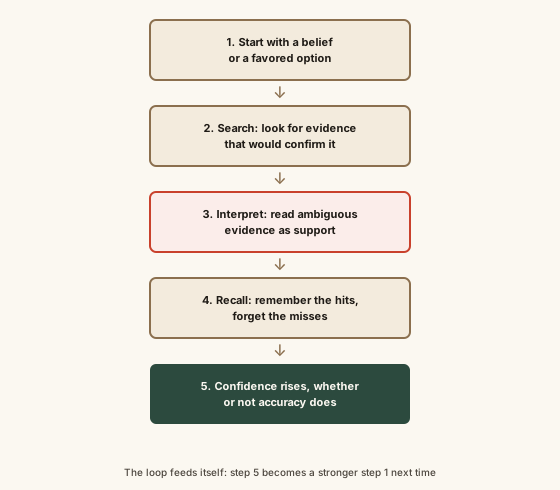
Once you believe something, your mind starts working as that belief's lawyer instead of its judge. You search for facts that back it up. When something is unclear, you read it the way that fits. Later, you remember the times you were right more clearly than the times you weren't. None of this feels like bias from the inside. It feels like noticing how much evidence there is. That's what makes it tricky: the more you've gathered, the surer you feel, even if you never once checked whether you might be wrong.
You're told 2-4-6 fits a secret rule. You guess 'even numbers going up by 2.' Which test would teach you the most?
Worked examples
Example 1: Researching a car you've already chosen (baseline case)
You've fallen for a particular SUV. You search "[model] reliability" and click the glowing reviews first, skim past a forum thread about transmission failures as "probably a few unlucky owners," and a week later mostly remember the praise. Each step felt reasonable. Together they turned research into reassurance. A search for "[model] problems" or the reliability data for the specific model year would have been the real test.
Example 2: A first impression at work (interpretation)
A manager decides in week one that a new hire is careless. Afterward, a missed typo is "typical," while a well-handled client call is "a lucky day." Both events are real; the belief decides which one counts as evidence. By review time, the manager has a long, sincere list supporting the week-one impression, and a much shorter memory of the counterexamples.
Example 3: An investor's favorite stock (applied case)
An investor who owns a stock follows analysts who are bullish on it, reads bad earnings as "temporary," and treats a price drop as a chance to buy more. Having money on the line adds motivation to the bias. A useful counter is writing down, at purchase, the specific facts that would mean the reason for owning it no longer holds, and checking against that list later rather than against how the story feels.
Quick check
In Example 2, what is the clearest sign of confirmation bias?
How it works (visual)
The confirmation loop: belief shapes search, reading, and memory
Common mistakes
Common Mistakes
✕
Thinking confirmation bias only means ignoring evidence you dislike.
→ Watch the quieter stages too: which searches you run, how you read unclear evidence, and what you remember.
✕
Believing you're immune because you're smart or well informed.
→ Nickerson's review finds it in experts and scientists. Being skilled at argument can make it easier to defend a belief, not harder.
✕
Relying on willpower to 'stay objective.'
→ Use a process instead: write down what would change your mind before you research, and search for the opposing case on purpose.
Common misconception
“Confirmation bias is something other people do, usually on purpose, when they don't want to hear the truth.”
The research describes an ordinary, largely unconscious habit of reasoning that everyone shows. In Lord, Ross, and Lepper's study, sincere participants on both sides read identical evidence and each came away more certain. Nobody felt biased; each felt the other side's study was simply weaker. That's why the most reliable countermeasures are procedures that go looking for disconfirming evidence, not self-assessments of how fair-minded we are.
What to do next
What to do next
Before a big decision, write one sentence: "I would change my mind if I learned ___." Then look for exactly that.
Search for the opposite of your belief on purpose ("[option] problems," "case against [idea]").
Ask someone who disagrees to make their best argument, and restate it fairly before you respond.
Keep a simple log of predictions and outcomes so your memory can't quietly edit out the misses.
FAQ
FAQ
Related terms
Related terms
Confirmation bias
The tendency to search for, interpret, favor, and remember information in ways that support existing beliefs or expectations.
Cognitive bias
A systematic pattern in how people think and judge that departs from what the evidence or logic would support, usually because the mind uses shortcuts.
Positive test strategy
Testing an idea by looking for cases that should fit it, rather than cases that would reveal it's wrong. It's a major route into confirmation bias.
Biased assimilation
Judging evidence that supports your view as stronger and more convincing than equally good evidence that challenges it.
Disconfirming evidence
Information that would show a belief or hypothesis is false or incomplete if it turned up.
This entry was researched from public sources and drafted with AI-assisted tools, then edited — errors are still possible. Spot one, or want a topic covered? Read our disclaimer.
 KnowThis