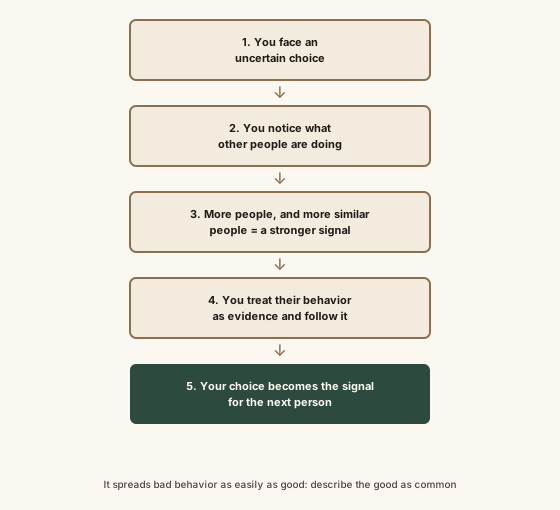
Social proof is the tendency to treat other people's behavior as evidence of the correct thing to do, especially when a situation is uncertain, as described in the APA Dictionary of Psychology. Field studies show its size. In a 1969 street experiment by Milgram, Bickman and Berkowitz, as the crowd staring up at a building grew from 1 person to 15, the share of passersby who stopped rose from about 4% to about 40%. In a 2008 hotel study, Goldstein, Cialdini and Griskevicius found that a card saying most guests reused their towels increased reuse compared with a standard environmental appeal, and a card referring to guests who had stayed in the same room did better still. Social proof can backfire: Cialdini (2003) reported that a sign stressing how many visitors stole petrified wood from a national park was associated with more theft than a sign simply asking people not to. Asch's 1950s line-judgment studies showed people will sometimes give an answer they can see is wrong when a group agrees on it.
Reading time
— 4 min
Updated
— Sep 26, 2026
Fact-reviewed
— Sep 26, 2026
Key Takeaways
Key Takeaways
1When we don't know what to do, we treat what others are doing as evidence of the right choice.
2The pull is strongest under uncertainty and from people who seem similar to us, and field studies show it changes real behavior, not just opinions.
3It cuts both ways: saying 'lots of people do this bad thing' can make the bad thing more common.
The concept
You're in a new city and have to pick between two restaurants. One is packed; the other is empty. Most people pick the packed one, because the crowd seems to know something they don't. That's social proof. It's usually a sensible shortcut: other people often do have useful information. But the shortcut can be gamed with fake reviews, and it can mislead when everyone is guessing. It also works on bad habits as easily as good ones. If you hear "everyone cheats on this," part of your brain hears "cheating is normal here."
Social proof is also built into the internet. Like counts, review stars and "trending" labels are designed around it, which is part of how social media feeds amplify what's already popular.
Quick check
A town wants less littering. Which sign is most likely to help, based on the research?
Worked examples
Example 1: The crowd on the sidewalk (baseline case)
In the 1969 New York study, researchers had people stand on a busy sidewalk and stare up at a sixth-floor window. With 1 person staring, about 4% of passersby stopped and about 42% glanced up. With 15 people staring, about 40% stopped and about 86% looked up. There was nothing special in the window. The crowd itself became the reason to look. That's informational social proof in its simplest form: more people doing something makes it seem more worth doing.
Example 2: The sign that backfired (edge case)
Visitors to Arizona's Petrified Forest National Park were taking small pieces of wood. A sign that stressed how many past visitors had taken wood was associated with more theft in Cialdini's test than a sign simply asking visitors not to take it. The warning was well-intended, but it quietly communicated that taking wood is what people do here. The lesson for anyone writing a public message: describe the good behavior as common, not the bad behavior.
Example 3: Reading online reviews (real-world use)
You're choosing between two space heaters. One has 3,000 reviews averaging 4.6 stars; the other has 11 reviews averaging 4.9. Social proof pulls you toward the first, and that pull is reasonable: 3,000 buyers is much stronger evidence than 11. But run two checks. Are the reviews from people like you (same use, same room size)? And do they look genuine, with specific details and a mix of ratings, rather than a wall of vague five-star praise? Social proof is only as good as the crowd behind it.
Quick check
In the hotel towel study, why did 'guests who stayed in this room' beat 'most guests'?
How it works (visual)
How social proof turns uncertainty into action
Common mistakes
Common Mistakes
✕
Warning people by stressing how common a bad behavior is.
→ Highlight the people doing the right thing, and pair it with a clear request.
✕
Trusting a popularity count without checking who's behind it.
→ Ask whether the crowd has real information and resembles you, and look for signs of fake reviews or bought followers.
✕
Assuming you're immune because you think for yourself.
→ Most people underestimate how much others' behavior affects them. Slow down on uncertain choices and name the evidence you're actually using.
Common misconception
“Only gullible or insecure people are swayed by what others do.”
Social proof works on nearly everyone because it's usually a smart shortcut: in unfamiliar situations, other people often do know something you don't. That's why it shows up in controlled experiments with ordinary adults, hotel guests and park visitors. The problem isn't using it. It's using it when the crowd has no better information than you, or when the crowd is fake.
What to do next
What to do next
Next time you follow the crowd on a purchase or decision, ask what the crowd actually knows.
When asking others to change a habit, describe how many people already do the good behavior.
Check reviews for detail, a realistic spread of ratings, and reviewers whose needs resemble yours.
On social media, notice when a like count is doing your thinking for you.
FAQ
FAQ
Related terms
Related terms
Social proof
Using what other people do as evidence of what's correct or appropriate, most strongly when we're uncertain.
Descriptive norm
What most people actually do, such as 'most guests reuse their towels.'
Injunctive norm
What most people approve or disapprove of, such as 'please don't take the wood.'
Conformity
Changing your behavior or stated beliefs to match a group, whether from genuinely believing the group is right or from wanting to fit in.
Informational influence
Following others because you think they know something you don't, as opposed to following them just to be accepted.
This entry was researched from public sources and drafted with AI-assisted tools, then edited — errors are still possible. Spot one, or want a topic covered? Read our disclaimer.
 KnowThis