 KnowThis
Key Takeaways
Key Takeaways
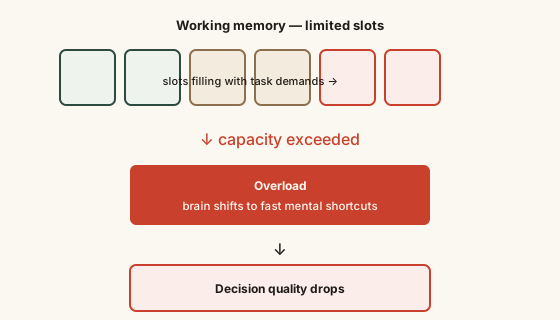
- 1Working memory has a small, well-documented capacity — it can only actively hold a handful of pieces of information at once.
- 2When a task's demands exceed that capacity, the brain doesn't work harder — it shifts to faster, less careful mental shortcuts instead.
- 3This is why important decisions made while multitasking, tired, or facing too many options at once tend to be measurably worse than the same decision made with full attention.
The concept
Understanding this matters practically: the fix for a high-stakes decision under heavy cognitive load usually isn't "try harder" — it's reducing the load itself, by simplifying the choice, writing things down externally, or postponing the decision to a lower-load moment.
Someone has to make an important financial decision while also fielding work calls, tracking a toddler, and running low on sleep. What does cognitive load research predict about this decision compared to the same one made with full, undivided attention?
Worked examples
Example 1: Choosing from a simple menu (baseline case)
Example 2: The same choice with 30 options and a crying child nearby (edge case / variation)
Example 3: Decision fatigue in professional judgment (real-world / applied case)
Why do checklists and written protocols help reduce decision-quality problems from cognitive load in high-stakes professional settings?
How it works (visual)
Common mistakes
Common Mistakes
Scheduling your hardest decisions for the end of a mentally demanding day.
→ Front-load complex, high-stakes decisions earlier, when working memory capacity hasn't already been consumed by the day's other demands.
Believing willpower alone can overcome high cognitive load.
→ Reduce the load itself (simplify the choice, write it down, remove distractions) rather than relying on effort to push through a genuine capacity limit.
Assuming a bad decision under heavy load reflects poor judgment rather than a load problem.
→ Separate the two — often the fix isn't 'think harder,' it's removing something else competing for the same limited mental capacity.
Common misconception
“Smart, capable people can just think harder to overcome mental overload.”
Working memory capacity is a real, well-documented cognitive limit, not a matter of effort or intelligence. Once task demands exceed that limit, the brain reliably shifts toward faster shortcuts regardless of how capable or motivated the person is — which is exactly why external tools (checklists, notes, simplified choices) are a legitimate strategy, not a sign of weakness.
What to do next
What to do next
- Schedule your most important, complex decisions for moments of lower cognitive load, not the end of a demanding day.
- Externalize information (write it down, use a checklist) for any decision with more details than you can comfortably hold in mind at once.
- Reduce the number of options you're actively comparing at one time, rather than trying to weigh many choices simultaneously.
- If you notice yourself defaulting to the easiest option under pressure, treat that as a signal to pause and reduce load, not as a character flaw.