 KnowThis
Key Takeaways
Key Takeaways
- 1Test anxiety mainly hurts performance by consuming working memory with intrusive worry thoughts, not by deleting what was studied — the knowledge is often still there but harder to retrieve under load.
- 2Some arousal actually helps performance; the relationship follows an inverted-U curve, so the goal isn't zero anxiety, it's staying below the point where arousal starts crowding out working memory.
- 3Test anxiety has two separate components, worry (cognitive) and emotionality (physical arousal) — they respond to different strategies, so treating them as one problem often misses half of it.
The concept
Once anxiety is understood as a resource-competition problem rather than a knowledge-erasure problem, the practical response follows: reduce what's competing for working memory during the exam, rather than trying to eliminate arousal entirely.
Why can someone who studied thoroughly still perform poorly on an exam because of test anxiety?
Worked examples
Example 1: Mild arousal helping performance (baseline case)
A student who feels almost no nerves before a routine quiz they've seen a version of before performs adequately but sluggishly, missing a couple of details they know but don't actively check. A second student, mildly nervous before a higher-stakes exam, checks their work more carefully, catches a careless error, and finishes with a slightly higher score covering similar material. The mild arousal sharpened attention rather than derailing it — consistent with the rising portion of the arousal-performance curve, not a flat "anxiety is always bad" rule.
Example 2: High anxiety derailing a well-prepared test-taker (edge case / variation)
A student who consistently scored well on low-stakes practice tests performs far worse on the real, high-stakes exam covering the same material. What does this pattern most directly suggest?
Example 3: Two students, same knowledge, different self-talk (real-world / applied case)
Two students study the same material to a similar level. Before the exam, one repeats to themselves specific worry statements about failing. The other uses a brief, practiced routine of slow breathing and a neutral reminder of their preparation. Both walk into the same exam with comparable underlying knowledge. The first spends noticeable mental effort managing intrusive thoughts throughout, especially on harder questions; the second has that working-memory capacity free for the actual task. Their scores diverge in a way that closely tracks how much of the exam period was spent managing worry versus solving problems.
Two students with comparable underlying knowledge get different exam scores. One spent much of the exam managing intrusive worry thoughts; the other used a brief calming routine beforehand. What best explains the score difference?
How it works (visual)
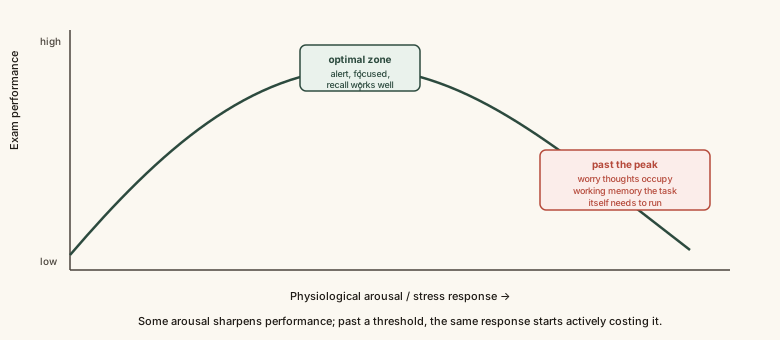
The goal isn't reaching zero nerves — it's staying on the left side of the peak instead of sliding down its far side.
Common mistakes
Common Mistakes
Treating any nervousness before an exam as purely harmful and something to eliminate entirely.
→ Recognize that mild arousal can sharpen focus — the goal is managing worry and staying below the point where arousal starts costing performance, not reaching zero nerves.
Assuming a bad exam score under high anxiety means the material wasn't actually learned.
→ Compare against lower-stakes practice performance on the same material — a sharp, stakes-specific drop points toward retrieval interference, not a knowledge gap, and calls for a different fix.
Addressing only the physical symptoms of anxiety (like taking deep breaths once) while the intrusive worry thoughts keep running underneath.
→ Address both components separately — physical arousal with breathing or relaxation techniques, and worry thoughts with a practiced, specific replacement thought or brief structured routine.
Common misconception
“Test anxiety is basically just not caring enough to prepare, or a sign of weak willpower.”
Test anxiety is a measurable cognitive interference effect that can affect thoroughly prepared, capable test-takers specifically because of how much working memory intrusive worry consumes in the moment. It correlates with the stakes and framing of a specific situation, not with how much someone studied or how much willpower they have. A student can genuinely know material well on a low-stakes practice test and still underperform on the real exam purely because more of their limited working memory gets diverted to worry under higher stakes.
What to do next
What to do next
- Before the exam, practice a brief, specific calming routine (slow breathing, a short grounding phrase) enough times that it's automatic under pressure, not something you're improvising in the moment.
- If a worry thought intrudes mid-exam, name it briefly and deliberately redirect attention back to the current question rather than trying to suppress it entirely.
- Compare a low-stakes practice score to your real exam score for the same material — a large, stakes-specific gap is a signal to work on anxiety management specifically, not just more content review.
- Read How to Budget Time During a Timed Exam next, since a clear time plan reduces one of the biggest sources of mid-exam worry: uncertainty about whether you'll finish.