 KnowThis
Key Takeaways
Key Takeaways
- 1Cramming often backfires because it trades away sleep, and sleep is when the brain does much of the work of consolidating recently studied material into stable long-term memory.
- 2Packing many similar facts into one short session increases retroactive interference, where newly crammed information competes with, and disrupts recall of, material learned earlier.
- 3A late cram session can genuinely raise short-term recognition right before the exam while simultaneously making retrieval less reliable once real conditions (time pressure, a full night gone) are factored in — the two effects can offset each other.
The concept
Once cramming is understood as trading consolidation time for exposure time, the practical fix follows: protect sleep before an exam, and treat a late cram session as a light review of already-learned material, not a substitute for having learned it earlier.
Why can a late-night cram session feel productive in the moment while actually leaving material less reliably retrievable by exam time?
Worked examples
Example 1: A full night of cramming with cut sleep (baseline case)
A student studies for six hours the night before an exam, going to bed at 3 a.m. and waking at 7 a.m. During the session, they feel like the material is sinking in — they can recognize and recall facts accurately at midnight. But with only four hours of sleep, the consolidation window for that late-night material is sharply reduced. By the time the exam starts the next morning, several facts they clearly recalled the night before feel noticeably shakier, particularly ones that closely resembled each other.
Example 2: Cramming similar material and confusing it under pressure (edge case / variation)
A student crams several closely related, similar-sounding formulas the night before an exam and then confuses two of them during the test itself. What does this most directly illustrate?
Example 3: Two students, same total study time, different distribution (real-world / applied case)
Two students each spend a total of eight hours studying the same material for an exam. One spreads those eight hours across two weeks in shorter sessions, sleeping normally throughout. The other compresses all eight hours into the single night before the exam, sleeping only a few hours as a result. On exam day, the first student's recall is noticeably more stable, especially on questions requiring them to distinguish between similar concepts. The second student recognizes some material well but struggles more with retrieval under pressure and reports feeling noticeably foggier during the exam itself, despite having reviewed the same total amount of content.
Two students study the same material for the same total number of hours, but one spreads the hours across two weeks with normal sleep while the other crams them into one sleep-deprived night before the exam. What's the most likely outcome, based on how memory consolidation works?
How it works (visual)
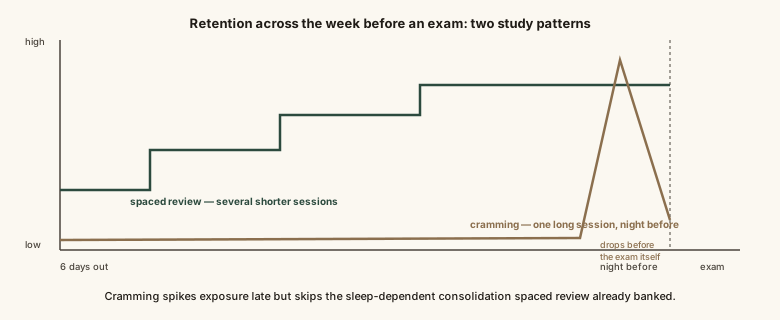
The cram line spikes higher right before the drop — which is exactly why it feels like it's working in the moment, even as it's about to fall off before the exam itself.
Common mistakes
Common Mistakes
Sacrificing a full night of sleep for a few extra hours of late review before an exam.
→ Protect at least a normal amount of sleep the night before an exam — treat it as part of studying, since it's when consolidation of that day's material happens.
Cramming several closely related, similar concepts back-to-back in one short session.
→ Space out similar material where possible, and if a late session is unavoidable, prioritize reviewing distinct, well-separated topics rather than tightly clustered similar ones.
Mistaking strong recognition during a late-night cram session for durable, exam-day retrieval ability.
→ Test retrieval the next morning, not just the night of studying — recall that survives a night's sleep is a better signal of what will hold up on exam day.
Common misconception
“If you're going to cram anyway, staying up as late as possible to review more material is always worth the extra sleep lost.”
Sleep isn't just downtime between study sessions — a substantial share of memory consolidation, the process that turns a freshly studied fact into something reliably retrievable later, happens during sleep itself. Cutting sleep short to gain a few more hours of review trades a process actively converting recent studying into durable memory for more raw exposure that hasn't had time to consolidate. Past a certain point, the lost consolidation and added interference between crammed facts can cost more retrieval reliability than the extra hours of review add, especially for material requiring you to distinguish between similar concepts under exam pressure.
What to do next
What to do next
- Set a firm cutoff time for studying the night before an exam that protects a normal amount of sleep, and treat that cutoff as non-negotiable.
- If a late review session is unavoidable, prioritize distinct topics over tightly clustered similar ones, to reduce interference between freshly studied facts.
- The next morning, test your recall of what you studied the night before rather than trusting how well it felt learned at the time.
- Read How Spaced Repetition Actually Works next to build a study pattern that reduces how much last-minute cramming feels necessary in the first place.