 KnowThis
Key Takeaways
Key Takeaways
- 1In most skills, a small subset of sub-skills accounts for a disproportionate share of real-world use — front-loading practice there gets you functional fastest.
- 2The rule describes a skewed usage distribution, not a fixed 20%/80% split or an effort shortcut — the actual ratio varies by skill and doesn't mean 20% of the work delivers full competence.
- 3The heuristic only helps where usage really is skewed; skills where components get used close to equally don't have a small high-leverage subset to prioritize.
The concept
Once the skewed-distribution mechanism is visible, the practical move follows: find out which sub-skills actually get used most in the real activity, and front-load practice there before spreading into rarer material.
What does the 80/20 rule actually describe when applied to learning a skill?
Worked examples
Example 1: High-frequency vocabulary in a new language (baseline case)
A learner starting a new spoken language focuses early study time on the few hundred to few thousand most common words and a handful of core grammar patterns, rather than spreading effort evenly across the full dictionary. Because that small set covers the large majority of everyday conversation, the learner reaches functional conversational ability much faster than someone who studies vocabulary in alphabetical order or at random.
Why does focusing early study time on high-frequency vocabulary speed up functional conversational ability?
Example 2: A skill with a flat usage distribution (edge case / variation)
A student preparing for an exam that tests the full periodic table equally can't apply the 80/20 heuristic the same way — there's no small subset of elements that gets tested disproportionately more than the rest. Because the "usage" (in this case, exam weighting) is close to uniform across all the content, prioritizing any particular 20% doesn't meaningfully reduce the amount of material that has to actually be learned.
Why doesn't the 80/20 heuristic help much for a topic like memorizing an entire periodic table for an exam that tests it evenly?
Example 3: Learning a programming language for real projects (real-world / applied case)
A self-taught programmer front-loads mastery of a small core set of language constructs and commonly used library functions — the handful of tools that show up in the large majority of everyday code. That lets them start building real small projects well before they've learned the language's full breadth of advanced syntax and rarely used features. Reaching professional-level fluency, including the less-common edge cases, still requires working through that long tail eventually — the shortcut is in the order, not in the total amount left to learn.
In the programming example, what does front-loading the core, commonly used constructs actually buy the learner?
How it works (visual)
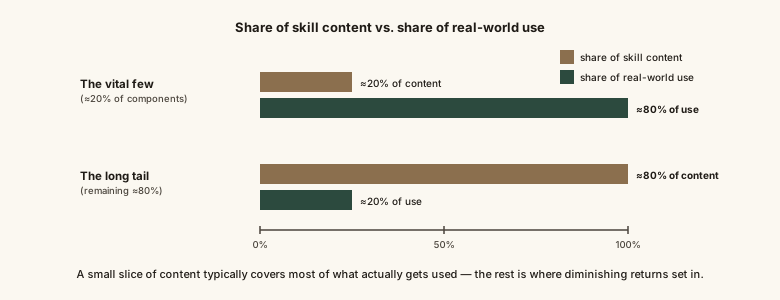
The gap between the two bar pairs is the whole argument for prioritizing: the same hour of practice is worth far more when it's spent on the vital few than on the long tail.
Common mistakes
Common Mistakes
Treating 80/20 as a literal, fixed ratio to hit for every skill.
→ Use it as a prioritization heuristic — look for whichever subset of content is genuinely used most, whatever the actual split turns out to be.
Assuming 20% of the total work delivers full competence, and stopping entirely once things feel functional.
→ Decide what your actual goal requires — hobby-level function and professional-level depth call for different amounts of the long tail — before deciding where to stop.
Guessing which subset is high-leverage instead of checking real usage data or asking someone experienced.
→ Look at actual frequency data, common curricula, or what experienced practitioners say gets used most, rather than assuming based on what feels important.
Common misconception
“The 80/20 rule means you can become good at a skill by only doing 20% of the total work.”
The rule describes which subset of a skill's content gets used most in the real world — it identifies where to focus first for the fastest functional payoff, not a way to shrink the total amount of effort a skill requires. Reaching basic functional competence with the vital few is genuinely faster than studying everything in an arbitrary order, but going from "functional" to advanced or professional-level tends to be exactly where the disproportionate remaining effort goes, since that's the long tail the heuristic sets aside for later. The actual ratio also varies a lot by skill and is a rough pattern from a skewed usage distribution, not a precise, universal law.
Try it yourself
Using a simple diminishing-returns learning-curve model, estimate how many practice hours it takes to reach a target proficiency level, given a 'characteristic learning rate' for that skill (roughly, the hours it takes to close about 63% of the remaining gap to full proficiency).
A simplified illustrative model, not a measured prediction for any specific skill — real learning curves vary by person, method, and domain.
Try it with a target of 80% versus 99% using the same learning rate — the jump in required hours for that last stretch is the diminishing-returns pattern behind the 80/20 heuristic made concrete.
What to do next
What to do next
- Define what 'functional' means for your specific goal before deciding how deep you actually need to go.
- Find real usage-frequency data, or ask an experienced practitioner which sub-skills come up most often in real use.
- Front-load practice time on that high-leverage subset before spreading into rarer material.
- Once you reach functional competence, deliberately decide whether your goal justifies pushing further into the long tail.