 KnowThis
Key Takeaways
Key Takeaways
- 1Deliberate practice targets a specific weakness just past current ability, paired with immediate, specific feedback and a correction before the next attempt.
- 2Ordinary repetition without that feedback loop tends to reinforce whatever pattern is already being used, errors included, which is why hours logged doesn't reliably predict improvement.
- 3Deliberate practice is mentally demanding and requires a task with a real standard to compare against and a real feedback source — not every activity or every long stretch of time supports it.
The concept
Once the feedback-loop mechanism is visible, the practical difference is concrete: identify a specific weakness, set a difficulty just past current ability, get feedback close in time to the attempt, and correct before repeating — rather than running the whole skill at a comfortable pace and hoping repetition alone closes the gap.
What is the core mechanism that makes deliberate practice different from ordinary repetition?
Worked examples
Example 1: Two piano students, same hours (baseline case)
Two students practice the same piece for the same number of hours. The first plays it front to back repeatedly, at a pace they can already manage. The second isolates the specific measure they keep getting wrong, slows it down below performance speed, works it with a metronome until it's consistently correct, then gradually brings it back up to speed. After the same total practice time, the second student has closed the specific gap; the first has mostly reinforced the version with the error still in it.
Why does the second student improve on the trouble spot faster despite practicing the same total hours as the first?
Example 2: Deliberate practice without rest (edge case / variation)
A call-center trainee tries to deliberately practice difficult calls for eight hours straight with no breaks, aiming to maximize improvement by maximizing time spent. By the later hours, concentration drops, feedback stops being processed carefully, and performance on later calls actually degrades compared to the morning session. Deliberate practice is mentally demanding specifically because it requires sustained close attention to feedback — without recovery, the feedback loop itself starts to break down even though the trainee is technically still "practicing."
Why does the trainee's performance degrade in the later hours of an unbroken eight-hour practice stretch?
Example 3: A programmer targeting a real weak spot (real-world / applied case)
A self-taught programmer notices they consistently struggle with a specific category of algorithm problems. They deliberately work through a curated set of graded problems just above their current level, checking their approach against a correct solution immediately after each attempt and adjusting before moving to the next problem. A peer with the same years of experience writes routine, similar-difficulty code daily without ever targeting that specific weak spot. After a year, the first programmer has closed the gap and taken on harder work; the second has the same years of experience but a similar blind spot to where they started.
What best explains why the first programmer closes their weak spot while the second doesn't, despite similar years of experience?
How it works (visual)
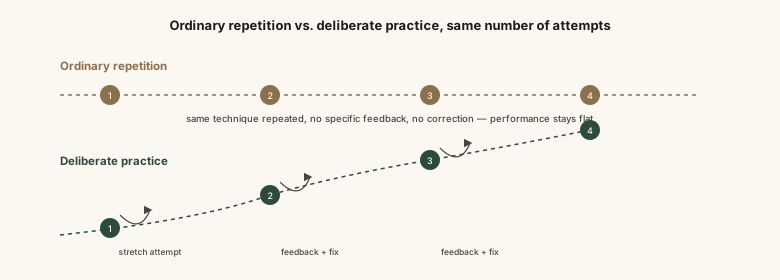
Both tracks show the same number of attempts — the difference in outcome comes entirely from whether each attempt is followed by specific feedback and a correction.
Common mistakes
Common Mistakes
Assuming more total hours of practice automatically means more improvement.
→ Check whether each practice session includes a specific stretch target and feedback close enough in time to correct the next attempt — hours without that loop tend to plateau.
Practicing only what's already comfortable instead of isolating the specific weak point.
→ Identify the exact error or gap first, then set the difficulty just past what you can currently do reliably.
Scheduling long, unbroken practice marathons expecting maximum gains from maximum time.
→ Keep deliberate practice sessions short and high-concentration, with real rest between them — sustained close attention to feedback is what the method depends on.
Common misconception
“Practice makes perfect, regardless of how you practice.”
Repetition without a specific target and specific feedback tends to reinforce whatever pattern is already being used, errors included, rather than correcting it — you get more consistent at doing the task the way you're already doing it, not necessarily more correct. Improvement tracks with practice that includes a stretch target just past current ability, feedback close in time to the attempt, and a correction before the next repetition — not simply with raw hours logged. This is also why two people can log the same number of hours on a skill and end up at noticeably different levels.
What to do next
What to do next
- Identify one specific weakness in the skill, rather than practicing the whole skill broadly.
- Set the next attempt just past your current reliable ability — hard enough to expose the error, not so hard it can't be attempted.
- Find or build a feedback source that can tell you, close in time to the attempt, exactly what went wrong.
- Keep sessions short and focused, with real rest between them, rather than stretching practice across long unbroken blocks.