 KnowThis
Key Takeaways
Key Takeaways
- 1Spaced repetition works by timing review sessions to land right before you're about to forget something, not at random or fixed daily intervals.
- 2Each successful recall makes the next forgetting curve flatter, which is why review intervals grow over time — a fact remembered easily gets reviewed less often, not more.
- 3Cramming builds short-term familiarity but skips the retrieval effort that actually strengthens long-term memory, which is why crammed material fades within days.
The concept
Once the timing mechanism is visible — review just before forgetting, not on a fixed schedule — it explains why spaced repetition feels harder in the moment than rereading, and why that difficulty is exactly the point.
Why does reviewing material immediately after first learning it help less than reviewing it a few days later?
Worked examples
Example 1: A single flashcard's growing intervals (baseline case)
Example 2: A missed review resets the interval (edge case / variation)
A flashcard that was on a 14-day review interval gets answered incorrectly. What should happen to its next interval?
Example 3: Preparing for a licensing exam months out (real-world / applied case)
Someone studying for an exam six months away starts reviewing core material early and spaces reviews out as they succeed, rather than saving everything for the final two weeks. By the time the exam arrives, the highest-value facts have been through five or six spaced reviews each, at exactly the intervals where they were starting to fade — producing durable recall under exam pressure, instead of the shallow familiarity that a two-week cram session produces and that tends to collapse under time pressure or stress.
Why does starting spaced review six months before an exam tend to outperform an intensive two-week cram session at the end, even with similar total study hours?
How it works (visual)
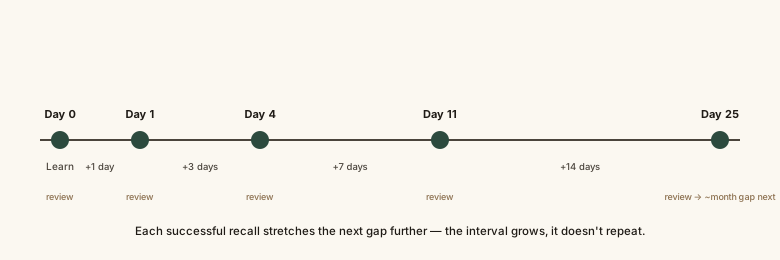
The growing gaps aren't arbitrary — each one reflects a system re-estimating how long a memory will hold, based directly on the last review's outcome.
Common mistakes
Common Mistakes
Reviewing everything every day 'to be safe.'
→ Trust the growing intervals — reviewing material you already recall easily wastes time that could go toward material actually at risk of being forgotten.
Treating a missed review as a failure to fix by cramming it repeatedly in one sitting.
→ Let the interval reset and rebuild gradually — repeated same-day review after a miss produces the same shallow familiarity cramming does.
Starting spaced repetition too close to a deadline for the intervals to actually stretch out.
→ Start as early as realistically possible — the long-interval reviews that build the strongest memory only happen if there's enough calendar time left for them.
Common misconception
“Spaced repetition just means studying a little bit every day instead of all at once.”
Daily review is only part of it, and often the wrong part once a memory is strong. The actual mechanism is variable timing tied to individual performance — easy recalls get pushed further apart, hard ones get pulled closer together. A flashcard app that reviews every card every day regardless of how well you know it isn't really using spaced repetition; it's just repetition.
Try it yourself
A simplified version of the ease-factor scheduling many spaced-repetition tools use.
What to do next
What to do next
- For any material you need to retain long-term, schedule your first review 1–2 days after first learning it, not the same day.
- When a review feels easy, let the interval stretch further rather than reviewing it again soon out of caution.
- When a review fails, don't panic-review it repeatedly — let it reset to a short interval and rebuild naturally.
- Read The Forgetting Curve Explained next to see the underlying decay pattern spaced repetition is designed around.