 KnowThis
Key Takeaways
Key Takeaways
- 1The forgetting curve shows retention dropping fastest in the hours right after learning, then leveling off — most of what you'll forget, you forget quickly.
- 2Each time you successfully relearn something, the next forgetting curve for that same material starts flatter and decays slower.
- 3The curve is the direct reason review timing matters: reviewing before the steep drop wastes effort, and reviewing after the drop means relearning from a bigger loss than necessary.
The concept
Once the shape is visible — steep, then flattening, then reset flatter with each relearning — the practical advice built around it (review early, review before the steep part hits) stops sounding arbitrary.
According to the forgetting curve, when does the largest share of memory loss for newly learned material typically occur?
Worked examples
Example 1: A single unreviewed fact (baseline case)
Example 2: The same fact, reviewed once before the steep drop (edge case / variation)
Why is a review timed to hit right before the steep part of the forgetting curve more valuable than the same review done a week later, after the curve has already flattened?
Example 3: Comparing two study plans for a certification exam (real-world / applied case)
Two people study the same 100 facts for a certification exam eight weeks out. One reviews everything once, in week one, and doesn't touch it again until the exam. The other reviews the material multiple times, spaced to land near where each fact's individual forgetting curve was about to drop steeply. By exam week, the first person is relearning most of the material almost from scratch, since their single early review did nothing to flatten the ongoing decay. The second person's facts have each been reset several times at a flatter and flatter slope, so far less has actually been lost by exam day, even though both people may have spent comparable total hours studying.
Two students spend the same total number of hours studying for an exam eight weeks out, but distribute that time differently. Why would the one who reviews material multiple times, spaced across the eight weeks, likely retain more by exam day than the one who reviews everything once early on?
How it works (visual)
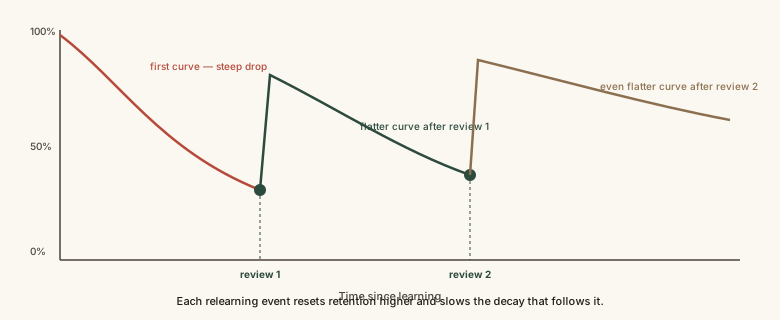
Notice each new curve after a review doesn't just start higher — it's also flatter than the one before it. That flattening, not just the reset itself, is what makes repeated spaced review compound over time.
Common mistakes
Common Mistakes
Assuming forgetting happens at a steady, even rate over time.
→ Remember the curve is steepest right after learning — the first day matters disproportionately more than any single day weeks later.
Skipping an early review because the material still 'feels' fresh.
→ Feeling fresh doesn't mean the steep-decay window has passed — an early review, even before it feels necessary, is what prevents the sharpest losses.
Treating one review as 'done' regardless of how much time has passed since.
→ Each review only flattens the curve that follows it — a single review doesn't prevent forgetting indefinitely, it delays and slows the next round of decay.
Common misconception
“If you learned something well the first time, you shouldn't need to review it again.”
Even well-learned material follows a forgetting curve — "learning it well" affects how flat the curve starts, not whether one exists at all. Skipping review because initial learning felt solid is exactly how strongly-learned material still quietly fades within days, since the steep part of the curve doesn't care how confident the learner felt at the time.
Try it yourself
A simplified exponential model: retention = e^(-time elapsed / memory strength). Higher memory strength means slower decay.
What to do next
What to do next
- Schedule a first review within a day of learning something you need to keep, since that's where the steepest loss otherwise happens.
- Don't judge whether you need to review based on how confident you currently feel — schedule review based on elapsed time instead.
- After each successful review, notice the material feels easier to hold onto — that's the flattened curve, and it's real evidence the next interval can stretch further.
- Read How Spaced Repetition Actually Works next to see how review timing is scheduled systematically around this exact curve.