 KnowThis
Key Takeaways
Key Takeaways
- 1Rereading builds recognition — the sense that something looks familiar — which is a weaker and less durable form of memory than being able to produce the answer unprompted.
- 2Active recall works by forcing the brain to reconstruct information from memory, and that reconstruction effort is what strengthens the memory trace.
- 3Active recall feels harder and slower than rereading in the moment, which is exactly why people underuse it despite it outperforming rereading in study after study.
The concept
Once the difference is framed as recognition versus retrieval, it explains why students can reread a chapter and still blank on an exam question covering the exact same material.
Why does rereading notes often feel more effective in the moment than it actually is for long-term retention?
Worked examples
Example 1: Studying a single term (baseline case)
Example 2: A recall attempt that fails (edge case / variation)
A student attempts to recall a definition from memory, gets it wrong, then immediately checks the correct answer. Was the failed attempt still useful?
Example 3: Preparing for a professional certification exam (real-world / applied case)
Someone preparing for a certification exam spends a week rereading their entire study guide twice, then switches strategy for the second week to closing the book and writing out practice answers from memory before checking them. In practice runs, the recall-based week tends to reveal real gaps — topics that felt familiar while reading but couldn't actually be reproduced — while the rereading week mostly reinforced confidence rather than tested it. Surfacing those gaps before the actual exam, rather than during it, is exactly what active recall is positioned to catch and rereading tends to miss.
Why might switching from a week of rereading to a week of active recall (writing answers from memory, then checking) reveal gaps that felt 'covered' during the rereading week?
How it works (visual)
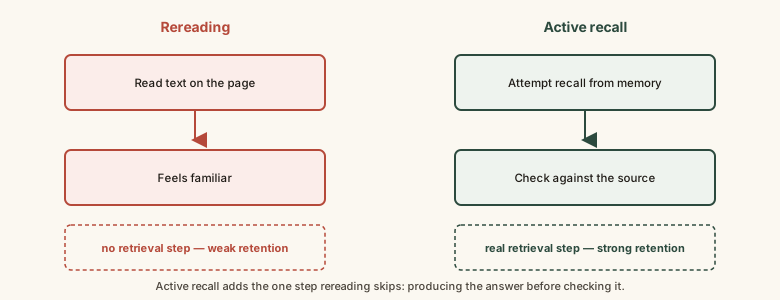
The core structural difference is a missing step: rereading never asks the brain to produce anything, it only asks it to recognize what's already on the page.
Common mistakes
Common Mistakes
Highlighting or rereading notes multiple times and treating it as equivalent to studying.
→ Convert rereading into a self-test: cover the notes, try to state the material from memory, then check — the checking step is where rereading alone falls short.
Avoiding active recall because it feels slower and less confidence-building than rereading.
→ Expect it to feel harder — that difficulty is the retrieval effort doing its job, not a sign the method is working worse.
Using active recall for material that hasn't been learned yet at all.
→ Use rereading or initial instruction for genuinely new material first, then switch to active recall once there's something in memory worth testing.
Common misconception
“If material feels easy and familiar when you review it, you must know it well.”
Familiarity is a weak signal — it reflects recognition of the text, not the ability to produce the answer unprompted. This gap, known as the fluency illusion, is exactly why students who reread confidently can still freeze on a real test question covering the same material. The only reliable way to check actual retention is to attempt recall without the source in front of you.
What to do next
What to do next
- After a first read-through of new material, close the source and try to summarize or answer questions on it from memory before checking.
- Treat a wrong or incomplete recall attempt as useful information, not a failure — it shows exactly where to focus the next review.
- Reserve rereading for genuinely new material on first exposure, not as the main review method for anything you've already studied once.
- Read How Spaced Repetition Actually Works next to see how to time these recall attempts for maximum retention.