 KnowThis
Key Takeaways
Key Takeaways
- 1The three common note-taking methods differ mainly in the structure they impose: Cornell separates content from review cues, outline captures strict hierarchy, and mind mapping captures non-linear relationships.
- 2A method fails not because it's inherently bad, but because its structure doesn't match the shape of the material — a strict hierarchy forced onto interconnected ideas loses the connections.
- 3None of these methods automatically produce retention on their own — they organize information for later review, but the review itself still has to happen (ideally through active recall) to actually build memory.
The concept
Once note-taking methods are separated into "how is content organized" versus "how is content set up for review," it becomes clear why comparing them as if only one can be "the best" method misses the point.
Why might the outline method feel unhelpful when taking notes on a topic where ideas connect to each other in multiple, non-linear directions?
Worked examples
Example 1: Outlining a clearly hierarchical topic (baseline case)
Example 2: Forcing an interconnected topic into an outline (edge case / variation)
Why does an outline format tend to break down when notes involve several factors that influence each other in a loop, rather than a strict top-to-bottom hierarchy?
Example 3: Preparing lecture notes for exam review using Cornell (real-world / applied case)
A student takes lecture notes in the main Cornell column during class, using whatever internal structure fits the material (sometimes outline-style, sometimes a rough diagram). After class, they fill in the narrow cue column with review questions based on the notes — not answers, just prompts. Weeks later, before an exam, they cover the main notes column, read only the cue questions, and try to answer each one from memory before checking. The Cornell structure didn't change how the original content was organized — it added a built-in active-recall review layer on top of whatever structure the content itself had.
What is the specific role of the narrow cue column in the Cornell note-taking method?
How it works (visual)
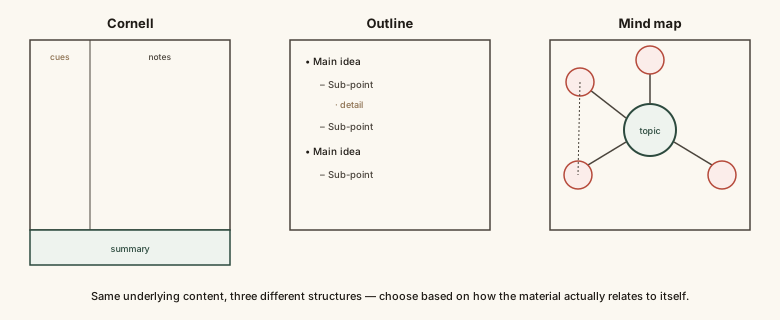
None of these three structures is more "correct" in general — each fits a different shape of material, and the same course could reasonably use all three depending on the topic that week.
Common mistakes
Common Mistakes
Picking one note-taking method and forcing every topic into it regardless of the material's actual structure.
→ Match the method to the material — hierarchical content fits an outline, interconnected content fits a mind map, and either can be wrapped in a Cornell layout for the review benefit.
Treating note-taking itself as the study step, rather than a preparation step for later review.
→ Plan an actual review session using the notes, ideally through active recall (like the Cornell cue column), rather than assuming the act of writing notes alone builds retention.
Assuming a visually elaborate mind map is automatically more effective than a simple outline.
→ Effectiveness depends on fit to the material, not visual complexity — a simple outline on genuinely hierarchical material will outperform an over-elaborated mind map on the same content.
Common misconception
“There's one universally 'best' note-taking method, and everyone should switch to it.”
Research and practical use both point the other way: the best method depends on the structure of the material being studied, not a fixed ranking of methods. A student who only ever outlines will struggle with genuinely interconnected topics, and one who only ever mind-maps will lose useful hierarchy on genuinely sequential topics. Flexibility across methods, not loyalty to one, is what actually helps.
What to do next
What to do next
- Before your next note-taking session, ask whether the material is more hierarchical (favor an outline) or more interconnected (favor a mind map).
- Try adding a Cornell-style cue column to your existing notes format, regardless of which structure you use for the main content.
- Schedule an actual review session using your notes — ideally testing yourself with active recall — rather than treating note-taking alone as complete.
- Read Active Recall vs. Rereading next to see how to turn any of these note formats into an effective review session.