 KnowThis
Key Takeaways
Key Takeaways
- 1The Pomodoro Technique breaks work into short, fixed intervals (traditionally 25 minutes) with a mandatory break after each one, rather than working until you feel tired.
- 2Its real mechanism is managing attention fatigue and task switching, not just time-boxing work — the breaks are scheduled recovery, not a reward.
- 3A short interval lowers the psychological barrier to starting a task, which is why it's especially effective against procrastination on tasks that feel large or unpleasant.
The concept
Once the mechanism is framed as fatigue management rather than a scheduling trick, it explains why the breaks are non-negotiable, not optional padding around the "real" work.
Why are the short breaks in the Pomodoro Technique considered a required part of the method rather than optional?
Worked examples
Example 1: A single work session (baseline case)
Example 2: An interruption mid-interval (edge case / variation)
A Pomodoro interval gets interrupted by a genuine urgent question from a colleague. What does the technique suggest doing?
Example 3: Studying for multiple subjects in one evening (real-world / applied case)
A student has three subjects to study in one evening. Instead of vaguely dividing the evening into three loosely-bounded chunks, they run six Pomodoros total, two per subject, with a 5-minute break after each and a longer break after the first four. Splitting each subject into two separate, single-task intervals rather than one long block also creates a natural spacing effect between the two study sessions on the same subject, since other material gets studied in between — layering a secondary benefit on top of the primary fatigue-management one.
Why might splitting study time for one subject into two separate Pomodoro intervals, with other subjects studied in between, provide a benefit beyond just managing attention fatigue?
How it works (visual)
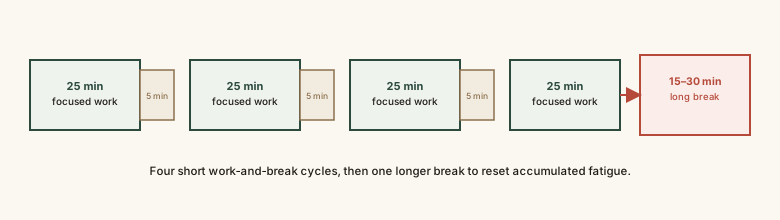
The longer break after four intervals matters as much as the short ones between them — it's recovery scaled to accumulated fatigue across the whole cycle, not just the most recent interval.
Common mistakes
Common Mistakes
Skipping breaks to keep working when 'in the zone.'
→ If genuinely in flow on deep work, that's a legitimate reason to extend the interval deliberately — but skipping breaks routinely just because stopping feels inconvenient defeats the fatigue-management purpose.
Trying to fit multiple unrelated tasks into a single Pomodoro interval.
→ Keep each interval single-task — mixing tasks within one interval reintroduces the task-switching cost the technique is designed to avoid.
Treating the 25-minute number as fixed and non-negotiable for every kind of work.
→ Adjust interval length to the type of task — some deep work genuinely benefits from longer uninterrupted stretches, as long as a real, planned break still follows.
Common misconception
“The Pomodoro Technique is just a scheduling gimmick — any timer would work the same way.”
The specific structure matters. A generic timer without the single-task rule and the mandatory break doesn't address the actual mechanism at play, which is attention fatigue and the cost of task switching. It's the combination — bounded focus on one task, plus scheduled recovery — that produces the effect, not the act of timing something in general.
Try it yourself
What to do next
What to do next
- Pick one task you've been avoiding and commit to a single 25-minute interval on it, nothing more, to see if the smaller commitment lowers the barrier to starting.
- Actually take the short break when the timer rings, rather than pushing through — treat it as required recovery, not optional.
- For deep, hard-to-restart work, try a longer interval (45–90 minutes) while keeping the same principle: a planned interval followed by a real break.
- Read How Procrastination Actually Works next to see why smaller, bounded commitments are especially effective against task avoidance.