 KnowThis
Key Takeaways
Key Takeaways
- 1Time blocking assigns each task a specific slot on a calendar, while a plain task list only shows what needs doing without saying when there's actually time for it.
- 2The calendar constraint forces a realistic check: a day only has so many hours, and blocking tasks into it exposes overcommitment that a list can hide indefinitely.
- 3Leaving deliberate buffer time between blocks matters as much as the blocks themselves — a fully packed schedule with no slack collapses the moment one task runs long.
The concept
Once a list becomes a set of calendar commitments, the same overcommitment that's invisible on paper becomes impossible to ignore — there's simply no more room on the calendar to hide it in.
Why does time blocking tend to surface overcommitment that a plain to-do list can hide?
Worked examples
Example 1: Converting a task list into blocks (baseline case)
Example 2: A fully packed schedule with zero buffer (edge case / variation)
A time-blocked schedule with no buffer time between tasks falls apart after the first task runs 15 minutes late. What does this demonstrate?
Example 3: Protecting deep-focus work on a busy calendar (real-world / applied case)
Someone with a calendar full of meetings notices their actual project work never happens, because it has no fixed slot and gets pushed aside whenever a meeting request comes in. Applying time blocking, they proactively block a recurring 90-minute slot for focused project work each morning, treating it with the same protection as a meeting — visible on the shared calendar, not casually overridden. Because the block occupies real calendar space, it competes on equal footing with meeting requests instead of losing by default the way an unscheduled task always does.
Why does blocking a recurring slot for focused work on a shared calendar protect it more effectively than simply intending to 'find time' for it during the week?
How it works (visual)
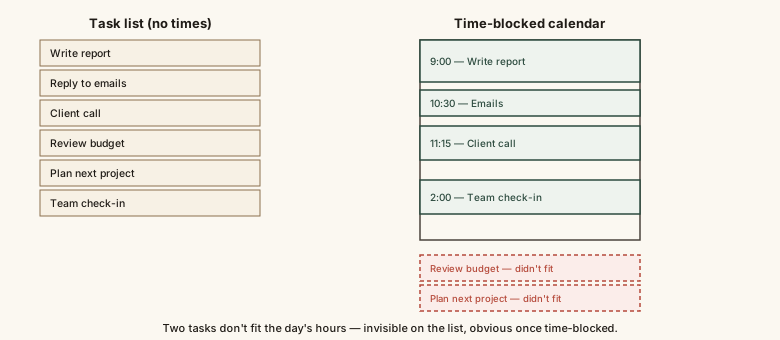
The two unplaced tasks on the right are the point of the exercise — that mismatch was invisible on the plain list, and only became visible once the tasks had to compete for real calendar space.
Common mistakes
Common Mistakes
Packing every minute of the calendar with zero buffer time between blocks.
→ Leave deliberate gaps (10–15 minutes is common) between blocks so a normal overrun doesn't cascade through the rest of the day.
Estimating task durations optimistically instead of realistically.
→ Base block lengths on how long similar tasks have actually taken before, not on how long you'd like them to take.
Treating a time-blocked schedule as unchangeable once set.
→ Adjust blocks as the day unfolds — the goal is a realistic plan, not a rigid one that ignores what's actually happening.
Common misconception
“Time blocking is just a to-do list with times written next to each item.”
The difference isn't cosmetic. A to-do list with times still lets every item coexist regardless of whether the day can actually hold them all. Time blocking places each task into a single, exclusive slot on a calendar with a hard total limit — the exclusivity and the limit are what force a realistic reckoning with available time, which a list with times attached still doesn't provide.
What to do next
What to do next
- Take tomorrow's task list and assign each item a realistic start and end time on your actual calendar, based on how long similar tasks have taken before.
- Leave at least 10–15 minutes of buffer between blocks rather than scheduling back-to-back with no gaps.
- Notice any tasks that don't fit anywhere on the calendar — that's real information about overcommitment, not a scheduling inconvenience to work around.
- Read The Eisenhower Matrix Explained next to decide which tasks deserve a protected block versus which should be delegated or cut entirely.