 KnowThis
Key Takeaways
Key Takeaways
- 1The two-minute rule says any task under roughly two minutes should be done immediately, not added to a list, because tracking it usually costs more effort than finishing it.
- 2The rule specifically targets tracking overhead — the mental cost of capturing, storing, and later re-evaluating a small task — not the task's execution time alone.
- 3It's meant for genuinely small, standalone actions, not as an excuse to squeeze in quick pieces of a much larger task that actually deserves proper planning.
The concept
Once the rule is understood as targeting tracking overhead rather than just execution time, it explains why it applies specifically to small, standalone tasks and not to quick pieces of bigger projects.
Why does the two-minute rule recommend doing a small task immediately rather than adding it to a to-do list?
Worked examples
Example 1: A quick standalone reply (baseline case)
Example 2: A quick piece of a larger project (edge case / variation)
A five-minute edit needed on a larger, still-in-progress report comes to mind while working on something else. Why might the two-minute rule not apply here, despite the edit itself being short?
Example 3: Clearing a backlog of small administrative tasks (real-world / applied case)
Someone opens their inbox to find fifteen small, unrelated administrative tasks — confirming a receipt, updating a contact detail, approving a minor request — each individually well under two minutes. Applying the rule, they work through the list knocking out each one on the spot rather than flagging all fifteen for later, and finish the entire batch in under twenty minutes. Had each one instead been added to a task backlog for later, the combined tracking overhead across fifteen separate small items would likely have taken longer than just clearing them immediately, on top of leaving a lingering sense of unfinished obligation.
Why does applying the two-minute rule to a batch of fifteen small administrative tasks tend to be more efficient than deferring all of them to a task list for later?
How it works (visual)
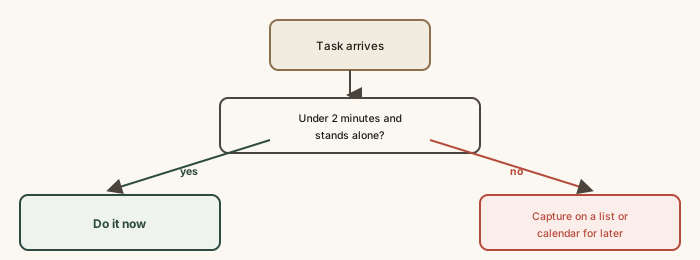
The rule works precisely because it's a cheap, fast filter applied once per task — deciding takes only a moment, and it prevents small tasks from ever accumulating tracking overhead in the first place.
Common mistakes
Common Mistakes
Applying the rule to a quick piece of a much larger, in-progress project.
→ Check whether the task is genuinely standalone — if it's part of a bigger project, defer it to be handled with proper focus alongside the rest, even if that one piece is short.
Using the rule as an excuse to constantly interrupt focused work for small unrelated tasks.
→ Apply the rule during natural transition points or dedicated small-task batches, not as a justification for breaking concentration on deep work whenever a minor task comes to mind.
Overestimating how long a task will 'really' take to avoid doing it immediately.
→ Be honest about the estimate — the rule only works if 'two minutes' is applied accurately, not stretched to rationalize deferring something that's genuinely quick.
Common misconception
“The two-minute rule means you should do every small task the instant it comes up, no matter what else you're doing.”
The rule is about avoiding unnecessary tracking overhead for genuinely small, standalone tasks — it isn't a license to interrupt focused work on something bigger every time a minor task crosses your mind. Applied during natural breaks or a dedicated pass through a list of small items, it's efficient; applied as constant interruption to deep work, it undermines the very focus that deep work depends on.
What to do next
What to do next
- Next time a small, standalone task comes up during a natural break, ask whether it genuinely takes under two minutes — if so, just finish it instead of listing it.
- During a dedicated inbox or task-list review, apply the rule as a triage filter: anything genuinely quick, do immediately; everything else, plan properly.
- Watch for the edge case: don't apply the rule to quick pieces of a larger project you're actively focused on elsewhere.
- Read How Procrastination Actually Works next to see why lowering the barrier to starting a task, which this rule effectively does for small tasks, matters so much.