 KnowThis
Key Takeaways
Key Takeaways
- 1Procrastination isn't primarily a time-management or discipline failure — psychological research frames it as short-term mood repair, avoiding the discomfort a task triggers right now.
- 2Present bias explains why people who fully understand a delay will make things worse still delay anyway — immediate relief is weighted more heavily than a future cost, even a predictable one.
- 3Because the driver is emotional avoidance, not information, most effective countermeasures target the emotional barrier to starting, not just better scheduling or more willpower.
The concept
Once procrastination is framed as emotional avoidance rather than a scheduling or willpower failure, it explains why purely logistical fixes — better planners, stricter deadlines alone — often fail without also addressing the emotional trigger.
Why does someone who fully understands that delaying a task will make things worse still procrastinate anyway?
Worked examples
Example 1: Avoiding a task that triggers self-doubt (baseline case)
Example 2: A task-specific pattern, not a general trait (edge case / variation)
A person procrastinates heavily on one specific task but is reliably prompt on most others. What does this pattern suggest about the cause of their procrastination?
Example 3: Addressing the emotional barrier directly (real-world / applied case)
Someone repeatedly delays starting a difficult conversation with a colleague, despite knowing the delay is making the underlying issue worse. Instead of relying purely on willpower or a stricter deadline, they address the actual barrier — anxiety about the conversation going poorly — by preparing a short, specific opening line in advance, which lowers the emotional activation cost of starting. Once the barrier to starting is smaller, the same task that was avoided for weeks gets initiated far more easily, since the fix targeted the actual mechanism (emotional discomfort at the point of starting) rather than just adding more external pressure.
Why might preparing a short, specific opening line in advance help someone finally start a conversation they've been procrastinating on, more effectively than simply setting a stricter deadline?
How it works (visual)
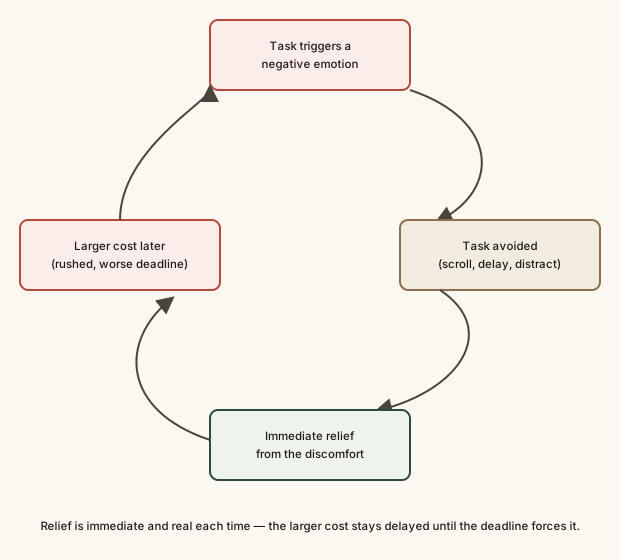
The loop repeats because the relief is real and immediate every time, while the larger cost is delayed and abstract until the deadline actually arrives — an asymmetry that keeps favoring avoidance in the moment.
Common mistakes
Common Mistakes
Treating procrastination purely as a scheduling or willpower problem.
→ Identify the specific negative emotion the task triggers (boredom, self-doubt, anxiety) and address that barrier directly, alongside any scheduling fix.
Assuming procrastination on one task means a general character flaw.
→ Notice whether the delay is task-specific — if so, look for what's different about that particular task rather than treating it as a fixed personal trait.
Relying only on stricter deadlines without lowering the discomfort of starting.
→ Pair any deadline pressure with something that reduces the actual barrier to starting, like breaking the task into a smaller, less intimidating first step.
Common misconception
“People who procrastinate are just lazy or bad at managing their time.”
Procrastination research consistently points to emotional avoidance, not a general character flaw or a pure information/skill gap, as the primary driver. The same person can be highly disciplined on tasks that don't trigger discomfort and still reliably delay a specific task that does — a pattern a "laziness" framing doesn't explain, but an emotional-avoidance framing does.
What to do next
What to do next
- Next time you notice yourself delaying a specific task, name the emotion it's actually triggering (boredom, anxiety, self-doubt) rather than labeling it as laziness.
- Lower the barrier to starting by breaking the task into a smaller, less intimidating first action, rather than relying on willpower alone.
- Notice which tasks you don't procrastinate on — the contrast is useful evidence about what's specifically different about the ones you do delay.
- Read The Two-Minute Rule Explained next for a small, concrete technique aimed directly at lowering the barrier to starting.