 KnowThis
Key Takeaways
Key Takeaways
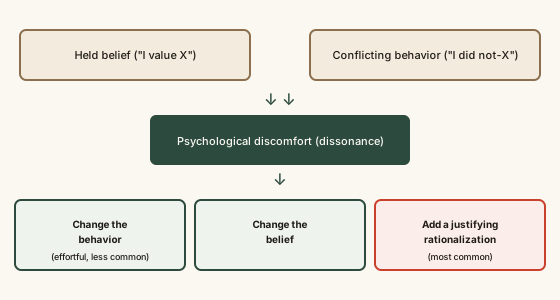
- 1Cognitive dissonance is the real psychological discomfort of holding two contradictory beliefs, or acting against a belief you hold about yourself.
- 2The mind is motivated to resolve that discomfort, but often does so by changing the belief or adding a justification — not by changing the behavior.
- 3Recognizing the feeling in the moment is what makes it possible to choose a more honest resolution instead of an automatic rationalization.
The concept
This is also why simply pointing out a factual contradiction to someone rarely changes their mind on the spot — the discomfort of the contradiction is often resolved by defending or rationalizing the existing belief rather than by updating it.
Someone who values healthy eating orders fast food regularly, then starts telling themselves 'one meal doesn't really matter' more often than before. What is this pattern an example of?
Worked examples
Example 1: Justifying a costly decision after the fact (baseline case)
Example 2: Actually changing behavior instead of rationalizing (edge case / variation)
Example 3: Dissonance in a workplace decision (real-world / applied case)
Per cognitive dissonance theory, why do people commonly resolve dissonance through rationalization rather than by changing their actual behavior?
How it works (visual)
Common mistakes
Common Mistakes
Assuming a changed opinion always reflects new evidence rather than discomfort-driven rationalization.
→ Notice when a belief shifted right after a conflicting decision or action — that timing is a signal worth examining honestly.
Expecting a factual correction alone to change someone's mind.
→ Recognize that pointing out a contradiction can trigger rationalization instead of belief change, especially if the existing belief is tied to self-image.
Treating the discomfort of dissonance as a signal to silence quickly, rather than a signal worth examining.
→ Pause on the discomfort long enough to consider whether changing the behavior, not just the belief, is the more honest resolution.
Common misconception
“Cognitive dissonance means simply feeling conflicted or unsure about a decision.”
Per the APA's definition, cognitive dissonance specifically refers to the discomfort from holding two contradictory cognitions, or from a behavior conflicting with a self-belief — and it comes with real motivational pressure to resolve that specific contradiction, not just general uncertainty. The distinguishing feature is the resolution pattern: the mind is pushed toward changing the belief, the behavior, or adding a rationalization, which is a more specific mechanism than ordinary indecision.
What to do next
What to do next
- Notice when a new justification for a behavior appears right after that behavior conflicts with a stated value — that timing is worth examining.
- When trying to persuade someone, understand that a direct factual contradiction can trigger rationalization instead of genuine belief change.
- When you notice the discomfort of dissonance in yourself, consider whether changing the behavior, not just reframing the belief, is the more honest resolution.
- This is general psychological education, not a clinical diagnosis tool — for persistent distress, consult a licensed mental health professional.