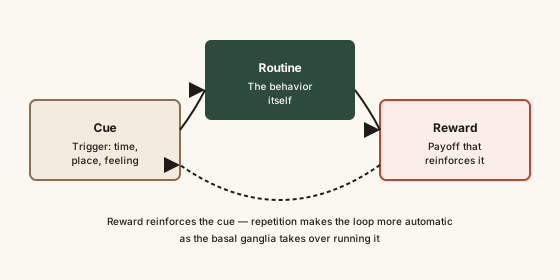
A habit forms as the brain repeatedly links a cue, a routine, and a reward into a loop, and the basal ganglia — a brain structure involved in automating repeated behavior — gradually takes over running that loop with less involvement from the more deliberate, conscious parts of the brain, per the American Psychological Association and the National Institutes of Health; this is also why habits are so hard to simply 'delete': the old neural pathway doesn't disappear once formed, so breaking a habit generally means building a competing routine strong enough to override it, not erasing the original one.
Reading time
— 4 min
Updated
— Sep 30, 2026
Fact-reviewed
— Sep 23, 2026
Key Takeaways
Key Takeaways
1A habit forms through a repeated cue-routine-reward loop, where a trigger leads to a behavior that produces an outcome reinforcing the loop.
2The basal ganglia, a brain structure involved in automating repeated behavior, gradually takes over running the loop, which is why habits feel effortless.
3Old habit pathways don't disappear once formed — breaking a habit generally means building a competing routine strong enough to win out, not deleting the original.
The concept
A habit is a behavior your brain has run so many times it stopped needing your full attention to do it. It starts with something that triggers the behavior (a cue), the behavior itself (the routine), and something the brain finds rewarding about doing it (the reward). Do that loop enough times and the brain starts running it more and more automatically, which is why habits can feel like they happen "before you even think about it." And that's also why habits are so hard to just switch off — the brain doesn't erase a pathway once it's built. It's usually still there, which is part of why old habits can resurface even after a long break.
This is also why habit change strategies that focus purely on stopping a behavior tend to struggle — per the APA, they don't address the cue that's still present or offer the brain an alternative routine to run in response to it.
Quick check
Per the APA's cue-routine-reward framework, what actually triggers a habitual behavior in the moment?
Worked examples
Example 1: A simple everyday habit forming (baseline case)
Someone starts making coffee every morning right after brushing their teeth. The cue is finishing brushing their teeth; the routine is making coffee; the reward is the taste and the mental alertness that follows. After enough mornings, they notice they're already filling the kettle before they've consciously "decided" to — the routine has become more automatic, run increasingly by the basal ganglia's automatic processing rather than deliberate choice each time.
Example 2: An old habit resurfacing under stress (edge case / variation)
Someone who quit biting their nails years ago finds themselves doing it again during a stressful week at work. This isn't a full "reset" of their progress — per the NIH, the old neural pathway for that habit was never erased, only overshadowed by a newer routine. Under stress, the brain is more likely to fall back on the older, more deeply worn pathway, which is why the behavior can reappear even after a long gap.
Example 3: Deliberately building a replacement routine (real-world / applied case)
Someone trying to stop scrolling their phone right after waking up (cue: waking up; routine: scrolling; reward: novelty/information) instead keeps a glass of water by the bed and drinks it first thing. They're not trying to erase the old cue-triggered pathway — they're building a new routine attached to the same cue, competing for the same reward-seeking response, which per the cue-routine-reward framework is a more workable approach than simply trying to suppress the old behavior with willpower alone.
Quick check
Why does simply trying to stop a habit through willpower alone often fail, per the mechanism described by the APA and NIH?
How it works (visual)
The cue-routine-reward loop that builds a habit
Common mistakes
Common Mistakes
✕
Trying to 'delete' a habit through willpower alone, without addressing the cue.
→ Identify the actual cue triggering the routine, and build a competing routine that responds to the same cue instead of just trying to suppress the behavior.
✕
Treating a relapse into an old habit as starting completely from zero.
→ Recognize that the old neural pathway persisting is a normal, well-documented part of how habits work, not a sign that all prior progress is erased.
✕
Assuming a new habit that's stopped being consciously effortful means the old one is gone.
→ Understand the new routine runs alongside the old pathway, not in place of it — the old pathway can still be triggered under the right (or stressful) conditions.
Common misconception
“Once you build a new habit to replace an old one, the old habit is essentially erased from the brain.”
Per the National Institutes of Health, the neural pathway underlying an old habit generally isn't deleted when a new routine forms — the new routine develops as a separate, competing pathway. This is why stress or a disrupted routine can cause an old habit to resurface even long after it seemed replaced. Durable habit change tends to come from consistently reinforcing the new routine in response to the same cue, not from believing the old pathway has been permanently removed.
What to do next
What to do next
Identify the actual cue behind a habit you want to change — the time, place, emotional state, or action that triggers it.
Design a replacement routine that responds to that same cue and still delivers some form of reward, rather than trying to simply stop the behavior.
Expect the old pathway to still exist, especially under stress, and treat a relapse as expected friction, not total failure.
This is general educational information about habit-formation research, not personalized behavioral or clinical guidance — consult a licensed professional for significant behavior-change goals.
FAQ
FAQ
Related terms
Related terms
Cue-routine-reward loop
The repeating pattern behind a habit: a trigger (cue) leads to a behavior (routine) that produces an outcome (reward), which reinforces the loop happening again.
Basal ganglia
A group of brain structures involved in automating repeated behavior, among other functions — implicated in how habits become less consciously effortful over time.
Neural pathway
A connected route of neurons that activates together when a specific behavior or thought pattern occurs; repeated use strengthens the connection.
Automaticity
The degree to which a behavior can be carried out with little conscious attention or deliberate decision-making, typically increasing the more a behavior is repeated.
This entry was researched from public sources and drafted with AI-assisted tools, then edited — errors are still possible. Spot one, or want a topic covered? Read our disclaimer.
 KnowThis