Procrastination is the voluntary delay of a task despite expecting to be worse off for it, and brain and behavioral research describe it as a timing problem in how the brain weighs rewards and discomfort. Piers Steel's 2007 meta-analysis in Psychological Bulletin found the strongest predictors were how unpleasant the task feels, how far away the reward is, low confidence and impulsiveness, and summarized them in temporal motivation theory: motivation rises with expectancy and value and falls with impulsiveness multiplied by delay. Brain-imaging work fits that picture. A 2018 study of 264 people in Psychological Science (Schlüter and colleagues) linked weaker action control, a core part of procrastination, to a larger amygdala and weaker connectivity between the amygdala and the dorsal anterior cingulate cortex, though the design was correlational. A 2009 fMRI study (Ersner-Hershfield, Wimmer and Knutson) found that thinking about your future self activated a key brain region less than thinking about your present self, and people with a bigger gap discounted future rewards more steeply. Avoiding the task gives immediate relief, which reinforces the habit. Evidence-backed countermeasures shrink the delay or the discomfort: smaller near-term deadlines, if-then plans, and self-forgiveness after a lapse.
Reading time
— 5 min
Updated
— Sep 30, 2026
Fact-reviewed
— Sep 30, 2026
Key Takeaways
Key Takeaways
1Procrastination is a timing problem in how the brain weighs things: discomfort is felt now, the reward arrives later, and later loses.
2Steel's 2007 meta-analysis found task unpleasantness, distant rewards, low confidence and impulsiveness were the strongest predictors.
3Brain imaging links weaker action control to the amygdala's 'this feels bad' signal and treats your future self almost like another person.
4What works is shrinking the delay or the discomfort: near-term mini-deadlines, if-then plans and forgiving yourself after a slip.
The concept
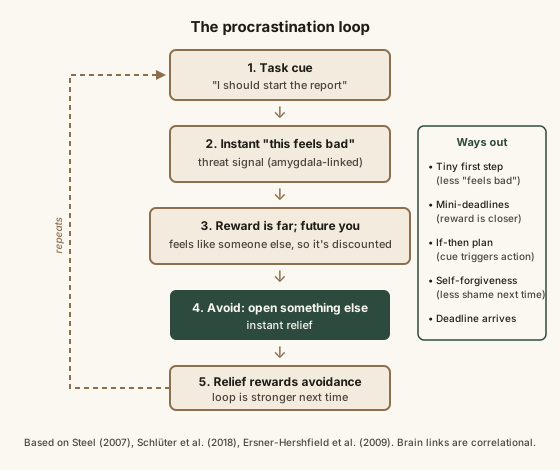
Your brain doesn't weigh "now" and "later" equally. When you look at a dreaded task, the unpleasant feeling arrives instantly, while the payoff (a finished report, a good grade) is days away. Distant rewards feel smaller, and the person who'll enjoy them, future you, registers in your brain a bit like a stranger. So the choice isn't really "report vs scrolling." It's "feel bad now for a stranger's benefit" vs "feel better now." Avoiding the task brings instant relief, and that relief teaches your brain to avoid again. The pattern flips only when the deadline gets close enough that the payoff, or the panic, finally feels immediate.
How common is it? Steel's review cites estimates that 80 to 95% of college students procrastinate, and that roughly 15 to 20% of adults do it chronically. The cost shows up later, not sooner. Tice and Baumeister (1997) tracked students across a semester: procrastinators reported less stress and fewer symptoms early on, then more stress, more illness symptoms and lower grades as deadlines arrived.
Quick check
In temporal motivation theory, which term multiplies the delay before a reward?
Worked examples
Example 1: Report vs phone, 14 days out (baseline case)
Plug illustrative numbers into Steel's formula. A report due in 14 days: you're fairly confident you can do it (expectancy 0.8), it matters (value 10), and you're moderately impulsive (0.5). Its pull today is (0.8 × 10) ÷ (1 + 0.5 × 14) = 8 ÷ 8 = 1.0. Scrolling your phone is certain (1.0), mildly rewarding (value 2), and immediate (delay 0): 2 ÷ 1 = 2.0. The phone wins, even though the report is worth five times more. Run it again the day before the deadline (delay 1): 8 ÷ 1.5 = 5.3. Now the report wins. The numbers are made up, but the shape is the point: the task didn't change, only its distance.
Example 2: Self-set deadlines help, but not as much as you think (edge case)
If distance is the problem, setting your own earlier deadlines should fix it. Ariely and Wertenbroch (2002) tested that. Students and paid proofreaders worked under one final deadline, self-chosen interim deadlines, or evenly spaced deadlines set for them. Self-chosen deadlines beat a single final one, but people chose them poorly (often too late), and evenly spaced external deadlines produced the best results. The edge case: you know you procrastinate, you try to bind yourself, and you still under-commit. Deadlines that someone else holds you to, or that cost you something to miss, cut the delay term more reliably than private intentions.
Example 3: Breaking the relief loop (applied case)
You've avoided a tax form for three weeks, and each time you think of it you feel a stab of dread, then relief when you open something else. Two moves target the brain mechanisms above. First, forgive the delay: Wohl, Pychyl and Bennett (2010) found students who forgave themselves for procrastinating before a first exam procrastinated less before the next one, likely because the task carried less shame. Second, write an if-then plan (an implementation intention): "When I sit down with coffee on Saturday, I'll open the form and fill in my name and address." A 2006 meta-analysis by Gollwitzer and Sheeran found if-then plans had a medium-to-large effect on reaching goals. The first step is tiny on purpose: it lowers the discomfort the amygdala is reacting to and makes the reward (one section done) almost immediate.
Quick check
Why does a task you ignored for two weeks suddenly feel urgent the night before?
How it works (visual)
The procrastination loop in the brain
Every trip around the loop teaches the brain that avoidance works, because relief is a reward that arrives instantly. The exit points are the two levers in the formula: make the payoff closer (mini-deadlines, a visible first win) or make the task feel less aversive (a tiny first step, self-forgiveness).
Common mistakes
Common Mistakes
✕
Treating procrastination as laziness or a character flaw.
→ Treat it as a timing and emotion problem. Ask what about the task feels bad right now, and shrink that part.
✕
Beating yourself up after a delay.
→ Forgive the lapse explicitly. In research, self-forgiveness reduced procrastination on the next task.
✕
Relying on one far-off deadline.
→ Split it into evenly spaced checkpoints, ideally ones someone else will see.
✕
Making the first step big ('write the report').
→ Make it trivially small and specific ('open the doc and write the title').
✕
Reading brain-scan headlines as 'my amygdala made me do it'.
→ The imaging findings are correlations. Behavior-change tactics work regardless of brain structure.
Common misconception
“Procrastinators are bad at managing time.”
Most procrastinators know exactly how much time they have. Steel's meta-analysis points to how unpleasant the task feels, how distant the reward is, and impulsiveness, not poor calendar skills. That's why a better planner often doesn't help, while shrinking the first step or adding near-term deadlines does.
What to do next
What to do next
Name the feeling the task triggers (boredom, fear of judgment, confusion). That's the part to shrink.
Write one if-then plan: 'When [specific cue], I will [tiny first action].'
Split any deadline more than a week away into evenly spaced checkpoints.
Tell someone your checkpoint, or put something small at stake, so the deadline is external.
After a lapse, say 'I forgive myself for putting this off' and restart with the tiny step.
Make the first reward immediate: tick a box, share a draft, take a short break after the first 10 minutes.
FAQ
FAQ
Related terms
Related terms
Temporal motivation theory
Piers Steel's model of procrastination: motivation for a task equals expectancy times value, divided by one plus impulsiveness times delay. The longer the delay to the reward, the weaker the pull.
Temporal discounting
The tendency to value a reward less the further in the future it arrives, so a small reward now can beat a larger one later.
Amygdala
A pair of almond-shaped structures deep in the brain involved in detecting threats and assigning emotional weight, including the 'this feels bad' signal a dreaded task can trigger.
Dorsal anterior cingulate cortex (dACC)
A region in the brain's frontal midline involved in monitoring conflict and choosing actions; in the 2018 Schlüter study, weaker amygdala-dACC connectivity was linked to poorer action control.
Implementation intention
An if-then plan that ties a specific action to a specific cue, such as 'When I finish lunch, I will open the report and write one heading.'
This entry was researched from public sources and drafted with AI-assisted tools, then edited — errors are still possible. Spot one, or want a topic covered? Read our disclaimer.
 KnowThis