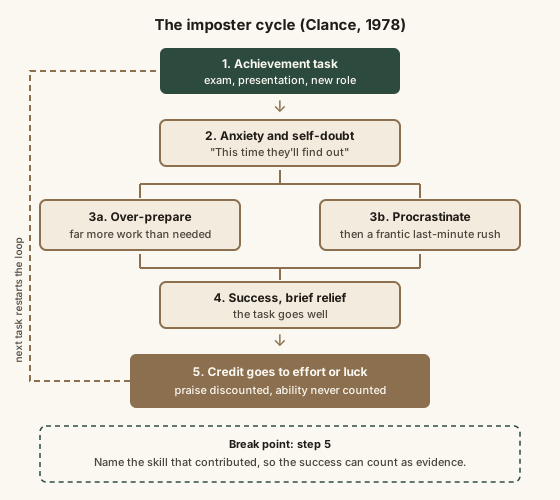
Imposter syndrome, first described as the 'impostor phenomenon' by psychologists Pauline Clance and Suzanne Imes in 1978, is the persistent belief among capable people that their success comes from luck, timing or fooling others rather than ability, paired with a fear of being exposed as a fraud. It is not a diagnosis in the DSM-5 or ICD-11; it is a pattern measured with tools like the 20-item Clance Impostor Phenomenon Scale. Clance described a self-sustaining 'imposter cycle': an achievement task triggers anxiety, the person either over-prepares or procrastinates then rushes, they succeed, and they credit the success to the extra effort or to luck instead of ability, so the relief is brief and the next task restarts the cycle. A 2020 systematic review of 62 studies (Bravata et al.) found reported prevalence ranging from 9% to 82% depending on the measure and cutoff, and linked the pattern to anxiety, depression and burnout. Researchers also stress context: feeling out of place can be partly accurate when someone is underrepresented or unsupported in a setting, so the fix is not only individual mindset.
Reading time
— 5 min
Updated
— Oct 1, 2026
Fact-reviewed
— Oct 1, 2026
Key Takeaways
Key Takeaways
1Imposter syndrome is the persistent belief that your success comes from luck or fooling people, plus a fear of being found out. It was named the 'impostor phenomenon' by Clance and Imes in 1978.
2It is not a diagnosis. It isn't in the DSM-5 or ICD-11; researchers measure it as a pattern, most often with the 20-item Clance Impostor Phenomenon Scale.
3It runs on a cycle: anxiety, then over-preparing or procrastinating, then success, then crediting the success to effort or luck, so the evidence never sticks.
4Reported prevalence ranges from 9% to 82% across studies because the tools and cutoffs differ. Context, not only mindset, shapes the feeling.
The concept
Imposter syndrome is the feeling that you don't really deserve where you are. You got the job, passed the exam or won the award, but some part of you insists it was luck, timing, or that people simply haven't noticed yet. Think of it as a faulty accountant in your head: every failure goes straight into the "proof I'm not good enough" column, while every success gets filed under "luck" or "I just worked extra hard this time." Because the books are rigged, the balance never improves, no matter how many wins you add. It's common, it shows up most in capable people, and it isn't a mental illness. It is a pattern of thinking that can be noticed and loosened.
The distinction that matters most is between imposter feelings and actual incompetence. Imposter feelings are a gap between how well you're doing and how well you believe you're doing, in the pessimistic direction. That is why the pattern is reported so often among people who are objectively performing well: the gap only exists if there's real performance for the belief to undercount. It is roughly the mirror image of the confirmation bias trap: you notice evidence that fits "I'm a fraud" and explain away evidence that doesn't. Noticing that feeling and naming it, rather than obeying it, is part of what psychologists mean by emotional intelligence.
Quick check
After acing a certification exam, someone says, 'I only passed because the questions happened to cover what I studied.' What is this an example of?
Worked examples
Example 1: The new graduate (baseline case)
A software engineer is hired out of a competitive interview process with five rounds. In her first month she asks fewer questions than she needs to, because asking feels like evidence she doesn't belong. When her first feature ships without bugs, she thinks a senior colleague must have quietly fixed things. Here, every piece of evidence about her skill (passing five interview rounds, shipping clean code) is real, and every piece is explained away. That's the textbook pattern: the evidence isn't missing, the accounting is.
Example 2: When the feeling is partly accurate (edge case)
A first-generation university student in a lab where everyone else grew up around academics feels like a fraud because he doesn't know the unwritten rules: how to email a professor, what a "lit review" looks like, when it's fine to push back. Some of what he's noticing is true: he is missing information the others absorbed earlier. What's false is the conclusion that he is missing ability. This is the case Feenstra and colleagues highlight. Labelling it a personal syndrome can hide a fixable gap in mentoring and onboarding. The useful response is to separate "I don't know this yet" (true and fixable) from "I don't belong here" (an attribution, not a fact).
Example 3: Scoring the pattern (applied case)
A team lead takes the Clance Impostor Phenomenon Scale in a workplace workshop and scores 68. Under the scale's commonly used bands (40 or below few feelings, 41 to 60 moderate, 61 to 80 frequent, above 80 intense), that falls in the "frequent" range. What it does not mean is that she has a disorder or that her doubts are true. It's a snapshot of how often she discounts her own success. Her practical next step is to compare the belief against a record: she lists the last ten pieces of feedback she received and finds eight positive ones she'd forgotten and two critical ones she'd remembered word for word. That asymmetry is the pattern made visible.
Quick check
Which response breaks the imposter cycle at the point where it usually sustains itself?
How it works (visual)
The imposter cycle
Common mistakes
Common Mistakes
✕
Treating imposter syndrome as a diagnosis or a personality type.
→ It's a pattern of thinking measured by questionnaires, not a DSM-5 or ICD-11 condition. If anxiety or low mood is persistent and affecting daily life, that's worth raising with a doctor or licensed therapist.
✕
Assuming the feeling is proof that you're underqualified.
→ Check it against external evidence: hiring decisions, grades, feedback, results. Imposter feelings are defined by a gap between that evidence and your belief.
✕
Fixing it only with more effort.
→ Extra effort is one of the cycle's two branches. It often produces success that you then credit to the effort, so the belief stays intact.
✕
Ignoring the setting.
→ Mentoring, clear expectations and seeing others like you succeed reduce the feeling. If you lead a team, onboarding is part of the fix, not only individual mindset.
Common misconception
“Imposter syndrome means you actually are a fraud who has been lucky so far.”
The pattern is defined by a mismatch between real accomplishment and how you interpret it. Clance and Imes first described it in people with degrees, honours and professional standing. The Dunning-Kruger research points the other way: Kruger and Dunning (1999) found the lowest performers tended to overestimate their scores. Doubt alone isn't evidence of incompetence.
What to do next
What to do next
Keep a running evidence file: feedback, results and decisions others made about you (hired, promoted, accepted). Reread it before high-stakes tasks.
After a success, write one sentence naming a skill that contributed, not just the hours or the luck.
Separate 'I don't know this yet' from 'I don't belong here'. The first is a gap to close; the second is an attribution to question.
Talk about it with a peer or mentor. Many people discover the colleagues they compare themselves to feel the same way.
If self-doubt comes with persistent anxiety, low mood or exhaustion, talk to a doctor or licensed mental health professional.
FAQ
FAQ
Related terms
Related terms
Impostor phenomenon
The original 1978 term from Clance and Imes for the persistent belief among high achievers that their success is undeserved and that they will be exposed as frauds.
Imposter cycle
The self-reinforcing loop Clance described: anxiety before a task, over-preparation or procrastination, success, then crediting the success to effort or luck rather than ability.
Attribution
The explanation a person gives for an outcome, such as ability, effort, luck or circumstances. Imposter feelings involve attributing success to unstable or external causes.
Clance Impostor Phenomenon Scale (CIPS)
A 20-item self-report questionnaire scored from 20 to 100, the most widely used research measure of imposter feelings. It is a screening tool, not a diagnosis.
Discounting
Dismissing or explaining away positive feedback, such as assuming praise is politeness or that a reviewer missed your mistakes.
This entry was researched from public sources and drafted with AI-assisted tools, then edited — errors are still possible. Spot one, or want a topic covered? Read our disclaimer.
 KnowThis