 KnowThis
Key Takeaways
Key Takeaways
- 1A performance review typically evaluates three separate layers — results against role expectations, behavioral competencies, and a forward-looking growth signal — not just whether targets were hit.
- 2Meeting every numeric goal doesn't guarantee a top rating if the competencies section (how the work got done) or the trajectory signal (readiness for more) pulls the overall rating down.
- 3Calibration — comparing ratings across employees before finalizing them — means a manager's initial assessment can still shift once it's checked against a broader group.
The concept
Once it's clear a review is scoring results and behavior and trajectory separately, the practical skill becomes tracking evidence for all three across the year, not just the numbers.
Why can an employee who hit every numeric goal still receive a lower-than-expected performance rating?
Worked examples
Example 1: Hitting the numbers, missing the competency weighting (baseline case)
An account manager hits every sales quota for the year and assumes a top rating is essentially locked in. Their rubric, however, weights results at 50%, competencies (collaboration, communication with internal teams) at 30%, and growth/development at 20%. Peer feedback during the review notes recurring friction with the fulfillment team. The competencies score comes in low enough that, even with a perfect results score, the blended rating lands at "meets expectations" rather than "exceeds."
Example 2: A rating that shifts after calibration (edge case / variation)
A manager privately says they're recommending a top rating, but the final rating the employee receives is lower. What most likely explains the difference?
Example 3: Two employees, same output, different trajectory signal (real-world / applied case)
Two analysts on the same team produce nearly identical output over the year. One has documented instances of mentoring a newer teammate, proposing a process fix that was adopted by the team, and volunteering for a cross-functional project. The other did strong, comparable individual work but nothing beyond their assigned tasks. Both receive similar results scores, but only the first analyst's review includes language about being "ready for expanded scope" — the trajectory layer of the review, which becomes the deciding factor when a promotion slot opens later that year.
Two employees produce nearly identical measurable output, but only one is described in their review as ready for expanded responsibility. What does this most likely reflect?
How it works (visual)
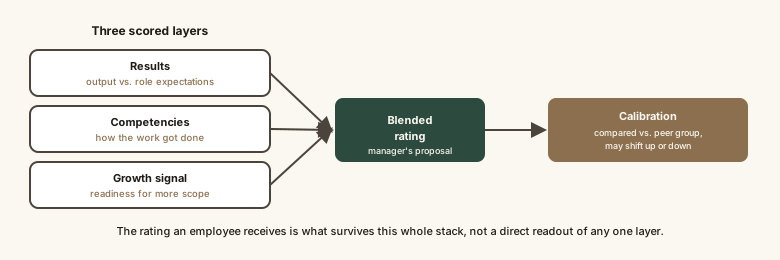
The rating that eventually reaches an employee is the output of that whole stack, not a direct readout of any single layer.
Common mistakes
Common Mistakes
Tracking only quantitative results throughout the year and having no evidence ready for the competencies or growth components.
→ Keep a running note of collaboration wins, feedback received, and initiative taken — not just output numbers — so evidence exists for every part of the rubric.
Assuming a manager's private, pre-review comment about a rating is the final number.
→ Understand that many organizations run a calibration step after the manager's initial assessment, which can move the number before it's delivered.
Treating a lower-than-expected rating as purely arbitrary or personal, without asking what specifically drove it.
→ Ask directly which part of the rubric — results, competencies, or trajectory — pulled the rating down, so the actual gap can be addressed.
Common misconception
“If you hit every goal on your scorecard, a top performance rating is essentially guaranteed.”
Most formal rubrics weight results alongside behavioral competencies and, in many organizations, a forward-looking growth or potential signal — and a calibration step can move even a strong manager recommendation. Two employees can post nearly identical numbers and land on different ratings because the rubric is measuring more than the number, and a rating can shift during a comparison process the employee never sees directly.
What to do next
What to do next
- Ask your manager or HR contact directly what the review rubric actually weighs — results, competencies, growth potential — and by roughly how much.
- Keep a running log throughout the year of both quantitative results and behavioral evidence (collaboration, feedback received, initiative taken).
- If a rating comes in lower than expected, ask specifically which rubric component drove it rather than assuming it was arbitrary.
- Read How to Ask for a Raise Effectively next to see how a strong review result actually translates into a compensation conversation.