 KnowThis
Key Takeaways
Key Takeaways
- 1A raise request is constrained by a compensation budget most managers don't fully control — timing it before that budget is locked matters as much as the strength of the case.
- 2Framing the request around documented impact and market value, not personal financial need, matches what most managers are actually authorized to evaluate.
- 3Off-cycle raises happen, but typically only when there's a real trigger — a documented scope increase, a retention risk, or a clear market gap — not just a well-timed ask alone.
The concept
Once the budget-cycle mechanism is visible, the practical approach follows: find out roughly when the cycle is planned, and bring a value-based case with a specific number before that window closes.
Why can a manager agree a raise is deserved and still be unable to grant it right away?
Worked examples
Example 1: Timing a request ahead of the budget cycle (baseline case)
An employee learns that annual compensation planning typically begins in early autumn. Several weeks before that, they schedule a conversation with their manager, bring three documented achievements from the past year with measurable results, cite a researched market range for their role and location, and ask for a specific percentage increase. Because the request lands before the budget is finalized, the manager has room to actually include it in the proposal they submit.
Example 2: A real scope change outside the normal cycle (edge case / variation)
What generally makes an off-cycle raise request realistic, as opposed to one that's unlikely to be approved outside the normal cycle?
Example 3: Two employees, same performance, different outcomes (real-world / applied case)
Two employees with comparable performance both decide to ask for a raise. The first raises it right after the annual merit pool has already been finalized and frames it around rising personal expenses. The second raises it two months earlier, before planning begins, framed around a specific project's measurable results and a researched market comparison. The first request is met with genuine sympathy but no available budget until the following cycle. The second is folded into that cycle's proposal. The underlying performance was similar — the outcome diverged almost entirely on timing and framing.
Two employees with similar performance ask for a raise with very different outcomes. What's the most likely explanation, based on how these requests are usually processed?
How it works (visual)
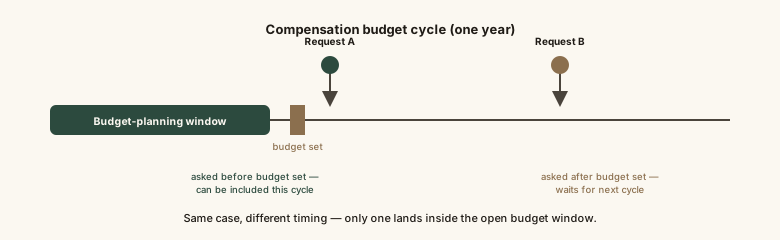
The same case, made a few weeks apart, can land in two different budget windows entirely — which is why timing carries as much weight as the argument itself.
Common mistakes
Common Mistakes
Asking for a raise right after the annual compensation budget has already been finalized.
→ Find out roughly when your organization plans compensation for the cycle, and raise the request a few weeks before that planning begins.
Framing the request around personal financial need instead of documented impact and market value.
→ Lead with specific, measurable achievements and a researched market range — the criteria a manager is actually authorized to evaluate against.
Asking for an off-cycle raise with no specific, real trigger behind it, such as a genuine scope change.
→ Reserve off-cycle requests for a documented change — a lasting increase in responsibilities, a retention risk, or a clear market gap.
Common misconception
“If your work is good enough, when you ask for a raise shouldn't matter.”
Most raises are funded from a fixed compensation budget pool that gets planned during a specific cycle, often well above any individual manager's day-to-day discretion. A manager can genuinely agree a raise is deserved and still have no budget available until the next cycle if the request comes after that pool is already committed. Strong performance is necessary, but timing the request relative to the budget cycle is a separate, real factor in whether it can be acted on right away.
Try it yourself
Turn a current salary and a requested percentage increase into the new salary amount you'd be asking for.
What to do next
What to do next
- Find out roughly when your organization's compensation budget cycle is planned, and aim to raise the conversation a few weeks before it begins.
- Document three or more specific, measurable achievements from the past review period, along with a researched market range for your role and location.
- Draft the ask around demonstrated value and a specific requested number, not personal financial need.
- Read What a Performance Review Actually Evaluates next to make sure your case addresses every part of how you'll actually be assessed.