 KnowThis
Key Takeaways
Key Takeaways
- 1Answering with a researched range instead of a single number preserves negotiating room on both sides of the conversation.
- 2Whoever states a number first sets an anchoring point that the rest of the negotiation tends to revolve around — which is why it can help to redirect the question back before naming a figure.
- 3A range should be based on researched market rate for the role, location, and experience level — not on a personal minimum, which reveals the floor you're willing to accept.
The concept
Once the anchoring mechanism is visible, the practical approach follows: research a realistic market range first, and answer with that range rather than a single guessed or minimum-driven number.
Why does answering a salary question with a range tend to work better than answering with a single specific number?
Worked examples
Example 1: Answering with a researched, market-based range (baseline case)
A candidate researches the typical pay for a similar role, experience level, and location before the interview and finds a realistic range. When asked about salary expectations, they answer: "Based on my research for this role and my experience level, I'm looking at a range of [low] to [high]." This keeps the conversation open — the employer can respond anywhere within or near that range without either side having committed to one fixed figure.
Example 2: Being asked the salary question before the role's scope is clear (edge case / variation)
A candidate is asked about salary expectations very early, before learning much about the role's actual responsibilities. What's a reasonable way to handle this?
Example 3: Handling a lowball offer after a strong range was given (real-world / applied case)
A candidate states a researched range of [low] to [high] earlier in the process. The eventual offer comes in below even the low end of that range. Because the candidate anchored on real market data rather than a personal minimum, they have a clear, specific basis to reference in a counter: "Based on my research for this role and level, I was expecting something closer to [low]–[high] — is there flexibility to get closer to that range?" A candidate who never stated a range, or who understated it out of nervousness, has a much weaker position to negotiate from at this stage.
Why does having stated a researched range earlier in the process help a candidate if the eventual offer comes in low?
How it works (visual)
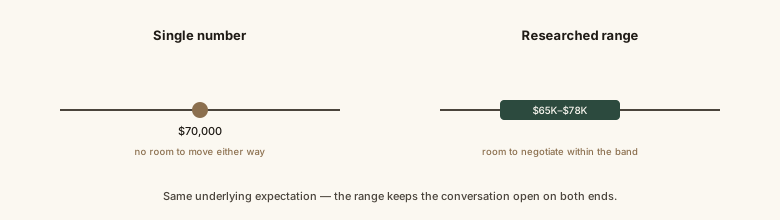
The range doesn't just sound softer — it structurally leaves room the single number doesn't, on both sides of the eventual number that gets agreed on.
Common mistakes
Common Mistakes
Naming a single, specific number out of nervousness instead of a researched range.
→ Prepare a realistic market-based range in advance so you're not improvising a single figure under pressure.
Basing the range on personal minimum needs rather than actual market data.
→ Research typical pay for the role, location, and experience level — a range anchored to your minimum reveals your floor rather than your value.
Answering the salary question before understanding the role's actual scope.
→ It's reasonable to briefly redirect and ask about scope or budgeted range first if the question comes very early in the process.
Common misconception
“Bringing up salary first or naming a high number will make you look greedy and hurt your chances.”
A well-researched, market-based range presented professionally is a normal and expected part of most hiring processes, not a red flag. What tends to hurt a candidate is a number with no research behind it, or extreme discomfort discussing compensation at all — both signal less preparation, not more humility. Employers generally expect candidates to know their market value and state it clearly.
Try it yourself
A quick reference point when preparing how to discuss a salary range in an interview.
What to do next
What to do next
- Research typical pay for the specific role, location, and experience level before any interview where salary might come up.
- Prepare a range, not a single number, and be ready to frame it as based on research rather than a personal minimum.
- If asked very early, before the role's scope is clear, it's reasonable to briefly redirect the question.
- Read What a Panel Interview Actually Tests next to prepare for compensation questions that come up in a group interview setting.