 KnowThis
Key Takeaways
Key Takeaways
- 1A panel interview combines multiple interviewers' perspectives on the same answers, which reduces the impact of any single interviewer's individual bias on the hiring decision.
- 2Beyond the stated questions, a panel also reveals how a candidate manages attention and communication across several people with potentially different priorities at once.
- 3Addressing the specific person who asked a question, while briefly including the rest of the panel, generally reads better than picking one favorite interviewer to focus on.
The concept
Once the multiple-audience structure is visible, the practical skill becomes tracking who asked what and briefly acknowledging the whole group, not just performing for whichever interviewer seems most senior or most engaged.
What does a panel interview format add beyond testing the same competencies a one-on-one interview would?
Worked examples
Example 1: Addressing the questioner while including the room (baseline case)
A panelist on the technical side asks a candidate a detailed question about a past project. The candidate answers by looking primarily at that panelist while giving the technical detail, then briefly glances to the rest of the panel while summarizing the outcome and its broader impact — giving everyone a reason to stay engaged without ignoring the person who actually asked the question. This balance (primary focus on the questioner, brief inclusion of the group) is the standard approach panels expect.
Example 2: Two panelists asking questions that reflect conflicting priorities (edge case / variation)
Two panelists ask questions reflecting different priorities (technical realism vs. client-facing reliability). What's the best way to handle this?
Example 3: A candidate freezing when multiple people jump in at once (real-world / applied case)
During a panel interview, a candidate is mid-answer when a second panelist interjects with a related follow-up before the first question is fully finished. A composed response acknowledges the follow-up, briefly finishes the original thought, then addresses the new question directly — showing the candidate can track multiple threads without losing structure. A candidate who gets flustered and abandons the original answer entirely, or who ignores the interjection completely, both signal weaker composure under the multi-threaded pressure a panel specifically creates.
A second panelist interjects with a follow-up question before the candidate finishes their original answer. What response best demonstrates the composure a panel format is partly designed to test?
How it works (visual)
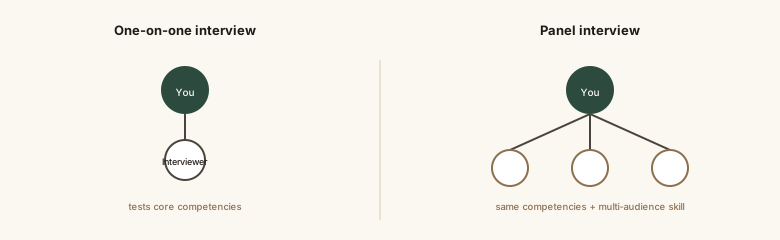
The core competency layer stays the same across both formats — what a panel adds sits entirely in that extra layer of managing multiple audiences at once.
Common mistakes
Common Mistakes
Only making eye contact with one panelist throughout the entire interview.
→ Address the person who asked the question primarily, but briefly include the rest of the panel, especially when summarizing an answer.
Getting flustered when two panelists ask related questions close together.
→ Briefly close out the first thought before addressing a follow-up — this shows composure, not confusion.
Assuming every panelist shares the same priority and giving an identical, one-note answer regardless of who asked.
→ Notice what each panelist's question suggests they value, and address that dimension honestly within your answer.
Common misconception
“A panel interview is just a harder, more intimidating version of a one-on-one interview.”
The core evaluation criteria are usually the same as a one-on-one interview would use — the panel format mainly adds a genuine reduction in any single interviewer's individual bias, since the hiring decision draws on several perspectives instead of one. It also reveals something real about how a candidate communicates across multiple people, which is directly relevant for roles that require exactly that skill on the job.
What to do next
What to do next
- If given panelists' names or roles in advance, note what priorities each might have based on their function.
- Practice giving answers that briefly acknowledge the whole group while primarily addressing the person who asked the question.
- Prepare to handle a follow-up interjection calmly by briefly closing out your original thought first.
- Read Why You Should Still Ask Questions at the End of an Interview next, since a panel format offers a chance to address multiple stakeholders' concerns at once.