 KnowThis
Key Takeaways
Key Takeaways
- 1Closing questions serve two functions at once: gathering real decision-relevant information, and independently signaling genuine engagement to the interviewer.
- 2Saying 'no, I think you covered everything' skips both functions and reads as a missed opportunity even after an otherwise strong interview.
- 3The strongest closing questions are specific to what was actually discussed in that interview, not generic questions that could be asked at any company.
The concept
Once both functions of a closing question are visible — real information plus a genuine-interest signal — the practical goal becomes preparing at least one question specific enough that it couldn't have been asked before the conversation actually happened.
What are the two distinct things a candidate accomplishes by asking a genuine question at the end of an interview?
Worked examples
Example 1: A specific question referencing the actual conversation (baseline case)
Earlier in the interview, the hiring manager mentioned the team is currently restructuring how projects get prioritized. At the end, the candidate asks: "You mentioned the team is reworking how projects get prioritized — what does success look like for that process six months from now?" This question couldn't have been prepared before the interview started, so it demonstrates the candidate was genuinely listening and thinking critically throughout, not just reciting a memorized list.
Example 2: Asking a generic question that signals little (edge case / variation)
Why does a generic closing question like 'What's the company culture like?' do less work than a question referencing something specific discussed earlier in the interview?
Example 3: Declining to ask any questions after a strong interview (real-world / applied case)
A candidate answers every question well throughout an interview, building a strong impression. At the close, asked if they have questions, they say: "No, I think you covered everything." Even after a genuinely strong interview, this ending leaves the interviewer with no additional evidence of engagement at the one moment specifically designed to provide it — and, separately, the candidate walks away without any of the information they'd actually need to evaluate whether to accept an offer if one comes.
A candidate had a strong interview overall but declined to ask any questions at the end. What's the practical cost of that choice?
How it works (visual)
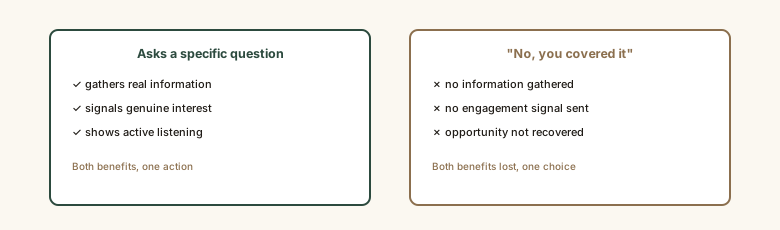
Both benefits come from the same single action, which is exactly why skipping it costs more than it might seem to in the moment.
Common mistakes
Common Mistakes
Saying 'no, I think you covered everything' to end the interview quickly.
→ Prepare at least one or two questions in advance, and be ready to adapt them based on what was actually discussed.
Asking only generic questions that could apply to any company.
→ Reference something specific from the interview itself — a project, a challenge, a team structure — to show genuine engagement.
Asking a question purely to seem prepared, without wanting the answer.
→ Ask something you'd genuinely find useful for deciding whether to accept an offer — real curiosity reads more naturally than a performed question.
Common misconception
“Asking about salary, benefits, or time off at the end of a first interview will make you look uninterested in the actual work.”
Practical questions about compensation and logistics are a normal part of evaluating a role, and asking one thoughtfully doesn't cancel out genuine interest shown earlier in the interview. What tends to read poorly isn't asking a practical question — it's asking only practical questions with nothing about the role, team, or work itself, which can suggest the compensation is the only thing being evaluated.
What to do next
What to do next
- Prepare two or three questions in advance based on the role and what you can research about the team beforehand.
- During the interview, note one specific detail mentioned that you could turn into a closing question.
- Avoid ending with 'no, I think you covered everything' — even one genuine, specific question is better than none.
- Read What a Panel Interview Actually Tests next if your closing questions will need to address multiple interviewers at once.