 KnowThis
Key Takeaways
Key Takeaways
- 1Job boards don't list postings by post date or employer size — they rank each listing with a composite score built from keyword relevance, recency, applicant engagement, and sometimes paid placement.
- 2Every search recalculates that score, which is why the same posting can appear in a different position depending on the exact words a searcher used.
- 3Matching the specific phrasing common to a role — not just the general skill — usually improves a listing's visibility more than any other single factor a job seeker or employer can control.
The concept
Once the indexing-plus-scoring mechanism is visible, it explains a lot of what otherwise looks arbitrary about search results — including why the same role can look completely different in ranking depending on the exact words used to search for it.
Why can two searches for what's essentially the same job title (like 'marketing coordinator' vs 'marketing associate') return listings in a different order?
Worked examples
Example 1: Exact keyword match beats a synonym (baseline case)
A searcher types "digital marketing manager." One posting is titled and described using that exact phrase throughout. A second, otherwise similar posting uses "online marketing lead" instead — a close synonym, but not the searched phrase. All else being equal, the first posting scores a higher relevance match and appears closer to the top, not because the underlying job is a better fit, but because its indexed text more closely mirrors the searcher's actual words.
Example 2: A well-matched but aging posting loses ground (edge case / variation)
A job posting that was highly relevant to a search term 40 days ago now ranks lower than a newer, less precisely matched posting. What's the most likely explanation?
Example 3: Optimizing a job search around how ranking actually works (real-world / applied case)
A job seeker notices that searching their exact target title turns up dozens of loosely related results, while a more specific phrase pulls up a tighter, more relevant set near the top. Rather than browsing broad category listings and scrolling for pages, they search using the precise job titles and skill terms common in their field, check back regularly since newly posted listings tend to rank higher, and treat any obviously sponsored results at the very top as a separate category worth a quick look but not the full picture of what's actually available and well-matched.
Why might searching with a precise, industry-standard job title tend to surface more relevant results than searching with a broad, general term?
How it works (visual)
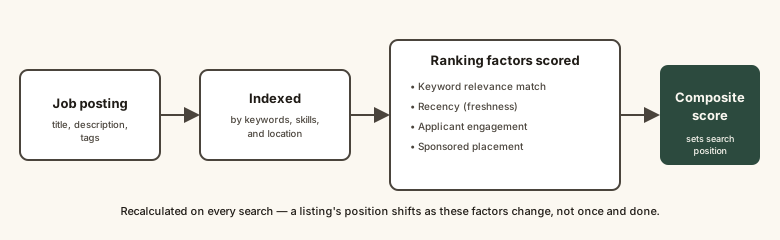
None of these factors act alone — a listing's position is the combined result of all four, recomputed every time someone searches.
Common mistakes
Common Mistakes
Assuming job boards list postings in the order employers submitted them.
→ Treat the order as a computed ranking based on relevance, recency, and engagement — not submission order — and search with precise terms to work with that system rather than against it.
Only browsing the first page of results and assuming it represents every relevant opening.
→ Try several close variants of your target title and skills — different phrasing surfaces genuinely different, still-relevant listings that a single search misses.
Treating sponsored listings at the top as the full, representative picture of what's available.
→ Scroll past paid placements to the organically ranked results too — sponsored position reflects a paid boost, not necessarily a better match.
Common misconception
“Job boards show every open listing in a neutral, complete, unranked list — what you see is simply what's out there.”
What you see is a filtered, scored, and sorted subset shaped by a ranking algorithm, not a neutral inventory. Relevance to your exact search terms, how recently a posting was published or edited, how often other users have engaged with it, and paid placement all shape what appears and in what order. Two people searching the same general role with slightly different words can see meaningfully different result sets from the same underlying pool of postings.
What to do next
What to do next
- Search using the precise, field-standard job title and skill terms your target roles actually use, not just a general category name.
- Run the same search with two or three close phrasing variants, since ranking is recalculated per query and can surface different relevant listings each time.
- Check back on saved searches regularly — recency decay means newly posted or recently edited listings tend to rank higher than older ones with similar content.
- Read What Applicant Tracking Systems Actually Do next to see what happens once you've found a listing and actually submit an application.