 KnowThis
Key Takeaways
Key Takeaways
- 1A job description is written by combining several people's input into one document, which is why it typically blends genuine hard requirements with an aspirational wish list.
- 2Hard requirements — a required license, a legally mandated credential, work authorization — are usually non-negotiable; most everything else listed is a softer, often flexible preference.
- 3Meeting roughly 60 to 70% of the listed qualifications, including all the true hard requirements, is generally still a reasonable basis to apply, not an automatic disqualifier.
The concept
Once the multi-author drafting process is visible, it explains why a posting can list a dozen or more qualifications for a role that, in practice, only truly requires a handful of them.
Why do job descriptions often list more qualifications than a role actually strictly needs?
Worked examples
Example 1: A posting that clearly separates required from preferred (baseline case)
A posting has two clearly labeled sections: "Required Qualifications" listing a specific degree, a professional license, and legal work authorization, and "Preferred Qualifications" listing several years of experience with a particular tool and familiarity with a specific methodology. A candidate meets every required item but only two of the four preferred items. Because the required section covers genuine hard requirements and the candidate clears all of them, applying is reasonable — the preferred section is exactly the kind of wish-list content it's labeled as.
Example 2: An undifferentiated list mixing hard and soft items (edge case / variation)
A posting lists a required professional license and a specific reporting tool in the same undifferentiated bullet list, with no 'required' vs 'preferred' labeling. How should a candidate weigh the two items differently?
Example 3: Deciding whether to apply while meeting most, not all, criteria (real-world / applied case)
A candidate reviews a posting and counts roughly seven of ten listed qualifications they clearly meet, including every item that reads like a genuine hard requirement — legal work authorization, the stated minimum years in the field, and any required certification. The remaining three unmet items are specific tools and a slightly higher years-of-experience figure than they have. Rather than skipping the application, they apply, reasoning that the hard requirements are covered and the rest reads like the kind of wish-list phrasing that's common in postings drafted from multiple people's input.
A candidate meets all the apparent hard requirements in a posting but falls short on a couple of the softer, preference-style items. What's a reasonable way to decide whether to apply?
How it works (visual)
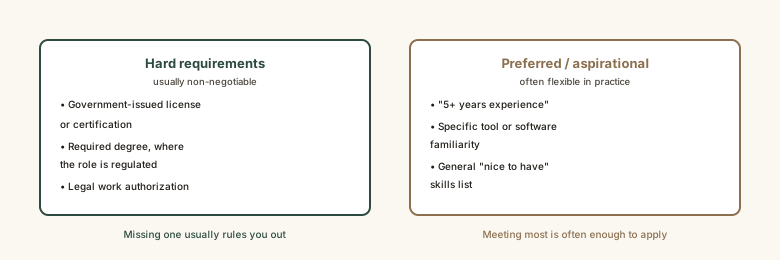
Sorting a posting's items into these two columns — rather than treating the whole list as a single strict bar — is usually the more accurate way to read it.
Common mistakes
Common Mistakes
Skipping an otherwise strong-fit application because a couple of preferred, non-legal items aren't fully met.
→ Separate the true hard requirements — licenses, credentials, legal work authorization — from softer preferences before deciding whether an unmet item is actually disqualifying.
Assuming every listed item carries equal weight simply because it's on the list.
→ Read for signals of genuine necessity (legal, safety, or credential-related language) versus wish-list phrasing (specific tools, exact years, general soft-skill adjectives).
Applying to a role while missing a genuine hard requirement, assuming enthusiasm will make up the gap.
→ Treat legally or credential-based requirements as real filters — these are usually the one category of listed item that isn't negotiable through interview performance alone.
Common misconception
“If you don't meet every single qualification listed in a job posting, applying is a waste of time and you'll be automatically screened out.”
Postings are typically drafted from multiple people's input and tend to accumulate more items than the role strictly needs, so meeting most — but not literally all — of the listed qualifications is a common and often successful basis to apply. The exception is the genuine hard requirements: a required license, a legally mandated credential, or work authorization. Those really do function as filters. Everything else on a typical list carries more flexibility than the format of a bulleted checklist suggests.
What to do next
What to do next
- When reading a posting, sort the listed items into two mental categories: genuine hard requirements (licenses, credentials, legal work authorization) and softer preferences.
- Apply if you clearly meet the hard requirements, even when you fall short on some of the softer, wish-list-style items.
- If a posting doesn't separate required from preferred, use the content itself as the signal — legal, safety, or credential-related language usually marks a genuine filter.
- Read What Applicant Tracking Systems Actually Do next to see how a submitted resume gets screened against a posting's listed keywords once you apply.