 KnowThis
Key Takeaways
Key Takeaways
- 1A recruiter screen filters candidates against a shared scorecard of baseline qualifications, logistics, and communication fit — it's a filtering step, not the final hiring decision.
- 2Recruiters act as an intermediary layer between the full applicant pool and the hiring manager, who typically only sees a short, pre-filtered list rather than every applicant.
- 3What a recruiter screen actually evaluates is often narrower than candidates expect — basic fit and qualification match, not deep technical evaluation, which usually happens later with the hiring manager or team.
The concept
Once the filtering-layer mechanism is visible, it explains why a recruiter screen can feel narrower and more procedural than candidates expect — that's not a lack of interest, it's the role the conversation is actually designed to play in the funnel.
Why does a recruiter screen typically focus on baseline qualifications and logistics rather than deep technical evaluation?
Worked examples
Example 1: A standard recruiter screen for a mid-level role (baseline case)
A candidate applies to a posted role and is invited to a 25-minute recruiter call. The recruiter confirms the candidate's work history matches the role's required experience, asks a few questions about why they're interested and what they're looking for next, checks salary expectations against the budgeted range, and confirms availability to start. No technical or in-depth skills questions come up — those are reserved for the hiring manager round that follows if the candidate advances.
Example 2: Reactive screening vs. proactive sourcing (edge case / variation)
Why might a recruiter's approach look noticeably different for a hard-to-fill senior role compared to a high-volume, frequently-hired role?
Example 3: Preparing for a recruiter screen strategically (real-world / applied case)
A job seeker researches the role beforehand and anticipates that the recruiter screen will likely check a handful of specific things: whether their experience clears the role's baseline requirements, whether their salary expectations are within the budgeted range, their availability and location logistics, and general communication and interest fit. Rather than over-preparing deep technical talking points for this particular call, they focus on clearly and concisely covering those scorecard basics — saving the deeper technical discussion for the hiring manager round, where it's more likely to actually be evaluated.
A candidate is preparing for an upcoming recruiter screen. Based on what the recruiter screen typically evaluates, what's the most useful focus for that specific call?
How it works (visual)
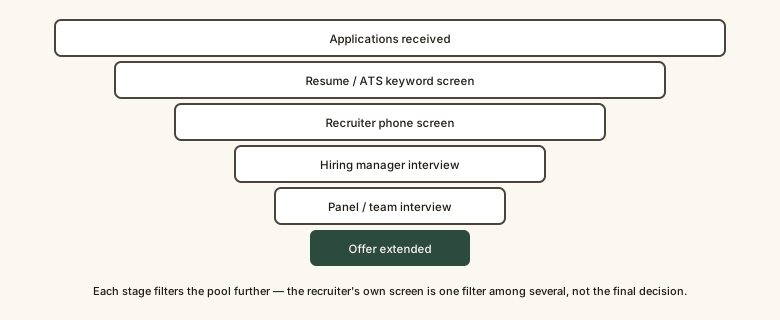
The recruiter screen sits early in this funnel — its job is to narrow the pool responsibly, not to make the call the later stages are actually designed to make.
Common mistakes
Common Mistakes
Treating a recruiter screen as if it's the final interview and over-preparing deep technical answers for it.
→ Focus the recruiter call on clearly covering baseline qualifications, logistics, and fit — save deeper technical depth for the hiring manager round where it's actually assessed.
Assuming a recruiter's enthusiasm on the call guarantees advancement to the next round.
→ Treat a positive screen as a good sign, not a decision — recruiters typically pass a shortlist forward, and the hiring manager still makes the actual next-round call.
Being vague about salary expectations or availability during the screen to avoid an early filter.
→ Answer logistics questions directly — the scorecard check exists early specifically to avoid wasting later rounds on a mismatch that could have been caught sooner.
Common misconception
“If a recruiter screen goes well, you're basically already hired and the rest of the process is just a formality.”
A recruiter screen passes a candidate through one filtering layer in a multi-stage funnel — it doesn't carry hiring authority in most organizations. The hiring manager, and often a panel or team round after that, still independently evaluates fit, skills, and final decision-making. A strong recruiter screen means you cleared the baseline filter, not that the remaining rounds are a formality.
What to do next
What to do next
- Before a recruiter screen, review the role's likely scorecard basics — required experience, salary range, and logistics — and be ready to address them clearly.
- Save deep technical or project-specific detail for the hiring manager round, where it's more likely to actually be evaluated.
- If a role is highly specialized, expect the recruiter conversation to be more of a two-way pitch than a pure evaluation, since you may have been proactively sourced.
- Read Why Companies Ask Behavioral Interview Questions next to see what the hiring-manager and panel stages that follow the recruiter screen typically evaluate.